
Where the Styx Runs Cold, Vol. 2 Ch 6: The Olympian Gambit Pt. 2
In the ash of a destroyed Pantheon reactor, Hawke’s team rewrites reality, planting physical, digital, and human lies to frame a goddess.
SERIALIZED FICTIONWHERE THE STYX RUNS COLD
5/3/20269 min read
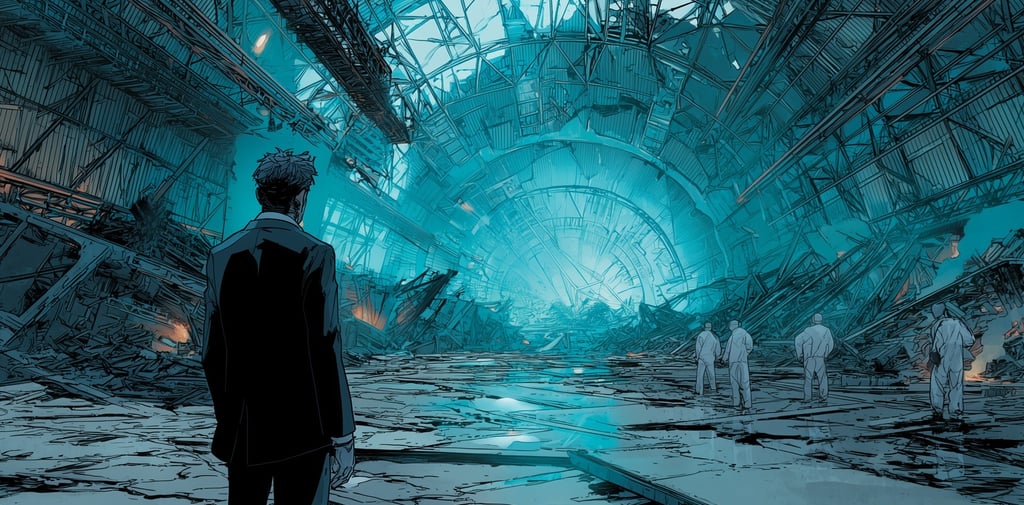
The air over Chicago tasted of ash and ozone.
Arthur Hawke stepped out of the SUV and into controlled chaos. FEMA officials in yellow jackets. NTSB investigators with serious faces. Pantheon's own recovery specialists moving through the wreckage in white hazmat suits, their movements practiced and clipped. The chemical smell of burnt electronics hit first, sharp and stinging. Then ozone. Then the damp, heavy smell of wet ash from the fire crews' work. His boots crunched on a thin layer of grey dust that had settled over everything—equipment cases, caution tape, the hoods of parked vehicles.
His suit was dark and fitted. A deliberate contrast. His ID—Hawke Global Security Consulting—was flawless, backed by a fictional insurance group with the kind of institutional weight that made checkpoints wave you through. He and his team moved with quiet, professional seriousness. Masks of competence. Performances without seams.
Breaker held his usual energy in check, projecting authority through restraint alone. Ricochet and Lancet ran readings with Klein-funded equipment that looked expensive and official to anyone who didn't know what it actually did.
Pantheon's security lead watched from a distance. Fred Deakins. Former Secret Service. The kind of man who spent his career reading faces.
Arthur met his eyes. Gave a slow, somber nod. Two professionals sharing the burden of a grim job. A lie held in posture and expression. Deakins nodded back.
The real work started.
Arthur moved toward the center of the blast. The skeletal remains of the core chamber. The destruction was absolute in the specific way that high-energy events produced—not scattered, but concentrated, the violence organized around a point of origin. Massive steel beams had been twisted into shapes that had no business existing in engineered metal. The floor was a crater of fused alloy and glass, its surface rippled like water caught at the moment of impact. A faint blue light pulsed from deep inside the ruin. The signature of Pantheon's exotic energy systems. Still breathing, even now.
"Ordnance," Arthur said into his comm. "Structural integrity readings. Primary containment ring."
Ordnance threaded through the debris with the ease of a man who'd spent years in worse conditions. He knelt beside a shattered slab of reactor wall—metal alloy as thick as a man's torso—and placed a humming device against its surface. The kind of equipment that looked serious and purposeful to anyone watching from fifty meters away.
Arthur watched the feed on his datapad. The device wasn't measuring. It was rewriting. A focused, low-level energy field was altering the alloy's atomic structure, seeding it with the chemical signature of low-grade, cost-cut material. The kind Pantheon, with its divine engineering budget and obsessive quality controls, would never use. The kind that told a story. Rushed production. Gross, catastrophic carelessness. A company that cut corners and paid for it in blood.
A lie written at the atomic level.
The first piece was in place.
Dr. Andi Beaumont stood near a makeshift medical tent, hands wrapped around a styrofoam cup she wasn't drinking from. Her lab coat was grey with soot. Her face was pale, the kind of pale that comes from shock that hasn't yet found its shape.
Arthur approached. His voice, when he spoke, was gentle. Calibrated. The exact frequency of a man who handled disasters for a living and had learned that softness opened doors that authority only locked.
"Dr. Beaumont. Arthur Hawke, risk assessment. I know this is a difficult time."
"It shouldn't have happened," she said, before he'd finished. "The containment fields had triple redundancy. The energy models were stable. I checked them."
"Tell me about the man in the chamber. Dr. Nobu Kobashi."
Her expression shifted. Grief underneath the shock, surfacing. "Nobu was brilliant. A kinetic dampener—his job was to serve as a living failsafe, absorb minor energy spikes before they could cascade. The most stable operative on the project. He was calm in ways that made other people calm just by being near him."
Arthur nodded. He let silence stretch. Waited. She filled it, the way people always did when someone listened to them with enough patience.
"He'd been quiet the last few weeks," she admitted. Her gaze went somewhere past his shoulder. "Distracted. I thought it was project stress. The schedule was aggressive."
He logged that. Schedule was aggressive.
"Any system anomalies in the lead-up? Spikes, irregularities—however minor?"
"None," she said, shaking her head. "The system was green across the board. I checked the logs myself, right before—" She stopped.
He moved before she could recover. "So you were unaware of any pre-existing problems in the core."
Not a question. A summary. The framing was precise. Not what she'd said—but not obviously different from what she'd said. The distinction would vanish in quotation.
"I… yes. I was unaware," she said, frowning slightly at the phrasing, too hollowed out to push back.
He had it. Her professional confidence, recast as ignorance. The soundbite that would make a boardroom's negligence sound like the incompetence of individuals.
"Thank you, Doctor. You've been very helpful."
He walked away and left her to her grief.
A cold distance settled over him. Familiar. Necessary. The Architect's mask locked back into place. He had the physical evidence. He had the testimony. The foundation was set.
Static would build the cathedral.
* * *
Inside the mobile command center, the air was cool and hummed with electronics. Thick cables ran across the floor like roots. Server racks lined two walls, their indicator lights blinking in steady rhythms. Aisha Qadir sat at the central holographic interface, her fingers moving in a blur, her mind distributed across a dozen network branches at once.
Her job was to build the lie.
Arthur's team gathered the clay—altered material samples, twisted witness statements. Her job was to breathe a digital soul into the creation. To make the lie so internally coherent, so logically structured, that it would be accepted as the shape of what had happened.
She started with the security logs. Pre-explosion data fed to her through a backdoor into the Pantheon servers, courtesy of Klein's network. The logs were immaculate. A flat, steady green from the moment of the last diagnostic right up to the detonation. Not the signature of neglect or system failure. The clean, abrupt signature of an external attack.
She began to erase it.
It was an art form. She introduced phantom spikes—small amber flickers in the hours before the blast, each one within safe parameters but suggestive of a system under growing stress. Then, in the final thirty minutes, she escalated. Sharp red-line surges. Each one paired with a falsified log entry: containment field momentarily destabilized. The picture that emerged was of an installation begging for help in the only language it had, and a team too overextended to hear it.
The maintenance records next. A scheduled recalibration of the main containment field, logged as 'Completed' one week before the incident. She changed its status to 'Deferred—Pending Project Prometheus Timeline Review.'
One word. What had been a routine procedural entry became a damning boardroom decision. Pantheon, chasing a PR deadline, had consciously delayed a critical safety check.
The final piece was the most delicate. The scapegoat.
She built a ghost. A series of internal emails from Tanaka to his supervisor, composed from nothing. The first was dated two weeks before the explosion—professional, measured. Minor energy fluctuations during his shifts. Probably sensor noise. Flagging it for awareness.
The second, a week later: the fluctuations becoming more frequent. The core feels jittery. Requesting a full diagnostic before the project pushed to the next output level.
The third, the morning of the explosion: I have told you three times. The core is unstable. Pushing it now is reckless. If you won't act, I will go to Waid herself. We are risking complete containment failure.
A clean arc. Concerned employee. Escalating warnings. Death.
It would condemn Pantheon's leadership and cast Tanaka—dead, unable to contest a word of it—as an erratic, unstable figure whose legitimate concerns were indistinguishable from paranoia.
Then the flaw. The calling card. Arthur had been specific.
The timestamps, routing, and metadata on all three emails were perfect. Aged correctly. Indistinguishable from genuine records under any standard forensic analysis. But buried inside the source code of the final email, Aisha embedded a single anomaly. A quantum encryption algorithm—complex, specific, elegant. Pulled from a top-secret Pantheon R&D project file provided by Klein's network.
A file dated three months after the explosion.
The algorithm embedded in the email hadn't existed yet at the time the email was supposedly sent.
To any legal proceeding, any standard review: corrupted data. Noise. Filtered out and ignored. But to a system with access to Pantheon's own uncensored R&D timeline—the kind of comprehensive intelligence architecture a goddess like Alexis Waid would surely maintain—it was a flare in a dark room. Undeniable proof of fabrication. A signature. We did this. We're telling you.
Aisha sat back. The blue light of the holographic display reflected in her eyes.
Technically, it was beautiful. The complexity appealed to the part of her that understood systems as things to be solved. The part that had once believed that precision was its own kind of integrity.
The other part sat with Radzig's family in her memory. Sat with the face she'd imagined for Tanaka—a man she'd never met, whose digital existence she had just rewritten into something grotesque.
She closed her eyes. In the humming dark of the command van, she sat with the question she couldn't logic her way out of: whether an elegant lie was still a lie.
She already knew the answer.
* * *
The coffee shop near the disaster zone was loud and frantic. Journalists in rumpled suits typed with the urgency of people racing a deadline. The air smelled of burnt coffee and stress. Screens glowed everywhere. The story was breaking, and everyone in the room could feel it.
Samira Hassan sat in the corner and was not herself.
She was Brenda. Mid-level Pantheon technician. Late forties. The disguise was a precise construction of light-based illusion—not just the visual surface but the physical detail that made a person legible in a room. A tired slouch. Hands around a cold mug with a subtle, built-in tremor. An oversized Pantheon windbreaker that hung wrong, suggesting weight lost in a hurry. The faint smell of coffee on her breath was intentional. Every detail had been selected.
Her job: give the lie a human voice. Then vanish.
She pulled out a burner phone and dialed a number that went nowhere. The performance she delivered was one-sided, hushed, pitched with surgical precision at just above the hearing threshold of the journalist at the next table.
"I know, I know. I should have said something louder," she sobbed. Eyes shut. A single photonic tear tracked down her cheek. "But the pressure—the Prometheus timeline—they just wouldn't listen."
The journalist's head snapped up. She kept going without looking at him.
"I told them," Brenda said, voice cracking. "Nobu told them. He sent emails. He begged them to shut it down for a full check. But Waid wanted results. The launch event was next month. So they pushed him. Pushed the whole system. And now—"
The man was out of his chair and at her table before she'd finished the sentence.
Miller. High-traffic digital outlet. His voice dropped to a conspiratorial murmur. "Excuse me. I couldn't help but overhear. Did you work at the lab?"
Samira looked up. She played reluctant, tearful, caught between self-preservation and guilt. "I can't talk about it."
"People deserve the truth," Miller said, sliding into the chair across from her. "If there was carelessness—"
Over twenty minutes, Brenda wove the story. Ignored warnings. A corporate culture that ran on deadline-worship and dismissed concern as behavioral weakness. Dr. Tanaka recast as frantic, unstable—a man whose legitimate fear had been treated as a problem to be managed.
"He kept saying the core felt wrong," she whispered, eyes wide with the performance of recalled dread. "He sent three emails. Three. He begged them to run a full diagnostic before they pushed output higher. But the launch was coming. Waid was going to be there personally. So they told him to push through. Told him the numbers were fine." She stopped. Let her jaw tighten. "They pushed him right up until it killed him."
Every word a stone in the pyramid.
When Miller had everything—the quotes, the texture, the human grief that would give the dry technical data a face and a villain—Samira stood. Body trembling with faked emotion, hands gripping the strap of her bag.
"I have to go. I shouldn't have said any of this. They'll fire me. Or worse."
She moved toward the restroom. Miller watched her go. His expression held the particular brightness of a man who believed he had just made his career.
The stall lock clicked.
A moment passed. Two.
The door opened. A young man in a bike messenger's uniform came out—canvas bag over one shoulder, headphones around his neck. He washed his hands at the sink, glanced at his reflection with mild boredom, and walked through the coffee shop without looking at anyone.
Out the front door. Into the Chicago street. Gone.
Brenda had never existed.
What she'd left behind would be on every major platform by morning—the tearful source, the damning quotes, the human story that would give the technical report its emotional charge and its face. The lie had a voice now. A grief that had looked real because it had been constructed by someone who understood that people remember conviction, not data.
The first chapter of a goddess's fall had been written. In ash, in altered metal, in digital ghosts and borrowed tears.
Arthur would be pleased.
Updates
Follow for the latest on my stories.
Fiction
contact@msrayed.com
© 2025. All rights reserved.
My Substack: https://msrayed.substack.com
My Patreon: https://www.patreon.com/cw/MSRayed