
Where the Styx Runs Cold, Vol. 2 Ch 3: The Price of Power Pt. 3
The illusion of a clean war shatters. A flawless digital frame-up spirals out of control, inciting a violent hate group Arthur can no longer stop.
SERIALIZED FICTIONWHERE THE STYX RUNS COLD
3/24/20268 min read
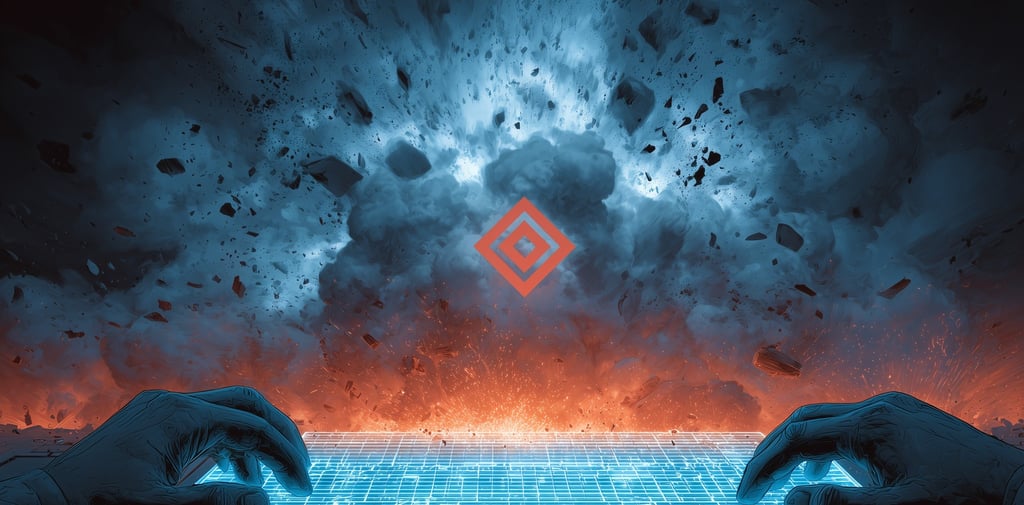
The ugliest part of a dirty war was how clean your hands felt after.
Static's fingers moved across the holographic keyboard. The keys clicked softly. Server racks lined the walls of the Denver rental, humming at a constant low frequency that had long since blended into silence. The air was dry, cool, thick with hot electronics and the faint chemical smell of new carpet—a rented office that belonged to no one, would remember nothing. Outside the tinted windows, afternoon sun hammered the city. In here, it was always a dim blue twilight.
Her battlefield. Data and firewalls, passwords and weak points, logic laid out in clean architecture she could read the way other people read faces. She felt the familiar focus settle over her—a surgeon's distance, a chess player's clarity. The problem in front of her was complex and interesting, which meant she was in her element.
The mission, as briefed by the Architect: build a believable trail of financial wrongdoing inside the Galahad Initiative's network. Enough to freeze their fundraising. Enough to destroy public trust. A digital execution. Clean, untraceable, effective.
She started with something real.
A legitimate donation of two million dollars, made three months prior, routed through a shell company called Argent Shield LLC. Properly reported. Fully disclosed. A dead end for any normal investigator.
She wasn't a normal investigator.
She dug into Argent Shield's formation history. Commands blurred. Layers peeled back. There—a law firm in the Cayman Islands, known for its confidentiality clauses and its discreet roster of clients. She began building from there. Backdated emails, encrypted, their digital fingerprints aged with methodical precision. Language calibrated to suggest coded intent without stating it directly—the grammar of money laundering, fluent and natural. A ghost trail of wire transfers linking Argent Shield to the Sons of Purity: a violent, well-funded anti-superhuman hate group whose public statements had been read into federal hate crime proceedings twice in the past four years.
She seeded a deliberate vulnerability into the Sons of Purity's secure servers. Sloppy enough to look like human error. Matching false records on their end. The story now existed in two places, confirming itself.
To any investigative journalist or federal agent following the trail she was laying, the conclusion would be inescapable: Adam Radzig's Galahad Initiative had been laundering extremist money for years. A man who'd spent his career building coalitions, secretly bankrolled by the people who wanted superhumans in camps.
The lie was perfect. It felt more solid than most truths she'd encountered.
Delivery: an anonymous encrypted file routed to a high-profile political blogger who ran on adrenaline and thin sourcing. Self-deleting. Untraceable.
The puzzle was finished. Her finger hovered over the send icon.
She didn't push it.
A strange numbness spread through her hands—not pain, just weight. She flexed her fingers. The key clicks sounded too loud. Her eyes drifted to the second monitor, where she'd pinned the Initiative's website as a reference point. The About Us section was still open. She hadn't looked at it in an hour.
She looked at it now.
Adam Radzig on a sun-lit porch. His arm around his wife. A boy on one shoulder, a girl on the other. All of them laughing—the kind of laughing that wasn't for a camera. The boy was missing a front tooth. The girl had a smear of chocolate on her cheek.
Static looked at the data file waiting on her primary screen.
A few kilobytes. A ghost. The architecture of a man's destruction.
A wave of dizziness moved through her. The command center felt suddenly small, enclosed—a bunker, not a battlefield. The clean logic of her work had a cost she hadn't included in any of her calculations, a human variable she'd deliberately kept off the screen. The photo. The boy's missing tooth. The girl's smeared cheek. She saw those things and then she saw the file and understood, with a clarity she would have preferred to avoid, that she was about to shatter the lives of people who had done nothing to her.
Her hands felt dirty.
She crushed it. A hard internal act, the way you close a door against noise. She was a soldier. Soldiers followed orders. The Architect had given the command; their survival, the fragile life they'd rebuilt, depended on execution. Her feelings were system noise. An inefficiency. She processed them and discarded them and did not look at the photo again.
Her finger came down.
The send icon flashed once. The file disappeared.
She sat still, looking at the dark monitor, her own pale reflection floating in the glass. A stranger's expression. Unreadable. The room's silence reconstituted itself around her, but it had changed. Heavier. Like something had been spent and would not be refunded.
* * *
The parking garage smelled like exhaust and damp concrete and spilled oil. Breaker moved through the dim rows, footsteps echoing. The air was cold. His breath came out slow and deliberate.
His power was a living current inside him—kinetic force, accumulated and ready. It was built for walls, armored vehicles, putting himself between his team and a firing line. It was not built for this.
He found David Chen on the third level, fumbling with his keys beside a plain sedan. Former civil rights attorney. Current key organizer for the Galahad Initiative. A man in a rumpled suit who looked like he'd been at the office since seven in the morning. Chen looked up as Breaker came around the corner. His eyes went wide with the particular terror of someone who immediately understands their size places them at a disadvantage.
One step back. Against the car. The briefcase trembling in his grip.
Breaker stopped close enough for the man to feel his size.
He hated Arthur for this. He hated himself more.
"David Chen."
"I—I don't want any trouble." Chen's voice came out thinner than he'd probably intended.
"You're already in it."
The words felt foreign. Lines from a script he'd been handed to recite phonetically. He turned his attention to the concrete support pillar beside Chen's head. He reached out and tapped it once with his knuckle—the lightest touch, barely intentional.
The crack spread like a spiderweb. Concrete dust rained down. The pillar let out a low structural groan from somewhere deep inside the material, the sound of internal pressure losing its argument. Chen flinched hard, a strangled gasp escaping him before he could stop it.
Breaker held out his hand. "The keys."
Chen dropped them into his palm without looking up. Breaker closed his fist. He didn't strain, didn't push—just let the ambient energy he'd absorbed through the day, every footstep and vibration and low mechanical tremor, focus into his palm. The metal complained. He opened his fingers and let what remained fall to the floor: a twisted, warm lump, still recognizable as keys only by context.
"The people you're working for are getting into things they don't understand," Breaker said, keeping his voice low. "This is a warning. Walk away. Tell your friends. The next warning won't be about your car."
Chen looked at the melted keys. Then at Breaker. His face had gone the color of the concrete walls. He nodded—fast, jerky—then moved. Around Breaker, hugging the far edge of the aisle, briefcase held against his chest like a shield. His footsteps accelerated toward the stairwell and then broke into a run. The echo faded up and then was gone.
Breaker was alone.
The garage fans hummed. His breathing was unsteady. He looked at his hand. The hand that had just crushed metal to impress upon a decent man the cost of believing in something.
He thought about Arthur giving the order. He thought about himself following it.
He turned to the uncracked side of the pillar.
The roar that came out of him wasn't calculated. Not a decision. It was the accumulated weight of all the things he'd become and all the things he'd stopped being, detonated through his fist at full, unmodulated capacity. Not a tap. Not a demonstration. Everything—every footfall since that morning, every vibration stored and held and waiting.
The pillar didn't crack. It disintegrated. Concrete and rebar turned to powder and shrapnel. The shockwave moved through the garage in a ring, and above him the ceiling sagged, a wide crack opening across its center as the supporting structure gave up its argument with gravity. Lights died. Emergency strobes fired, throwing the space into red-and-black pulses.
Debris rained down. His ears rang.
He stood in the dark with his chest heaving and his fist throbbing at the knuckle.
The pillar was rubble. The ceiling was failing. And in the strobing silence of what he'd made, he felt something settle into place that he hadn't wanted confirmed: a part of him had just broken in exactly the same way. Not cleanly. Not fixably. Just broken.
* * *
The command center was quiet in a way that indicted him.
Arthur stood at the main holographic display. Blue light. Successful parameters. The operation had gone cleanly by every objective standard. The weight of that sat in the room like a held breath.
He could read the damage without asking.
Breaker sat in the corner, eyes fixed on nothing. His silence was more articulate than speech would have been. The damage report from the garage—structural column failure, two-floor evacuation, an engineer on site to assess load-bearing integrity—was open on a side monitor and said the rest. Static sat at her console, pale, withdrawn. Ricochet stripped and reassembled his throwing discs with a methodical fury he was trying to make look like maintenance. The new team members logged their results with the clean, unhurried efficiency of people who hadn't been asked to feel anything about the work.
Arthur saw the fracture running through the room and knew he'd put it there.
He'd told himself it was a necessary cost. A temporary price for long-term survival. He'd said it clearly, in exactly those terms, to himself and to no one else.
Seeing their faces, he felt the logic begin to fail.
He opened the secure channel. Klein answered before the connection finished.
"Report."
Arthur made his voice flat. Professional. The voice of a man managing assets. "Phase one is complete. Target's public image is compromised. Key organizers have been destabilized. Financial networks are under investigative pressure. Thirty percent drop in support projected within two weeks."
"Acceptable." No pause. No acknowledgment. "Continue to Phase Two. I want the Galahad Initiative fully dismantled by end of quarter."
"Understood."
The door hissed.
Rita came in without waiting, face pale, a datapad in her hand with red-flagged messages stacking on the screen. She didn't wait for him to sign off.
"Static's leak went too far," she said. "The blogger has existing ties to the Sons of Purity. They're not running the story as news—they're running it as a call to arms."
She crossed to the main display and pushed the data over. Encrypted forum posts. Caps-lock lettering. Misspelled urgency. The framing was unambiguous: Radzig's fake corruption wasn't financial malfeasance—it was ideological betrayal. A superhuman sympathizer hiding behind civil rights language, finally exposed. The Sons of Purity were mobilizing. Organized posts calling for a citizen's militia to appear at Radzig's next rally in two days. Direct action. Police the threat.
Arthur read the words and felt the floor shift under him.
He had been surgical. Precise. He'd designed an operation to damage without escalating, control the story without generating a new one. He had been careful.
He had handed a lit torch to people actively searching for something to burn.
"I'll monitor the situation," Klein's voice said from the open line, unhurried, the tone of someone reviewing interesting data. "Let us see how this variable develops. It may provide a useful opportunity."
The line cut.
Arthur didn't move.
On the tactical map, the rally site pulsed red. A blood-red diamond over the Denver grid, steady and rhythmic, like a second heartbeat. He looked at it. The room was very still. He could hear Ricochet's discs clicking in the corner.
He had wanted to manage chaos. Had believed—needed to believe—that applying enough intelligence to a bad situation could contain it. That his judgment was the variable that changed outcomes.
The red light pulsed.
He had made a fire to contain a fire. Both were burning now. And somewhere in a secured channel he could no longer access, Klein was already deciding what to do with the heat.
Updates
Follow for the latest on my stories.
Fiction
contact@msrayed.com
© 2025. All rights reserved.
My Substack: https://msrayed.substack.com
My Patreon: https://www.patreon.com/cw/MSRayed