
Where the Styx Runs Cold, Vol. 2 Ch 2: The Price of Power Pt. 2
Hawke orders his covert team to dismantle a superhuman rights movement using lies and sabotage. The op succeeds, but at a devastating moral cost.
SERIALIZED FICTIONWHERE THE STYX RUNS COLD
3/7/202619 min read
Arthur Hawke had learned one thing about moral men: give them an immoral order they can't refuse.
The briefing room was polished grey stone and brushed steel. Sixty-eight degrees, always. The silence had texture now - Breaker's anger still in the air, the team's trust lying somewhere on the floor between them. Arthur stood at the head of the holographic table. Blue light cut shadows across his face in hard angles. He felt their eyes. Overload's flat, analytical calm. Breaker's hard stare that could have been a blade. He filed the weight of it behind a wall he'd spent years building, brick by brick, and sealed it. He was playing a part. He had to believe the mask was for them. For Klein.
He flicked his wrist. Adam Radzig's face materialized above the table, rotating slowly in three dimensions. Warm eyes. A real smile. The kind of face people followed into burning buildings.
"Our new objective." He let the words sit in the cold air. "The target is Adam Radzig, founder of the Galahad Initiative. His organization has accumulated significant political capital in the United States, pushing for a new Superhuman Rights Act. Our analysis - and our backer's - identifies this movement as a long-term threat to national and global security."
He let the language do the work. A threat to security. It meant everything and nothing, and could justify whatever came next. Ricochet's jaw moved once, a small twitching muscle. Static's fingers, usually a blur across her datapad, had gone still.
"Radzig's platform presents superhuman integration as inherently straightforward," Arthur continued, drawing straight from Klein's report. "It generates a political climate that will obstruct necessary, proactive intervention. Our mission: dismantle the narrative."
He rotated the image, layering in the intelligence web - public events, funding sources, key personnel. "We dismantle his credibility. Sever his funding. Introduce friction inside his inner circle. The objective is to render the Galahad Initiative politically toxic, ensure it collapses from within. No collateral damage. No open violence." He let his gaze move around the table once, slow and deliberate. "We are ghosts. The only thing we leave behind is doubt."
The new team members absorbed the briefing like surgeons reviewing a case file. Ghostwalker's eyes narrowed slightly, already threading a path through Denver's architecture. Ordnance leaned forward over the convention center schematics, chin propped on one fist. Mirage gave a single, deliberate nod - a woman confirming a restaurant order.
It was Overload who spoke first. Low, unhurried. "A non-lethal takedown of an idea. Efficient."
The word dropped into the silence like a stone into still water. The ripple reached Breaker in a visible instant - huge hands flattening against the table edge, the tendons in his forearms standing up like cables. Something volcanic building pressure underneath.
Arthur spoke before it could break surface. His voice went up like a wall, block by block. He distributed assignments with care, each one precisely placed - keeping his original team at the perimeter, away from the worst of it, while making clear to the new people exactly who held the chain of command. A bitter calculation. He was solving for survival. Not conscience.
"Mirage. Psychological operations. I want photonic deepfakes - subtle, deniable. Radzig slurring mid-speech. A senior aide photographed next to a known anti-superhuman lobbyist, a perfect illusion that holds long enough for a shutter to catch it. Create the smoke. The media invents the fire."
"Ghostwalker. Infiltration. Radzig's private office in Denver and his hotel suite. Listening devices - not for blackmail, intelligence. I want his private doubts, his personal friction, the cracks in his inner circle."
He turned to Ordnance. "Technical sabotage. The town hall in two days. Microphone feedback at a critical moment. Teleprompter failure. Stage lights cut at the top of his close. Make him look incompetent. Flustered. Small."
He turned to Static last, and when he spoke her name, something in her shoulders tightened before he'd even finished the sentence.
"Static. You coordinate our digital trail. Find financial irregularities among Radzig's donors. If none exist, manufacture them. Anonymous tips to the IRS, encrypted packets to investigative reporters. You'll be the whisper in the machine."
She looked at the table. A small response, carefully contained - the kind of flinch that only meant something if you knew what to look for. He knew. He was asking her to weaponize the same precision she used to find truth, and use it to build lies. She understood that. She would comply. The understanding and the compliance would both cost her, separately.
He'd stopped calculating the cost to himself. It was getting too high to count.
He paused. The next names cost him something.
"Breaker. Ricochet." His eyes touched theirs for a fraction of a second. "Overwatch. Secure the event perimeter during the town hall. Nothing in, nothing out. External threats only."
It was an insult dressed as an assignment - demoting two of the most capable people in the room to glorified sentinels, their skills reduced to standing on a rooftop and watching. He felt Breaker absorb it. Felt the slow burn of Ricochet's quiet wounded retreat. He was keeping their hands clean, and doing it in a way that felt exactly like punishment.
He turned and walked out without looking back, the team's silence pressing against his spine the full length of the corridor. Each step sounded like a nail going into wood.
***
The Galahad Initiative occupied three floors of a glass-and-steel tower in downtown Denver. Transparency by design. To Ghostwalker, standing in the happy-hour crowd across the street, it was a three-dimensional puzzle of concrete, wiring, and tempered glass to be solved.
Her power wasn't sight - not exactly. It was touch at distance. She felt the building as a physical thing, the way a hand reads a face in the dark. The server farm on the twelfth floor hummed at a frequency she'd memorized from a dozen similar installations. The elevator cables vibrated at 2.3 hertz on ascent, 1.9 on descent. The reinforced concrete core ran cold through the center like a spine. She built the map in her mind with the patience of a woman who had never once been in a hurry.
A city bus groaned away from the curb, its engine loud enough to swallow everything beneath it. She stepped into the shadow of a doorway. Then she stepped through the wall.
Phasing felt like cold water. The brief shock of displacement, then a floating weightlessness. The world went soft and grey. Street noise became dull, muffled thuds at a distance. The smell of the city - exhaust, hot asphalt, roasting chestnuts from a street cart - vanished entirely, replaced by something mineral and clean. The smell of the space between atoms.
She moved upward through concrete and rebar, a swimmer in a slow, solid current. Server rooms breathed warm air against her as she passed through. Empty offices carried the ghost of stale coffee and carpet cleaner. On the tenth floor, her path took her directly through a security guard at his desk.
The contact lasted a fraction of a second. His mind was a sudden burst of static - a dull ache in both knees, college tuition circling in a tight loop, the lingering taste of a microwaved burrito that had given up on life. She shed it all immediately, a reflex she'd long since stopped thinking about. As she cleared his desk, her peripheral vision caught the photo in the plastic frame: a teenager in a football uniform, grinning at someone off-camera.
She logged it - emotional attachment, potential leverage point, exploitable variable - and continued upward.
The fourteenth floor was quiet. Executive suites. She solidified inside a storage closet, the return to solid matter a jarring compression against the senses. Paper. Toner. The ambient hiss of climate control. She stood still for ten seconds. Heard nothing that required a decision.
Radzig's office sat at the end of the hall. Frosted glass, high-end electronic lock. She placed a palm flat against the door and walked through it.
The room smelled of glass cleaner and leather, and underneath those something quieter - hand soap, a faint personal frequency she had no instrument to measure. His desk held reports, fundraising correspondence, the ordinary infrastructure of a movement. Between them, handwritten letters from supporters, the kind that people still wrote by hand when they needed to believe the gesture mattered. A crayon drawing: a human and a glowing-eyed figure standing under a smiling sun, holding hands.
She spent four seconds on it. The child had colored outside the lines on the sun. The glowing-eyed figure had been given a cape. Both of them were smiling. She noted the drawing existed - evidence of Radzig's public-facing image, his cultivation of a certain kind of symbolism - and moved on.
The bug was the size of a screw - built to pass as one. Ordnance's work. A micro-thin solar cell for a head, an audio transmitter in the body capable of burst transmissions on an encrypted channel, drawing power from the office lights. She found the original screw on the underside of the desk's support bracket, swapped it out in nine seconds, ran the check on her wrist unit. One green light. Clean signal.
She stood and took a last look around. A man's life in paper and wood. His work, his hope, the accumulated weight of what he was trying to build - all of it laid out in front of her like a map of somewhere she'd never been. She read it the way she'd read the building: as structure, material, a stage she had moved through to perform a function.
She crossed to the window, placed her hand on the cold glass, and stepped out into the Colorado night.
***
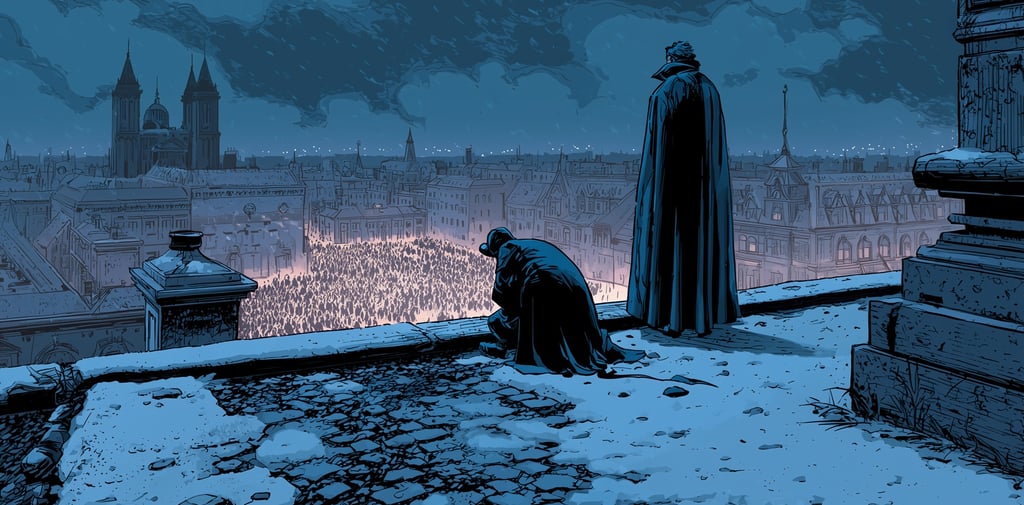
The rooftop smelled of asphalt and cold. Wind came straight off the plains with nothing to slow it, finding every gap in Ricochet's jacket collar. He lay prone, cheek pressed against the stock of his spotting scope, watching the crowd fill Civic Center Park below.
Ranchers in worn denim. Students with bright hair. Families with children holding small flags. Real faces, seen through optics at a safe remove. He kept the scope up and his thoughts where he could manage them.
Behind him, Breaker paced. The gravel crunched under his boots in a steady four-beat rhythm - the sound of a man barely containing something that hadn't found its shape yet. They'd been up here two hours. Parked on a rooftop at the edge of everything, nowhere near anything that mattered. Ricochet had spent the first hour telling himself it was protection. He'd stopped bothering with that an hour ago. It didn't feel like protection. It felt like a corner.
He lowered the scope.
Breaker stood against the darkening sky, motionless now. The faint gold glow of his eyes. The wind pulling his coat around his legs in slow, heavy arcs.
"You're going to wear a hole in the roof," Ricochet said.
Breaker's voice came out low and ground down. "This is wrong, Jay. I can't stand here and watch this happen."
Ricochet kept his eyes on the city below. "Arthur's gone, Javi. The man who came with us into Kivu isn't running this op." A pause. The wind. "Narrative neutralization. Strategic assets. That's Klein's language. Arthur's just the mouth it comes out of now."
He wanted to say the other thing. That this was a long game. Necessary evil, temporary, survivable. The words were right there in his throat. He let them sit until they went cold, because he already knew how they'd land - hollow, unconvincing, the sound of a man trying to talk himself into something he'd already stopped believing.
"He's still in there somewhere," he said instead. A smaller thing. Maybe true.
"Maybe," Breaker said. A pause that lasted long enough to say everything else. "But if he is, he's buried deep enough he might not find his way back." The pacing didn't resume. Breaker just stood there, a dark shape against the sky. "We're on our own."
Radzig walked onto the stage to a wall of sound - the crowd giving him everything they'd held in reserve, warm and generous and real. His voice carried clean through the speakers below. Power as responsibility. A future that could hold everyone under the same flag. Ricochet raised the scope and watched a man say true things to people who'd come a long way to hear them.
Then the microphone shrieked.
Feedback hit sharp and sudden, snapping Radzig's rhythm in two. The screens flanking the stage flickered - a fraction of a second, Mirage's work - and in that fraction Radzig's face went slack, eyes unfocused, a man three drinks into a bad evening. Gone before most eyes could catch it. But the murmur that moved through the crowd was the sound of a seed going in.
Radzig tried to recover. The teleprompter froze, then scrolled a line of junk code across the glass. He stumbled on his words, grabbed for the thread, missed. The crowd felt the stumble. Their noise shifted - restless, uncertain, the energy bleeding out the edges.
At the peak of his close, hands raised, voice climbing - the stage lights died. Shadow swallowed him whole. The groan from the crowd was flat and unanimous, the sound of a door shutting on a room everyone had wanted to enter.
People started leaving. Small flags dropped on the grass and stayed there.
"Ricochet." Arthur's voice in his earpiece. Crisp, professional, the voice of a man who hadn't been watching the same thing he had. "Report on crowd reaction."
He looked through the scope at slumped shoulders and disappointed faces, the slow dispersal of everything that had gathered here tonight.
"Crowd is unsettled, Architect." Someone else's voice, coming out of his mouth. "Target's credibility is taking damage."
He set the scope down on the gravel. The cold seeped through his jacket and he let it. He lay there in the thin mountain air and stared at the first stars coming through above the city glow.
Behind him, Breaker had stopped moving entirely. Just a big, still shape in the dark, looking out over the park where the crowd had come to believe something and were now going home with less than they'd arrived with.
Neither of them said anything. There wasn't anything to say that would make it smaller or easier or different from what it was. He'd watched the Galahad Initiative's momentum get quietly strangled over forty minutes by people who were very good at their jobs, and he had called it in like a professional, and now the night air tasted like nothing, and that was probably right.
He closed his eyes. The thin mountain air sat heavy in his lungs. He kept very still and didn't try to name what was coating the inside of his chest, because he already knew what it was, and naming it wasn't going to help anything.
Arthur Hawke had learned one thing about moral men: give them an immoral order they can't refuse.
The briefing room was polished grey stone and brushed steel. Sixty-eight degrees, always. The silence had texture now—Breaker's anger still in the air, the team's trust lying somewhere on the floor between them. Arthur stood at the head of the holographic table. Blue light cut shadows across his face in hard angles. He felt their eyes. Overload's flat, analytical calm. Breaker's hard stare that could have been a blade. He filed the weight of it behind a wall he'd spent years building, brick by brick, and sealed it. He was playing a part. He had to believe the mask was for them. For Klein.
He flicked his wrist. Adam Radzig's face materialized above the table, rotating slowly in three dimensions. Warm eyes. A real smile. The kind of face people followed into burning buildings.
"Our new objective." He let the words sit in the cold air. "The target is Adam Radzig, founder of the Galahad Initiative. His organization has accumulated significant political capital in the United States, pushing for a new Superhuman Rights Act. Our analysis—and our backer's—identifies this movement as a long-term threat to national and global security."
He let the language do the work. A threat to security. It meant everything and nothing, and could justify whatever came next. Ricochet's jaw moved once, a small twitching muscle. Static's fingers, usually a blur across her datapad, had gone still.
"Radzig's platform presents superhuman integration as inherently straightforward," Arthur continued, drawing straight from Klein's report. "It generates a political climate that will obstruct necessary, proactive intervention. Our mission: dismantle the narrative."
He rotated the image, layering in the intelligence web—public events, funding sources, key personnel. "We dismantle his credibility. Sever his funding. Introduce friction inside his inner circle. The objective is to render the Galahad Initiative politically toxic, ensure it collapses from within. No collateral damage. No open violence." He let his gaze move around the table once, slow and deliberate. "We are ghosts. The only thing we leave behind is doubt."
The new team members absorbed the briefing like surgeons reviewing a case file. Ghostwalker's eyes narrowed slightly, already threading a path through Denver's architecture. Ordnance leaned forward over the convention center schematics, chin propped on one fist. Mirage gave a single, deliberate nod—a woman confirming a restaurant order.
It was Overload who spoke first. Low, unhurried. "A non-lethal takedown of an idea. Efficient."
The word dropped into the silence like a stone into still water. The ripple reached Breaker in a visible instant—huge hands flattening against the table edge, the tendons in his forearms standing up like cables. Something volcanic building pressure underneath.
Arthur spoke before it could break surface. His voice went up like a wall, block by block. He distributed assignments with care, each one precisely placed—keeping his original team at the perimeter, away from the worst of it, while making clear to the new people exactly who held the chain of command. A bitter calculation. He was solving for survival. Not conscience.
"Mirage. Psychological operations. I want photonic deepfakes—subtle, deniable. Radzig slurring mid-speech. A senior aide photographed next to a known anti-superhuman lobbyist, a perfect illusion that holds long enough for a shutter to catch it. Create the smoke. The media invents the fire."
"Ghostwalker. Infiltration. Radzig's private office in Denver and his hotel suite. Listening devices—not for blackmail, intelligence. I want his private doubts, his personal friction, the cracks in his inner circle."
He turned to Ordnance. "Technical sabotage. The town hall in two days. Microphone feedback at a critical moment. Teleprompter failure. Stage lights cut at the top of his close. Make him look incompetent. Flustered. Small."
He turned to Static last, and when he spoke her name, something in her shoulders tightened before he'd even finished the sentence.
"Static. You coordinate our digital trail. Find financial irregularities among Radzig's donors. If none exist, manufacture them. Anonymous tips to the IRS, encrypted packets to investigative reporters. You'll be the whisper in the machine."
She looked at the table. A small response, carefully contained—the kind of flinch that only meant something if you knew what to look for. He knew. He was asking her to weaponize the same precision she used to find truth, and use it to build lies. She understood that. She would comply. The understanding and the compliance would both cost her, separately.
He'd stopped calculating the cost to himself. It was getting too high to count.
He paused. The next names cost him something.
"Breaker. Ricochet." His eyes touched theirs for a fraction of a second. "Overwatch. Secure the event perimeter during the town hall. Nothing in, nothing out. External threats only."
It was an insult dressed as an assignment—demoting two of the most capable people in the room to glorified sentinels, their skills reduced to standing on a rooftop and watching. He felt Breaker absorb it. Felt the slow burn of Ricochet's quiet wounded retreat. He was keeping their hands clean, and doing it in a way that felt exactly like punishment.
He turned and walked out without looking back, the team's silence pressing against his spine the full length of the corridor. Each step sounded like a nail going into wood.
***
The Galahad Initiative occupied three floors of a glass-and-steel tower in downtown Denver. Transparency by design. To Ghostwalker, standing in the happy-hour crowd across the street, it was a three-dimensional puzzle of concrete, wiring, and tempered glass to be solved.
Her power wasn't sight—not exactly. It was touch at distance. She felt the building as a physical thing, the way a hand reads a face in the dark. The server farm on the twelfth floor hummed at a frequency she'd memorized from a dozen similar installations. The elevator cables vibrated at 2.3 hertz on ascent, 1.9 on descent. The reinforced concrete core ran cold through the center like a spine. She built the map in her mind with the patience of a woman who had never once been in a hurry.
A city bus groaned away from the curb, its engine loud enough to swallow everything beneath it. She stepped into the shadow of a doorway. Then she stepped through the wall.
Phasing felt like cold water. The brief shock of displacement, then a floating weightlessness. The world went soft and grey. Street noise became dull, muffled thuds at a distance. The smell of the city—exhaust, hot asphalt, roasting chestnuts from a street cart—vanished entirely, replaced by something mineral and clean. The smell of the space between atoms.
She moved upward through concrete and rebar, a swimmer in a slow, solid current. Server rooms breathed warm air against her as she passed through. Empty offices carried the ghost of stale coffee and carpet cleaner. On the tenth floor, her path took her directly through a security guard at his desk.
The contact lasted a fraction of a second. His mind was a sudden burst of static—a dull ache in both knees, college tuition circling in a tight loop, the lingering taste of a microwaved burrito that had given up on life. She shed it all immediately, a reflex she'd long since stopped thinking about. As she cleared his desk, her peripheral vision caught the photo in the plastic frame: a teenager in a football uniform, grinning at someone off-camera.
She logged it—emotional attachment, potential leverage point, exploitable variable—and continued upward.
The fourteenth floor was quiet. Executive suites. She solidified inside a storage closet, the return to solid matter a jarring compression against the senses. Paper. Toner. The ambient hiss of climate control. She stood still for ten seconds. Heard nothing that required a decision.
Radzig's office sat at the end of the hall. Frosted glass, high-end electronic lock. She placed a palm flat against the door and walked through it.
The room smelled of glass cleaner and leather, and underneath those something quieter—hand soap, a faint personal frequency she had no instrument to measure. His desk held reports, fundraising correspondence, the ordinary infrastructure of a movement. Between them, handwritten letters from supporters, the kind that people still wrote by hand when they needed to believe the gesture mattered. A crayon drawing: a human and a glowing-eyed figure standing under a smiling sun, holding hands.
She spent four seconds on it. The child had colored outside the lines on the sun. The glowing-eyed figure had been given a cape. Both of them were smiling. She noted the drawing existed—evidence of Radzig's public-facing image, his cultivation of a certain kind of symbolism—and moved on.
The bug was the size of a screw—built to pass as one. Ordnance's work. A micro-thin solar cell for a head, an audio transmitter in the body capable of burst transmissions on an encrypted channel, drawing power from the office lights. She found the original screw on the underside of the desk's support bracket, swapped it out in nine seconds, ran the check on her wrist unit. One green light. Clean signal.
She stood and took a last look around. A man's life in paper and wood. His work, his hope, the accumulated weight of what he was trying to build—all of it laid out in front of her like a map of somewhere she'd never been. She read it the way she'd read the building: as structure, material, a stage she had moved through to perform a function.
She crossed to the window, placed her hand on the cold glass, and stepped out into the Colorado night.
***
The rooftop smelled of asphalt and cold. Wind came straight off the plains with nothing to slow it, finding every gap in Ricochet's jacket collar. He lay prone, cheek pressed against the stock of his spotting scope, watching the crowd fill Civic Center Park below.
Ranchers in worn denim. Students with bright hair. Families with children holding small flags. Real faces, seen through optics at a safe remove. He kept the scope up and his thoughts where he could manage them.
Behind him, Breaker paced. The gravel crunched under his boots in a steady four-beat rhythm—the sound of a man barely containing something that hadn't found its shape yet. They'd been up here two hours. Parked on a rooftop at the edge of everything, nowhere near anything that mattered. Ricochet had spent the first hour telling himself it was protection. He'd stopped bothering with that an hour ago. It didn't feel like protection. It felt like a corner.
He lowered the scope.
Breaker stood against the darkening sky, motionless now. The faint gold glow of his eyes. The wind pulling his coat around his legs in slow, heavy arcs.
"You're going to wear a hole in the roof," Ricochet said.
Breaker's voice came out low and ground down. "This is wrong, Jay. I can't stand here and watch this happen."
Ricochet kept his eyes on the city below. "Arthur's gone, Javi. The man who came with us into Kivu isn't running this op." A pause. The wind. "Narrative neutralization. Strategic assets. That's Klein's language. Arthur's just the mouth it comes out of now."
He wanted to say the other thing. That this was a long game. Necessary evil, temporary, survivable. The words were right there in his throat. He let them sit until they went cold, because he already knew how they'd land—hollow, unconvincing, the sound of a man trying to talk himself into something he'd already stopped believing.
"He's still in there somewhere," he said instead. A smaller thing. Maybe true.
"Maybe," Breaker said. A pause that lasted long enough to say everything else. "But if he is, he's buried deep enough he might not find his way back." The pacing didn't resume. Breaker just stood there, a dark shape against the sky. "We're on our own."
Radzig walked onto the stage to a wall of sound—the crowd giving him everything they'd held in reserve, warm and generous and real. His voice carried clean through the speakers below. Power as responsibility. A future that could hold everyone under the same flag. Ricochet raised the scope and watched a man say true things to people who'd come a long way to hear them.
Then the microphone shrieked.
Feedback hit sharp and sudden, snapping Radzig's rhythm in two. The screens flanking the stage flickered—a fraction of a second, Mirage's work—and in that fraction Radzig's face went slack, eyes unfocused, a man three drinks into a bad evening. Gone before most eyes could catch it. But the murmur that moved through the crowd was the sound of a seed going in.
Radzig tried to recover. The teleprompter froze, then scrolled a line of junk code across the glass. He stumbled on his words, grabbed for the thread, missed. The crowd felt the stumble. Their noise shifted—restless, uncertain, the energy bleeding out the edges.
At the peak of his close, hands raised, voice climbing—the stage lights died. Shadow swallowed him whole. The groan from the crowd was flat and unanimous, the sound of a door shutting on a room everyone had wanted to enter.
People started leaving. Small flags dropped on the grass and stayed there.
"Ricochet." Arthur's voice in his earpiece. Crisp, professional, the voice of a man who hadn't been watching the same thing he had. "Report on crowd reaction."
He looked through the scope at slumped shoulders and disappointed faces, the slow dispersal of everything that had gathered here tonight.
"Crowd is unsettled, Architect." Someone else's voice, coming out of his mouth. "Target's credibility is taking damage."
He set the scope down on the gravel. The cold seeped through his jacket and he let it. He lay there in the thin mountain air and stared at the first stars coming through above the city glow.
Behind him, Breaker had stopped moving entirely. Just a big, still shape in the dark, looking out over the park where the crowd had come to believe something and were now going home with less than they'd arrived with.
Neither of them said anything. There wasn't anything to say that would make it smaller or easier or different from what it was. He'd watched the Galahad Initiative's momentum get quietly strangled over forty minutes by people who were very good at their jobs, and he had called it in like a professional, and now the night air tasted like nothing, and that was probably right.
He closed his eyes. The thin mountain air sat heavy in his lungs. He kept very still and didn't try to name what was coating the inside of his chest, because he already knew what it was, and naming it wasn't going to help anything.
Updates
Follow for the latest on my stories.
Fiction
contact@msrayed.com
© 2025. All rights reserved.
My Substack: https://msrayed.substack.com
My Patreon: https://www.patreon.com/cw/MSRayed