
Where the Styx Runs Cold, Vol. 2 Ch 1: The Price of Power Pt. 1
Arthur’s new team is efficient, but soulless. As the old guard fractures, a dark order from Klein forces Arthur to see the bars of his golden cage.
SERIALIZED FICTIONWHERE THE STYX RUNS COLD
2/21/202610 min read
1995
The new team dismantled the holographic insurgents in two minutes and fourteen seconds. Hawke timed it from the platform rail. Perfection, he decided, had no use for a soul.
Below, the simulation held: war-torn Berlin, burning cars, broken concrete. The platform air carried ozone and recycled cold, a smell he'd started to associate with everything Neil Klein owned. He looked down at his team. They were already somewhere else.
The mission was standard—twelve super-powered insurgents holding a city block. His old team would have torn through it like a storm. Power and heat and bouncing discs, a mess that somehow became grace. This team was a different animal entirely.
"Ghostwalker, east wall. Overload, stand by." Arthur's voice in the comms was barely above a murmur.
She moved on instinct, black gear drinking the strobing light. At the wall—three feet of solid concrete—she didn't slow. Her body shimmered once, heat-haze quick, and the wall went grey and translucent. She stepped through it like smoke stepping through smoke. The sound she made was a soft exhale.
Inside, two guards spun. Their targeting systems had nothing to find.
"Mirage. Main nest, draw their fire."
From an alley, a woman appeared. Torn clothes. One arm clutched to her chest. A tear catching the light on her cheek. The roof gun swung toward her—that perfect, terrible instinct to aim at the weak thing. The kind of mistake you can't patch out of a program.
"Ordnance. Main gate."
Ordnance put one gloved hand against ten inches of blast door. Silver veins spread across the metal in silence. A low hum carried through the concrete, up through the soles of Arthur's boots where he stood on the platform above. Then the door didn't explode—it fell apart, crumbling inward in a cascade of hot metal dust.
Clean. Quiet. Arthur felt a cold professional respect he didn't want to feel. Klein had promised him the best tools money could build, and he hadn't been wrong. He just hadn't mentioned what it cost to use them.
"Breaker. Cover fire. Pin them down."
The order felt wrong before it finished leaving his mouth. Breaker moved up—a bull among scalpels—his power harness glowing as it drank a handful of panicked holo-rounds. He roared. A raw, human sound in a theater that had no use for it. The concussive blast tore a ragged hole in the building's side, rebar and concrete chunks spinning wide. It worked. It was also a sledgehammer swung at a door that was already open.
On a far roof, Ricochet gave one small shake of his head.
The remaining insurgents fell back to the simulation's boss: a six-armed chassis bristling with plasma cannons and missile pods, built specifically to be slow-killed by coordinated heavy fire. Hawke's finger hovered over the command to send Breaker and Ricochet into the grind.
"Architect." Overload's voice. Low, flat, utterly without color. "Requesting permission to engage."
"Permission granted."
Overload walked into the open street. The chassis opened up—plasma bolts, full stream—and he didn't flinch. His body seemed to drink it, a faint green luminescence pulsing under the skin. Not absorbing. Just erasing. He crossed the distance and laid his palm against the machine's hull.
The green light reversed. The chassis' core drained in silence, the machine's arms spasming once before it toppled forward, a shell.
Simulation complete. All hostiles neutralized. Mission time: two minutes, fourteen seconds. A new facility record.
The digital city vanished. Grey training grid. The air still tasted of ozone.
Ghostwalker, Mirage, Ordnance, and Overload were already at the gear station, cleaning equipment, talking about power consumption. A few yards away, Breaker stood with Ricochet and Static—a separate island. His shoulders carried the weight of a man who had just been told, without anyone saying a word, exactly what he was worth.
This was what Arthur had built to save his old team.
He gripped the platform rail. The cold of the steel moved up through his palms and into his wrists. He'd built the perfect machine. He just hadn't understood, until now, that he'd be locked inside it.
***
The common room at Valhalla was designed to calm. Polished concrete, pale wood, a single armored window looking onto the fjord—that vast, untouchable Norwegian beauty. Breaker had started thinking of it as the world's most expensive morgue.
He sat with Ricochet and Static, a protein shake going warm in his hand. Ricochet stared into his coffee. Static swiped at a datapad without reading it. The silence between them was the specific silence of people mourning something they couldn't name because naming it would make it permanent. Six months ago they'd have been loud with it—anger, dark humor, something. Now they just sat, occupying the same air in the same room, each one alone inside it.
Across the room, the new members talked quietly about tech and load-outs. Overload was at a workbench, field-stripping a bio-converter gauntlet with the focused care of a watchmaker—precise, absorbed, somewhere else entirely. Breaker watched him. A bitter heat climbed his throat. It wasn't the skill he hated. It was what the skill meant. When he looked at Overload, he saw the future Arthur was building. He saw himself being gently, efficiently replaced.
"The refining tech at that Kivu mine was impressive." Overload's voice. Flat, conversational, aimed at Ordnance across the bench. "Containment was weak, but the core process was years ahead of anything SHEPARD had. Shame we had to level the place. Could have been repurposed."
The word hit Breaker like a boot heel.
Repurposed.
He was talking about Kivu like it was a broken machine. The place where they'd nearly bled out, where Arthur had made his stand, where something had mattered—reduced to a resource-management problem. The protein shake tipped as Breaker stood, his chair barking against the concrete. Every head in the room turned.
He walked to the bench. Slow. His boots made a sound like counting.
Overload looked up with the mild interest of a man watching weather.
"You think that's all it was?" Breaker kept his voice low. "A pile of tech?"
"A target," Overload replied, setting down a small tool with precision. "With valuable materials. We neutralized the target and destroyed the materials in the process. From a resource standpoint, a poor outcome."
The red crept in at the edges of Breaker's vision. "There were people there. Being ground into dust to mine that rock. We fought for something. We stood for something."
"We stood for our commander's tactical decision." Overload picked up a polishing cloth. "Which secured us superior funding, better equipment, and operational freedom. A logical trade."
"There's nothing logical about you." Breaker leaned in. "There's nothing in you."
Overload stopped polishing. When he looked up, something faint pulsed in his pupils—a green light, deep, like something alive at the bottom of still water. "Souls don't win fights, Hendricks. Tactics do. Overwhelming force does. That's what the Architect understands. That's why he commands." He gestured vaguely at the room. "And why you're here."
Arthur walked in.
"Breaker. Stand down."
Quiet. But it had weight. Breaker held for a half-second—training and fury fighting to a draw—then stepped back from the bench, fists still coiled.
"He thinks Kivu was a business deal," Breaker said.
"The way he thinks is part of his function." Arthur moved between them, his face a neutral mask, but the tension lived in his jaw. "Every member of this team is a strategic asset. Overload's detachment is part of his value."
Strategic asset. Value. Klein's vocabulary, coming out of Arthur's mouth.
Breaker went quiet. He looked at Arthur—the man he'd followed through every variety of hell, loved like blood—and said nothing. Let the silence carry what he couldn't. He saw it land. Something moved behind Arthur's eyes and then was gone, replaced by the cool remove of a commander.
Breaker walked away. No slammed doors. No storm. Just his boots on concrete, the sound of them growing smaller, and the vast window on his left showing the fjord that they could see and never reach. He felt the tracker under his skin like a splinter he'd learned to stop noticing. He was heading for the weight room—the one place in this beautiful, engineered prison where the pain still told the truth.
***
The hallway to the sanctuary wing was lined with screens showing Icelandic meadows and Tuscan light. The air was sandalwood and bergamot, calibrated to soothe. Rita walked through it feeling none of it.
The argument sat in her chest like swallowed glass. The new team's cold precision. The new shape of Arthur's silences.
Elias Jenkins' door recognized her and opened. Inside: first editions floor to ceiling, a Kandinsky on the wall, and a full-wall screen displaying a forest so detailed she could almost smell it—light shifting with the hour, birdsong looped in seamless repetition. A comfortable lie.
Elias sat in his armchair with a Dostoevsky open across his knees, unread. He'd put on weight since Lyon. The hunted look had softened into something scholarly and sad. He smiled when he saw her.
"Checking on the prize canary?"
"I came to see how you were." She chose the plain wooden chair. The soft furniture here felt like a trap.
He closed the book. The sound it made was too loud in the room. "I have everything a man could want." He looked at the false forest. "Except the one thing that matters."
"The quiet must be difficult."
His laugh was dry and humorless. "Oh, it's never quiet." He tapped his temple. "He's always here. The Ledger left a mark—a copy of his entire mind, just... downloaded. I have his memories. I see through his logic." He leaned forward, and for a moment the scholarly exhaustion dropped away, and she saw the man from the printing press—frantic, precise, afraid. "That's the worst part. The silence gives me too much time to think his thoughts. He believes he's saving the world by killing parts of it. And when you have all his data—when you see the cycles of human failure laid out like equations—it becomes very hard to argue."
Rita felt a chill she couldn't locate exactly.
"You can't let his thinking become yours," she said.
"Can't I?" He sank back. "I watch your commander. The new team, the new efficiency. He's using the master's tools, Rita. But tools shape the hand that holds them. Klein gave him a new lens, not just a new budget. And lenses aren't easy to take off."
She wanted to defend Arthur. The words arranged themselves and then scattered. She'd been trying to form that defense for weeks, and it kept dissolving under the weight of small things she'd noticed and filed away without examining: the new vocabulary he'd started using, borrowed from Klein's world; the way his silences had changed shape, become more guarded; the plans he explained now in terms of assets and outcomes, the human wreckage underneath the logic treated as an acceptable remainder.
"He's stronger than that," she said instead.
Elias looked at her with a pity that was almost gentle. "I hope so. Klein never builds a cage without keeping the key. He never gives a gift without building the debt into the hinge." He turned back to the screen, to the perfect looping forest. "This place is designed to be so comfortable you forget what it is. That's the real trap. You start to think the cage is a home. And I'm afraid your friend is beginning to like the design."
The birdsong played on. The light shifted by a degree. Rita sat in it and understood, with a slow, heavy certainty, that Elias was right—and that she'd been feeling it for weeks, and calling it something else.
***
At the facility's peak, Arthur stood in the dark.
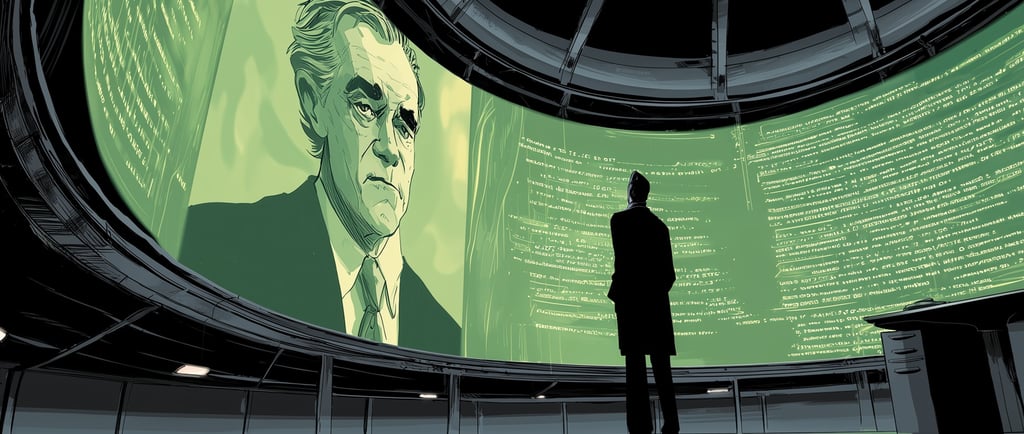
The Crow's Nest was circular, its walls a single panoramic screen usually showing the fjord and the Nordic sky in full resolution. A god's-eye view. He used it for that—to flatten everything below into data, into something manageable. Breaker's face. The confrontation. You're one of his now. He swiped through files. Overload's psych profile: stable, mission-focused, no observable internal conflict. Ghostwalker's infiltration records: twelve insertions, zero detections. He read them like prayers. He had to believe he was building something, or he had to admit he'd sold them all for a clean room and a set of perfect weapons.
Then the room went dark.
The fjord, the swirling data—everything blinked out. His hand went for the gun that wasn't there. Ambush. Trap. Then a single file appeared in the blackness, its green text punching through every layer of Static's security like it was paper.
A message from the landlord.
No greeting. Klein never bothered.
ASSET: ADAM RADZIG.
A photograph: a man in his forties, warm smile, kind eyes. The file summary scrolled beside it—minor telekinetic, founder of the Aegis Initiative for peaceful superhuman integration, growing political leverage in the EU.
Arthur knew what came next before he read it.
STATUS: STATISTICAL LIABILITY. NARRATIVE INIMICAL TO LONG-TERM STABILITY PROJECTIONS.
DIRECTIVE: DISMANTLE SUBJECT'S NARRATIVE. NEUTRALIZE CREDIBILITY. USE ANY MEANS NECESSARY.
MISSION CLASS: PRECISION & SUBTLETY. EVALUATION OF DIVISION'S DISCRETIONARY CAPABILITIES.
He stood very still.
Dismantle. Neutralize credibility.
Not a threat. Not an enemy combatant. A man with a movement built on peace. Klein wanted it killed quietly, wanted to know if his new team was sharp enough—and corruptible enough—to do it without fingerprints.
This was what the deal had always been. He'd just been allowed to forget it for six months.
He looked at Radzig's face. The hopefulness of it. The open warmth in the eyes of a man who apparently believed things could be different—who'd built something on that belief, gathered people around it, given it a name and a logo and a seat at the table. He thought of Breaker at the workbench, jaw clenched, eyes carrying the specific accusation of a man who'd trusted you completely and was now watching you become someone else. He thought of himself just now, reaching for a weapon that wasn't there, alone in the dark in a room Klein could turn off whenever he liked.
The green text hung in the air.
He stood in it for a long time. Not deciding. Just understanding, finally, what he'd agreed to.
He'd told Breaker the confrontation was a phase. A necessary cost. He'd told himself the same thing every morning since Kivu, standing in this clean room above this clean fjord, dressing the deal in the language of long games and strategic necessity. He was good at that. He was better at it than he'd been six months ago, and that was the thing he couldn't look at directly.
Adam Radzig's kind eyes glowed green in the dark. A good man, probably. A useful movement, certainly. And utterly, mathematically in the way of something larger.
He thought: this is how it starts. And then, more honestly: this is how it already started.
The chain wasn't new. He'd just run out of slack.
Updates
Follow for the latest on my stories.
Fiction
contact@msrayed.com
© 2025. All rights reserved.
My Substack: https://msrayed.substack.com
My Patreon: https://www.patreon.com/cw/MSRayed