
The Sky Above, the Rivers Below, Ch 24: The Festival
Needletip steps out of the shadows to host the defiant Borderlands Festival. Imran honors his mother's legacy, forging a true community sanctuary.
SERIALIZED FICTIONTHE SKY ABOVE, THE RIVERS BELOW
4/26/20268 min read
Min-ji said it on a Tuesday night, during the kind of meeting that ran too long and ended in cold tea.
"Chronic holds their Temporal Harmony Exhibitions every year." She didn't sit when she talked. She moved. "Sterile. Performative. They wheel out approved migrants, hand them approved instruments, serve lab-grown heritage food. Diversity theater. Designed to make people born in this time feel progressive while Chronic writes the story." She stopped moving. "We need to tell our own story."
Thomas watched her. Imran watched his slate.
"A festival," she said. "Loud. Messy. Authentic. The good, the bad, the broken. We take Needletip public. We claim a piece of this city. Not through angry signs. Through the sheer, defiant fact of being."
She called it the Borderlands Festival.
The name stuck immediately. Nobody debated it.
Needletip itself was nearly a year old. Since Jamila's death, Imran had pulled every loose thread of grief into the work of building it—a community space carved out of the overlooked lower levels of Neo-Kyoto, invisible to Chronic by design. A sanctuary. Hidden, quiet, fragile, real. Min-ji had always been impatient with the shadows. Now she was dragging them all into the light.
Imran set down his slate. Thought of his mother. The shelter she'd asked him to build.
This was the roof, thrown open.
***
The weeks that followed turned Needletip loud.
The usual quiet—low hum of Imran's tech, soft footsteps on worn floors—gave way to arguing and tuning and the smell of food being tested at all hours. Someone was always burning something in the kitchen. Someone was always fixing it. Trial batches of things Imran had no name for sat cooling on every available surface: a fermented paste the color of rust, a flatbread that had to be scraped and restarted four times before it came out right, something dumplings-adjacent that sparked a forty-minute bilingual argument about the correct angle of the fold.
Thomas ran the music. He'd assembled a loose ensemble: an elderly man whose flute-like instrument came from a time before humanity had discovered metal; a teenage girl who played tuned glass bowls with the focused patience of someone who'd started young; half a dozen others, traditions none of them shared. Thomas didn't force anything. He listened first. He found the threads—the longing, the grief shaped into melody, the way music from wildly different centuries reached for the same register. Then he wove, slowly, patiently, with a grace Imran hadn't expected and now couldn't stop noticing. He'd become unrecognizable from the withdrawn, haunted boy Imran had first encountered. Watching him work, Imran thought: this is what a person looks like when the weight finally redistributes.
Margaret handled the permits. She sat across from city officials with the same flat calm she'd once applied to managing a household that refused to balance. She navigated the maze of Community Harmony Guidelines, secured the public square, managed a budget with almost nothing to spare. She knew when to smile. She knew when to stop talking. She had learned, long ago, how to make powerful people feel heard while giving nothing away.
Sook-ja ran the food. Women from a dozen different times crowded into the expanded kitchen, pulling recipes not from data-slates but from their own memories—cross-referencing against the Virtual Memory Palace Imran had built, arguing in good-natured overlapping voices about spice levels and folding techniques and the right way to char something. Their disagreements were real and loud and utterly irreducible. Margaret had sourced actual ingredients through back-channels she'd built quietly over months. Not lab-grown. Not Chronic-approved. Not the synthetic, compliance-tested food of the cafeterias. Real things, with variation and rot and smell. The kitchen, when all the burners were going, smelled like five different centuries at once.
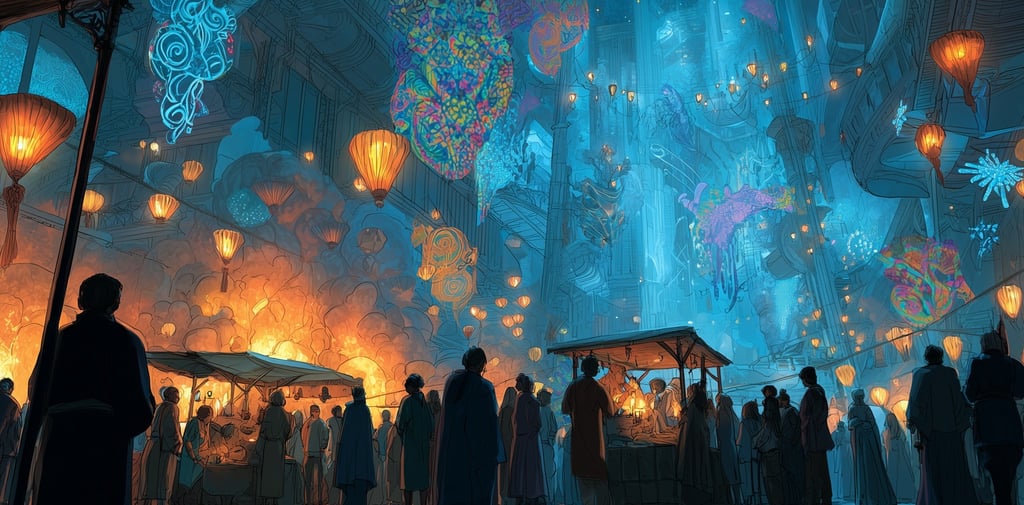
Imran and Geta handled the technology. Discreet projectors would cast children's drawings as holograms across the building facades surrounding the square—a snow-spirit drawn in crayon, a sea-creature from a mythology no one else in Neo-Kyoto had heard of, a dragon made of folded paper shapes. Augmented reality overlays through standard data-slates would surface the history behind each food stall, each pattern of cloth, each instrument. A tent in the shaded corner held several VR stations. Not games. Not escape. Short guided memory walks—a Korean village, a Bombay market—reconstructed from the elders' own recollections, described and designed by the people who'd actually been there. Evidence, Imran kept thinking. We're making evidence.
The Chronic officials came twice.
They arrived with careful questions and careful smiles and clipboards that noted everything. Elara appeared the second time. She walked the space slowly, professionally blank, pausing at each food stall and each tech installation with an expression of polite interest that masked something colder. The list of Community Harmony Guidelines attached to their permit approval had been Chronic's work. Everyone knew it. The guidelines were not hostile, exactly. They were precise. Designed to leave just enough room to comply and no room to breathe.
After Elara's visit, the community worked faster. Laughed louder. The defiant joy that took hold had a stubborn, almost physical weight to it. Imran watched it happen and didn't try to explain it. Some things ran beneath language.
***
The festival opened with the smell of Sook-ja's kimchi pancakes hitting hot oil.
It spread across the square before anyone had set up a single sign. People stopped mid-step. Turned. Came closer. The plaza—usually a stark, underused expanse of polished grey plasteel—was unrecognizable. Hand-woven streamers from a dozen aesthetic traditions moved between the minimalist light poles. The air was thick and layered: earthy corn cakes from a pre-Columbian time, spiced meat from a world that had run its caravans along a route nobody here called the Silk Road, fried dough sweet and sharp from a nineteenth-century European ghetto. A hundred languages rose and fell and crossed. Translation ran through community-managed audio relays, quiet and unobtrusive. Nothing Chronic had built.
People came. First a trickle, then a crowd, then something closer to a flood.
Imran walked through it slowly. His role as organizer had hollowed out, leaving something he didn't have a name for. He watched a girl from a sun-scorched desert time reach toward a holographic snow-spirit—a drawing by a quiet boy from a lost Norse saga world—and shriek with delighted laughter when her hand passed through it. He watched Sook-ja and Margaret bent together over a dumpling, their first attempt collapsing badly, both of them laughing anyway. He watched his father Omar, who had barely spoken in months, lean toward an elder from another time and begin to talk. The elder was listening. Omar's hands moved when he spoke. He hadn't done that in a long time.
Then Imran saw Lyra.
She stood near the edge of the square. Monochrome clothes, sleek and expensive, a small fashionable purse held close. She looked at the festival the way you might look at an interesting exhibit—curious, contained, at one remove. Her posture was perfect. Everything about her was curated and smooth, a figure from a different, shinier world. Their relationship had cooled in the year since his mother's death. Not a rupture—a drift. His grief and the work of building Needletip had left no room for the frictionless pleasantries they'd run on. He hadn't noticed the distance growing until it was already too wide to cross.
He walked over.
"Imran." Her smile was practiced, warm from the right distance. "This is quite a gathering."
"Thanks for coming."
"I was curious." Her eyes moved over the crowd with a cataloguing quality. "It's very rustic. Very authentic." She said authentic the way you might describe a deliberately distressed piece of furniture—an aesthetic choice, not a lived reality. "The engagement numbers on the social feeds are surprisingly high for an unsanctioned event."
"It's not about numbers," Imran said. No edge in it. Just a fact.
"Of course." The smile held. "It's a wonderful niche you've carved out. Very pro-social. I'm sure Chronic's auditors will note the improvement in your community engagement scores."
Imran looked at her. He thought of the man who would have been pleased by that. The man who would have taken it as validation, filed it away, tried to replicate it.
"The point isn't to get a better score from Chronic," he said quietly. "The point is to build a place where we don't need their scores."
The smile faltered. A small crack, quickly recovered. She looked at him—really looked—and something shifted. Not hostility. Recognition, maybe, of a distance that had become structural.
"You've changed, Imran."
"I hope so."
They stood for a moment. The music moved around them.
"Well." She checked her wrist-comm. "I have a reservation at Cyan. It was lovely to see what you've built." Her hand touched his arm—a light, fleeting pressure, a gesture from a different story. Then she turned and walked away, her silhouette dissolving into the glittering edge of a world she fit perfectly.
He watched her go.
No pull. Only a quiet sadness for the man he'd been—the man who would have followed.
He turned back.
***
Min-ji caught his eye from across the square. She nodded toward the stage.
He walked over. Stepped into the light.
The faces out there came from so many different times, different worlds—all gathered in this one small patch of salvaged city. He thought of his mother. Her last lesson. What she'd asked him to build.
"We wanted to create a space," he said. His voice carried without effort. "Where all our stories could be told, and all our stories could be heard. A place on the borderline—that belongs not to the past or the future, but to all of us who live in between."
He looked at Min-ji, at Thomas ready at the edge of the stage, at Margaret and Sook-ja standing together near the back.
"Welcome," he said. "Welcome to the Borderlands."
The applause was not the polite clapping of a corporate event. It was warm and unguarded. The sound of a community recognizing itself.
***
An hour later, the lights dimmed.
Lanterns—real flame and holographic both—drifted upward. The crowd went quiet in a way that felt collective, intentional. On the screens that had been showing children's art: portraits. Jamila Ahmed, her face calm, her eyes carrying something that Imran had needed years to understand. Yong-joon Kim, expression stoic, a faint suggestion of pride at the edge of his mouth. Other elders who had passed since arriving in this time, their names appearing beneath their images in native scripts—characters that most people here couldn't read, rendered anyway, because the point was not legibility but presence.
Thomas played from the edge of the stage. The melody was slow, unhurried. It held sorrow without collapsing into it. A thread of something else ran through—not resolution, not comfort exactly, but resilience. The sound of people who had learned to carry things.
Imran watched his mother's face shimmer in the soft light.
No sharp edges. Only something settled, deep in the chest.
When the last note faded, Min-ji guided Margaret and Sook-ja up to the stage. Her voice, when she spoke, had none of its usual combative edge—only a steady, unguarded warmth.
"Every community needs its foundation," she said. "We are blessed with the wisest, strongest, most stubborn women from two different centuries."
She presented each of them with a hand-woven shawl. Threads from dozens of traditions, dozens of pairs of hands. Margaret held hers against her chest and pressed her lips together. Sook-ja looked at the crowd with an expression she couldn't quite control.
The applause for them ran the longest.
***
The festival wound down gently. Families gathered sleeping children. Friends shared one last bite of food, made promises to come back. The goodbyes were easy, the kind that came from people who had somewhere to return to.
The square held the debris of the evening: discarded plates, fallen streamers, a child's holographic toy blinking softly in a corner where it had been forgotten. Happy wreckage.
Imran stood with Min-ji and Thomas near the stage. They didn't say much. They were too tired for it, and there wasn't much that needed saying.
Chronic was still out there. The future was still opaque. Tonight had not solved anything structural, had not dismantled anything Chronic had built. None of them were confused about that.
But the ground beneath Imran's feet felt different than it had. Solid in a way it hadn't been before. Made by their own hands. Claimed.
He looked up at the artificial sky—the fake stars that had so often felt like the glittering bars of a cage. He didn't feel that tonight. He wasn't looking up from the bottom of anything. He was standing on ground they had made sacred themselves, together, without asking permission.
He thought of his mother.
A shelter for others.
He had built it.
The past was quiet. The future was theirs.
***
Updates
Follow for the latest on my stories.
Fiction
contact@msrayed.com
© 2025. All rights reserved.
My Substack: https://msrayed.substack.com
My Patreon: https://www.patreon.com/cw/MSRayed