
The Sky Above, the Rivers Below, Ch 23: The Last Lesson
In her final moments, Jamila guides Imran away from escapism. As she passes peacefully, he vows to use his gifts to preserve human stories.
SERIALIZED FICTIONTHE SKY ABOVE, THE RIVERS BELOW
4/11/20268 min read

The beeping stopped. That was the first thing.
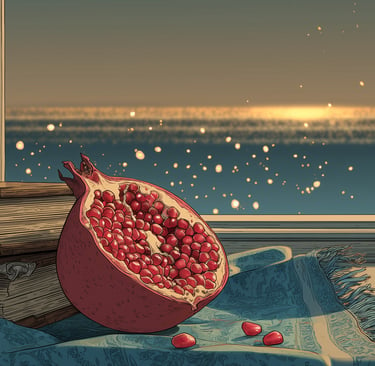
Imran had handled the transfer himself — forms, approvals, the grey-faced Chronic administrator who used the word compliance four times in a single sentence. He had signed everything and said nothing. The equipment followed her home. Monitors, dispensers, the low hum of the ventilation assist. But they stood against the far wall now, softened by distance. The sandalwood box sat on the shelf where it always had. The shawl hung over the chair. The window-screen showed Marine Drive at dusk — not the real one, not the drowned one, but the one she remembered, the sea flat and bronze and endless.
She watched Imran.
The slate was gone from his hands. The constant peripheral flicker of his attention — gone. He sat beside her bed and held her hand, and when she spoke, he looked at her face. Not past it. When she reached for the water glass he was already there. When her breathing roughened in the night he stirred in the chair without being asked, adjusted the pillow, went back to sleep in the same position, hand still resting near hers on the covers.
He read to her. Paper book, Urdu letters. His voice fumbled the meter sometimes, the way it had when he was eleven and she had made him practice at the kitchen table in Bombay, the ceiling fan stuttering overhead. He did not stop to correct himself. He read on.
He had started speaking Hindustani again. She had not asked him to. One morning it was simply there — the softer consonants, the older rhythms — as natural as breathing. She pressed her hand over his and said nothing.
The weakness in her was not a battle. She had stopped thinking of it as one. Her body was doing what bodies did, completing what it had started long ago in a different city under a different sky. There was a rightness to it. Not comfort, exactly. Rightness. Something as soft and worn as her oldest sari, the blue one with the fraying hem she had refused to throw away for forty years.
She watched the light from the fake sea move across the ceiling. She watched Imran's shoulders — the specific weight they carried, the way they curved slightly inward, the dark crescents under his eyes. She did not ask him to put it down. He would have to do that himself.
She observed the change in him the way she had always observed things: quietly, without announcement. The man who had moved through rooms like a live current, crackling with the restless forward motion of someone always leaving — that man was gone. This one sat still. This one could be in a room without needing to improve it, solve it, accelerate it. He had come back from Bombay different, and then her collapse had finished what Bombay had started, burned away whatever was left of the old restlessness. She did not say any of this aloud. She filed it away with the other things she had learned in her life about how people change — not when you push them, but when the world pushes first.
He was reading a ghazal by Ghalib when his voice broke.
It happened in the middle of a line. He stopped. She heard him draw one careful breath, then another. The shaking started in his hands, moved through his shoulders. He bowed his head, and a single tear landed on the back of her hand — hot, startling. She did not pull away.
"Ammi." A whisper. Barely that. "I'm sorry."
She said nothing. Let the silence hold him.
"I should have seen it. I heard you cough. I told myself it was nothing, that you were just worrying again, that you always worried." His voice cracked open. "I was in the studio for eighteen hours that day. Min-ji sent me three messages. I didn't read them. I was in the middle of a rendering pass and I told myself I'd look later, and then later came and went and —" He stopped. Pressed his forehead to her hand. "All those worlds. All that time. And I let this one fall apart. I let you fall apart. And I was right there. Right there."
He could not finish it.
She let him sit with it. The room was quiet. The fake sea moved its eternal tide across the screen.
"WorldWeaver is empty." His voice, when it came back, was flat. Wrung out. "I know that now. I stood in your room at the Chronic facility and I felt — nothing. All of it, everything I built, and I felt hollow. Min-ji said it was escapism. Chronic said it was escapism. I argued with both of them. I was wrong."
She waited until he raised his head. His eyes were raw. Ashamed.
"Imran." Her voice was weak. It was clear. "Look at me."
He looked.
"Your worlds were not empty because they were made of light and code." She paused. The breath cost something now — each long sentence a small expenditure she tracked carefully. "They were empty because you were hiding in them. Alone."
He started to speak. She raised one finger.
"The gift is not the sin. You were always going to build things. That is simply what you are." She found his hand again, held it. "The sin is the purpose. A world — real or invented — only holds meaning when someone else can enter it. When it eases something. When it carries something forward that would otherwise be lost." The ache behind her sternum. Not the medical kind. "You built a fortress. Beautiful, yes. But a fortress is always a prison. It does not matter what you put inside it."
"Ammi —"
"I'm not finished."
He closed his mouth.
"Think of it as a sword. A finely made one. It can cut through, or it can cut away. The weapon does not decide. The hand decides." Her grip, what was left of it, tightened on his. "Use your gift to shelter others. Not to shelter yourself. That is all I am asking. That is everything I am asking." She looked at him steadily. "Do you understand, beta?"
He did not speak for a long moment. He looked at their joined hands. Then he pressed his forehead down against them — a slow, deliberate movement, the gesture of someone receiving something they know they did not earn.
When he raised his face, the guilt was still there. It would be for some time. But underneath it — something else. Something younger. Something that had not been in his face a month ago.
She recognized it. She had been waiting for it.
The quiet that followed was a different kind of quiet. The storm side of the silence and the calm side of it. She lay back against the pillow and let herself rest in it.
Later — the same afternoon, or a different one; she had stopped tracking — she asked him about Needletip.
"Tell me what you are building there. Sook-ja has told me a little. I want to hear it from you."
He looked surprised. He started slowly, choosing words with care. Then the carefulness fell away.
He told her about the girl from the war years. Nine years old, silent for three years — no pathology, just refusal. She had spent four hours in the VR suite one afternoon rebuilding a cat. Grey fur, the precise angle of the ears, the way it slept curled against a radiator. She had matched the texture three times until she was satisfied. When she came out, she still hadn't spoken. But she had smiled, and it had been enough, and the following Tuesday she had come back.
He told her about Thomas Shepard's music. How it moved underneath the elders' recorded testimonies, under the cracked-voice memories of people who had lived through things that had no name yet. How the music did not explain or translate but simply held the words — the way water holds sediment in suspension. How one of the women had stopped mid-sentence during a session, listening to what Shepard had made of her own voice, and said quietly: that's what it sounded like inside.
He told her about Min-ji's language archive. Forty-three languages. The last speakers of some of them had died before the archive was finished. What remained was fragments, recordings, a grandmother in 2031 speaking into a phone without knowing why. Min-ji had built a system to reconstruct grammar from surviving samples. To make something learnable from something nearly gone.
Jamila listened. Her hands were still in her lap. She watched his face — the way the exhaustion was still there but the passion moved underneath it like current under ice, warming the surface from below.
She reached out and touched his cheek. He stilled.
"The path you walk now," she said. "It is a good one. It is an honorable one." She held his gaze. "Do not let Chronic turn you from it. Do not let your own doubts turn you from it." A breath. "Your father would be so proud."
She let her hand fall.
"And I am proud of you, Imran. I am very proud."
He could not speak. She had not expected him to. She closed her eyes.
***
That night she dreamed of Bombay.
Not the archived version. Not the scan that Chronic had presented to her like a gift, all color-corrected and emotionless. The real memory of it — imperfect and warm, the edges fraying the way memories did, the way they were supposed to. The streets smelled of rain and exhaust and something frying in oil two windows above. The pavement was hot. Her feet knew it. She ran barefoot the way she had run as a girl, laughing at nothing in particular, at the plain fact of being alive and unencumbered in a city that smelled like itself.
Her grandmother came out of the house.
Small, unhurried. Silver hair, oiled. She was holding a pomegranate — bright red, freshly cut, the seeds catching light. She held it out.
"I'm sorry, Ammi," Jamila said.
Her grandmother tilted her head. "For what, beta?"
"For what we lost. The names. The stories." The weight of it settled in her chest. "I tried to hold them. They slipped anyway. So many of them just — gone."
Her grandmother crossed the distance between them without hurry. She took Jamila's hands and placed the pomegranate in them, folding her fingers closed. The fruit was cool. The juice, where it ran, was startling red against her palms.
"You were given a gift," her grandmother said. "A powerful one. But power without purpose is only weight." She pressed Jamila's hands tighter. "Your purpose was lost for a while. Now it has been found. That is not failure, daughter. That is simply the journey. That is what the journey is for."
She leaned forward and kissed her forehead.
"Some seeds fall away," she said. "You will not find them again. But the ones being carried — the ones still in your hands — those can be planted. Those can feed whoever comes after."
A breeze came in from the ocean. Jamila closed her eyes.
The salt smell filled her lungs. The sound of the water.
She did not open her eyes again.
***
Imran woke to a chime.
Not an alarm. Something gentler — the bio-monitor registering the end of something, a quiet bureaucratic notation. He had been dozing in the chair with her hand still in his. He looked at her face. He sat with her for a long time without moving.
The grief was vast. He had known it would be. But it was the clean kind — the kind that comes when nothing has been left unfinished, when everything necessary was said and heard. He checked for the guilt that had lived in him for months like a stone in a clenched fist. It was not there. He checked again.
Gone.
He bathed her face with a soft cloth. He whispered the prayers she had taught him — the ones he had not said in years, that came back now word by word without effort, as if they had been waiting for exactly this use. He called Sook-ja. He called Margaret. They arrived quickly and said very little, which was what he needed.
When the Chronic officials finished their work, he stood alone in the apartment.
He walked to the window-screen. He did not change it. He stood in the bronze light of the city she had chosen — Marine Drive at dusk, the sea she had loved and lost and remembered — and he looked out at the real skyline beyond it. Neo-Kyoto, indifferent, vast, bright with the cold purposeful light of a city that did not care about any one life.
He looked at both of them at once. The city she remembered overlaid on the city that was. The past held in the light of the present.
He had work to do.
Not a project. Not a venture. A promise, made to someone who could no longer ask him to keep it — which was the only kind of promise that truly held.
He was still a builder of worlds. He knew which one mattered now.
He turned off the screen. He turned away. He went to do what needed doing.
Updates
Follow for the latest on my stories.
Fiction
contact@msrayed.com
© 2025. All rights reserved.
My Substack: https://msrayed.substack.com
My Patreon: https://www.patreon.com/cw/MSRayed