
The Sky Above, the Rivers Below, Ch 22: Coming Together
Thomas finds his true purpose at Needletip, using his music to heal the fading memories of temporal refugees and confront his own fractured past.
SERIALIZED FICTIONTHE SKY ABOVE, THE RIVERS BELOW
3/29/20268 min read
Chronic had offered Thomas therapy, assimilation modules, and polite, clinical judgment. Min-ji and Imran offered him a broken-down community space, a box of discarded VR headsets, and, for the first time in months, a reason to open the lute case.
The synth-lute had sat untouched since the Arts Council rejection. Since the dismissal. He would look at it sometimes—the latches dull under the apartment's cold light—and feel nothing but the familiar weight of having been found wanting. The city outside the window was glass and promise and not for him. He was adrift in it. He had been adrift for a long time.
The message came on his personal slate. Not a Chronic channel. A direct line, person to person, from Min-ji Kim—though the phrasing carried two voices clearly.
"Thomas. Imran and I have started something. A small, independent space in the lower commercial district. For people like us. The kids who are lost. The elders being forgotten. We're trying to use Imran's tech to help people tell their stories, to save their languages. But it's missing something. It's missing music."
He read it twice. Something shifted in his chest. An unfamiliar lurch.
"We remember how you worked with the younger children. We saw how your music reached them when nothing else could. We don't have an official title or a Chronic-approved salary. But we have a space, and we have a need. We need someone to lead the creative arts. Someone to help these kids find a voice for their stories. We need a storyteller. We need a musician. We need you."
No bureaucratic jargon. No facilitation role, no mentorship framework. Just the ask.
Caution came first. It always did—a reflex worn into him by years of quiet rejection, by the sneering boys at school, by the Arts Council's measured dismissal, by Lyra's word: appropriation. He sat with the message for a long moment. Why would this be different?
But it was Min-ji. It was Imran. His peers. His fellow in-betweeners. The only people, besides his mother, who had ever glimpsed the complicated map of what he actually was.
That evening, Margaret brought it up herself. Her tone was different now. The anxious hovering was gone. Something steadier had taken its place—he had noticed it growing in her since Virginia.
"I spoke with Sook-ja Kim today," she said, pouring them both tea. "She told me of the offer." She looked at him. "It is a good offer, Thomas. A real one."
"They don't know what they're asking for," he said. "My name. My history. It will cause them trouble."
"Perhaps," Margaret said. "Or perhaps their project is strong enough to withstand a little trouble." She wrapped both hands around her cup. "For years I encouraged you to be quiet, to be careful, to not draw attention. That was my fear speaking. Not my wisdom. I made you carry it. I'm sorry for that." She paused. "But this feels like a chance to build something, Thomas. Not just to survive."
He stared into his tea.
The next morning, fingers unsteady, he typed his reply. A single word.
"When?"
* * *
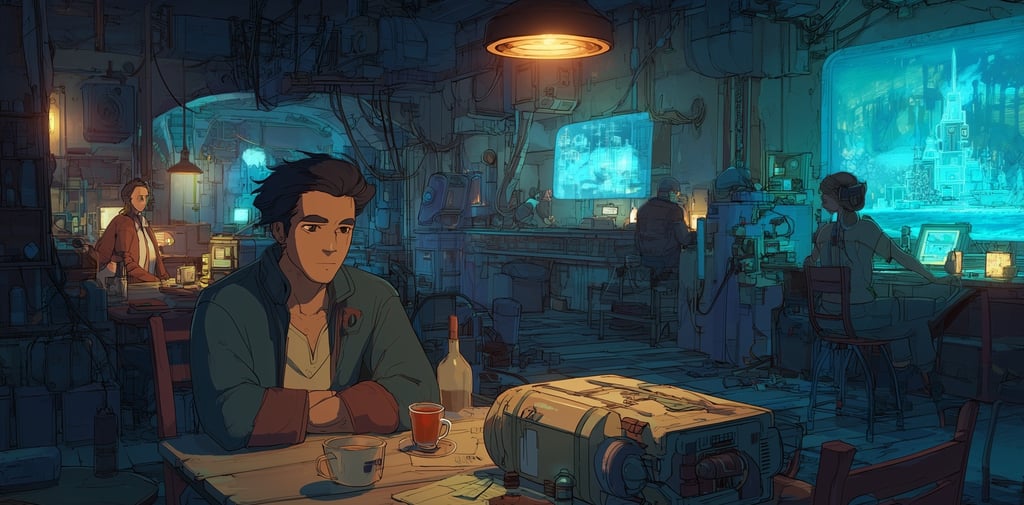
The community space was everything Chronic's facilities were not. Chaotic. Grimy in places. Alive in a way that had nothing to do with clean surfaces or approved programming. The air smelled of Sook-ja's barley tea, of Imran's repurposed tech, of a dozen home-world spices clinging to the clothes of people who had carried those smells a very long way.
Thomas's first sessions were with the children.
A silent girl whose village had been erased by a temporal paradox. A boy who flinched at loud sounds—arrived from a war-torn future, they said, though no one pressed him on it. A pair of siblings who spoke a clicking, complex language that Chronic's translators kept mangling. They watched him the way children watch any new adult: wary, waiting for the thing that would disappoint them.
He took out the synth-lute.
He learned fast that his own compositions weren't the point. He watched instead. As Min-ji or Imran helped a child navigate the VR interface—building a house, a pet, a creature from a grandparent's story—Thomas let his fingers move. Tentative. Listening. He read the emotional tone of what they made: the flickering light of something remembered, the careful architecture of something grieved.
For the girl who built a ghostly image of her village—each building exact, each detail precise, the whole thing luminous and impossibly still—he found a melody. Gentle. Mournful at its base, but threaded through with warmth that refused to leave. He didn't resolve it. He let it breathe.
She looked up at him.
First time she'd looked at anyone.
For the boy who built a silent, protective forest around his avatar—no sound in it, no wind, just trees—Thomas composed something that sounded like leaves and distance. Safety without drama. He played it softly. The boy's shoulders dropped. He didn't speak. He didn't need to.
Thomas began to think of it as story-soundtracks. A translation of what the children were making, the silent emotional language of their digital work, into something that could be shared, heard, felt from across a room.
Sook-ja came to him a few weeks in, after a session. She sat beside him while he repacked the lute. "Their memories are fading, Thomas-ssi," she said. "Chronic records the facts. The dates and the events. But not the feeling of a place. The sound of a grandmother's voice singing. The rhythm of a harvest song. That is what is being lost."
He started meeting with the elders.
An old man from a time of nomadic sky-farers. The man's voice cracked when he talked about sailing on solar winds—the sensation of weightlessness, the particular cold of deep space through a hull. Thomas sat with him for hours, listening. He didn't try to notate what he heard. He just listened. Then he went home and played. The melody he found was airy. Soaring. It caught something of what the man's eyes did when he talked about starlight.
The next session, Thomas played it for him.
The old man was quiet for a long time. Then he said, simply: "Yes."
* * *
They called the space Needletip.
Thomas stopped thinking of it as a project. It was where he went. The place he was most himself—or closest to it. Here, surrounded by people whose pasts were as fractured and complicated as his own, the specific weight of his family history felt less singular. Less like a sentence. He listened to stories of famine, of escape from oppressive governments, of entire worlds swallowed by time paradoxes. Everyone carried ghosts. He had simply been carrying his alone.
The idea came to him slowly. Over weeks. A quiet, uncomfortable melody forming somewhere behind his ribs.
He found Min-ji one evening, after the center had emptied out. She was cross-referencing a folk tale on her slate. He stood at the edge of the table until she looked up.
"I want to compose something," he said. "About Willow Creek. About the South." He stopped. Tried again. "Not just my family's story. The other story. The one that was silenced."
Min-ji studied him. The old version of her—the one from the early days, bristled and guarded—might have challenged him immediately. This version just held his gaze.
"That's a difficult path," she said.
"I know." He looked at his hands. "I've been researching the music of the enslaved people from my time. Work songs, spirituals. There's so much pain in them. But so much strength. I want to build something around that. An acknowledgment. A sad song."
She was quiet for a moment. Then she nodded and set down the slate.
"Show me what you have."
They worked on it for weeks. Min-ji pulled real historical accounts from Chronic's deeper archives—first-person testimonies, abolitionist writings, economic data on the machinery of the system his family had profited from. She read them to him without editorial. Just the facts, in the voices they were written. Thomas listened the way he listened to the elders. Without trying to fix anything.
The piece he built was nothing like his usual work.
It opened with a parlor minuet. Stately. Elegant. The music of the great house, every note polished. Then, by degrees, it began to fray. A harmonic tension crept in, slow enough to be mistaken for natural variation. Then the melody broke apart entirely. From its wreckage, something new surfaced—a theme built around the pentatonic scales of a spiritual he had found in the archives. Mournful at its core. Layered, as he worked through it, with the rhythm of repetitive labor, the texture of whispered prayer, a thread of something that refused to be extinguished.
It ended on a single sustained note. Not a resolution. A question held open.
* * *
He played it at one of Needletip's weekly gatherings.
He explained it first. His voice went unsteady once, explaining what he had tried to do, and he steadied it by looking at the lute in his hands rather than the room. Then he played.
When the last note faded, he kept his eyes closed.
Silence. Long enough to be uncomfortable.
He opened his eyes.
The old man who had escaped a labor camp in a dystopian future was in the front row. He nodded once, slowly. A single tear traced his cheek. He didn't wipe it.
Lyra was there—the woman who had said appropriation, who had looked at him with that particular kind of contempt. She was looking at him now with something harder to name. Not hostility. Not warmth. Something grudging and genuine.
He had braced for judgment. What he found was something quieter: the specific silence of people who recognized a difficult thing being done carefully.
He sat down. Someone pressed a cup of tea into his hands. He held it.
* * *
The weeks after that settled into a different rhythm.
The awkwardness that had lived in the space between Thomas and Min-ji, and between both of them and Imran, dissolved so gradually he didn't notice it was gone until one late night when he caught himself laughing—genuinely, without the careful half-second of self-monitoring beforehand—at something Imran had said. It was a small thing. He noticed it anyway.
The three of them had become the architecture of Needletip without planning it. Min-ji drove the ethics of it, the rigor, the why. Imran built the systems, the tools, the how. Thomas had become something harder to name: the emotional register of the place, the thread that ran between the children and the elders and the technology and the grief.
Late nights became their shared rhythm. The days were for the community. The nights were for them—the quiet work, the running inventory of what needed doing, the easy silences between people who had stopped needing to explain themselves.
One such night, Thomas paused in his work and looked at the room.
Children's digital drawings looped on one wall. Remembered homes, fantastical creatures, a house with no roof that a girl had rebuilt seven times until the walls were exactly right. His own music played softly from the speakers—a looping melody he'd written for a storytelling session three weeks ago, which Sook-ja had quietly set to play on a timer each evening. He hadn't known about that until tonight.
Imran was at his console, face lit by the screen, helping someone fix a glitch in an oral history recording. A small, focused smile on his face.
Min-ji was surrounded by data-slates, cross-referencing a folk tale with the particular intensity she brought to everything, her pen moving in short, decisive marks.
Thomas looked at it all for a moment. Then he went back to work.
Updates
Follow for the latest on my stories.
Fiction
contact@msrayed.com
© 2025. All rights reserved.
My Substack: https://msrayed.substack.com
My Patreon: https://www.patreon.com/cw/MSRayed