
The Sky Above, the Rivers Below, Ch 21: Hybrid Realities
Min-ji and Imran build a hidden, underground VR sanctuary, empowering refugees from across time to heal and preserve their endangered languages.
SERIALIZED FICTIONTHE SKY ABOVE, THE RIVERS BELOW
3/15/20267 min read
Imran’s message arrived in twelve words: Min-ji, I was wrong. My worlds are empty. Can you help me build something real?
She read it twice. Set her slate face-down on the desk.
The funding notice sat beside it. Official letterhead. “Programmatic restructuring.” “Synergistic alignment.” She had read those phrases three times already, each pass tightening her jaw a fraction more. Two years of grant applications. Fourteen speakers fluent in dialects that had fewer living voices every season. Gone. A bureaucratic silencing so polite it almost made it worse.
Her mother had surprised her the night before. No worried pleas, no measured advice about caution. Sook-ja had simply sat across from her at the kitchen table, hands folded, gaze clear and level. “When a powerful lord seals one door,” she said, “a wise person stops knocking. They build their own.”
She picked up the slate. Read the message again.
The weaver of dreams, she thought. Coming to me now that his own reality has crumbled.
She typed: Where?
***
He was already there when she arrived. Same corner table. Same coffee shop near the university - neutral ground, far from the corporate glass of his downtown towers. But the man in that chair was not the one she remembered. The restless, unearned confidence was gone. The easy dominance of someone used to every room bending toward him. He looked tired in a way that had nothing to do with sleep. The shadows under his eyes spoke of nights spent with things too real to ignore.
“Thank you for coming,” he said.
“Your message was unexpected.”
“I imagine.” He looked at his hands, then at her. For the first time in years she saw not the CEO, not the symbol she’d been arguing against in lecture halls and op-eds, but the quiet, serious boy from the schoolyard. The one who used to listen. “My mother is very ill. The trip back to Bombay - ” He stopped. Exhaled. “You were right, Min-ji. About most of it. WorldWeaver is an escape. I built it because I needed one. But it doesn’t help. Not in the ways that actually matter.”
She had come prepared. Sharp arguments, each one sharpened over days of frustration and drafts and second-guessing. They dissolved.
“I’m sorry about your mother,” she said. “Truly.”
A flicker crossed his face. Tired and grateful in equal measure. “And I’m sorry about your program. The cuts.” He leaned forward. Hands flat on the table. A new urgency in his voice. “That’s why I messaged you. I have a platform. Powerful. But I have no purpose for it anymore. I don’t want to build empty worlds. I want to build something real. I don’t know how.” He paused. “But I think you do.”
The skeptic in her was still watching. Measuring. Noting the timing, the convenience, the personal disasters that had preceded this conversion. But the woman who’d just had her tools stripped away was listening to something else entirely.
She said, “Tell me what you’re thinking.”
***
The conversation took two hours. The synth-coffee went cold.
He spoke about Bombay - the specific dislocation of returning to a home that had reorganized itself around your absence. His mother’s face. The things she could and couldn’t say anymore. The hollowness at the center of a company whose only real product was forgetting.
Min-ji spoke about Chronic’s preferred method of ending things - not confrontation, not argument, just paperwork and budget realignment. The quiet efficiency of it. She spoke about her students. About the fourteen speakers. About fighting battles that no one in this advanced, comfortable future seemed to notice were battles at all.
“How did we stop talking to each other?” he asked. He wasn’t performing the question. His face was open, without defense.
“You got big,” she said. “And busy. I thought you’d forgotten.”
“I did,” he admitted. “I didn’t understand what the consequences would be. For my mother. For you.”
“You helped people, Imran. I read the stories. It wasn’t all hollow.”
“You helped more. Your students, the refugees, the ones who couldn’t afford WorldWeaver - they had a seat at your table. I built something exclusive and called it liberation.”
She didn’t argue with that. “We can’t save everyone. That doesn’t make what you built worthless. It means something that you came here.”
He was quiet a moment. “Does it mean you’ll work with me?”
“Yes.” She met his eyes. “On one condition. We build something where no one gets left behind.”
“Yes.” No hesitation. “Show me how.”
***
The ideas came fast once they started.
Her language program - dead on paper - could live virtually. An immersive reconstruction: a Joseon village, a 17th-century Bombay market, a space where endangered dialects existed not as archived recordings but as living speech you could walk through. His AI could serve as a conversational partner, fluent in any dialect they could feed it data on. The remaining human speakers, scattered across timelines, could meet in a shared virtual space. No travel costs. No physical limitations.
“Mental health,” she said. “The older generations especially. Too much shame, too much learned silence.”
“Guided scenarios,” he said, already writing. “Private. Single-user. A person builds their trauma into a story - creates an avatar for their fear, an obstacle for their loss - and then confronts it within the narrative. Not therapy. Not public disclosure. Just them, and the story they needed to tell.”
“And archives. Living ones. Not Chronic’s filtered version - the recipes, the lullabies, the specific inflection of a particular village’s story. A Memory Palace. User-generated. Unsanitized.”
He looked up from his slate. Something had shifted in his face. The hollowness was still there. It wouldn’t leave that quickly. But behind it, something reorienting. The old focus, pointed at something new.
The technology isn’t inherently anything, she thought. It’s a tool. And right now, no one is watching this corner of the coffee shop.
For the first time in years, she didn’t see a cage. She saw the material.
***
The wall appeared the following week.
Ideas needed space. Space cost credits. Credits required applications, approvals, formal alignment with strategic integration goals. They drafted a proposal. She knew before sending it what the reply would be.
That evening she went to her mother’s apartment. Only intended to complain. She found Sook-ja sitting with Margaret Shepard - tea on the table, a quiet ease between two women from centuries apart that still startled her every time.
She laid out the problem. The full picture. “Chronic owns all the ground,” she finished.
Margaret set her cup down with a quiet click. Looked at Sook-ja. Something moved between them - an agreement already reached. Then she turned to Min-ji. “Then we shall get our own ground.” Her voice was calm. The authority behind it was not.
What followed moved faster than Min-ji expected. Margaret moved through the family’s long-dormant financial assets with the precision of someone who had spent decades not touching them and knew exactly what they were worth. She leased a commercial space in one of the lower-level cross-temporal districts - off-grid, overlooked, forgotten by Chronic’s appetite for anything profitable. A large empty room. A few smaller offices. Unfashionable. Unmonitored.
Sook-ja filled it. She went to the network she’d built over years - elders, artisans, recently arrived families - through shared meals and quiet commiserations. She brought in parents struggling to keep their children’s first language alive. She enlisted older women who still held the heritage dialects in their mouths. What Min-ji and Imran had designed over cold synth-coffee, this quiet coalition was now making possible on the ground.
***
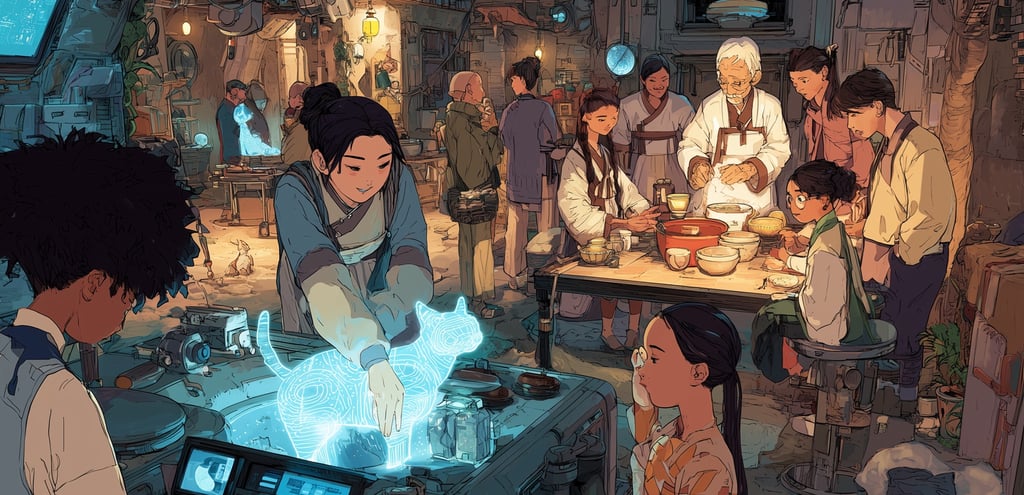
The first Story Circle met on a Tuesday afternoon. Twelve children from six different centuries.
Imran had repurposed several WorldWeaver headsets with a simplified interface - muted colors, soft lighting, a circular virtual room with the quality of a held breath. In the center, holographic images floated beside their words.
A small girl sat at the edge of the group. She hadn’t spoken since arriving. Min-ji had read her file - a war-torn 19th-century Eastern European timeline, a kind of displacement that left marks no language could quite reach. The girl reached out and touched a glowing holographic cat. An elderly volunteer - from the same ruined century - leaned close and whispered the word for it in their shared native tongue. The girl repeated it. A soft sound, barely there.
Then, using the interface Imran had built, she summoned her own image. Not the hologram. Hers. A cat from memory, still alive in the shapes she could give it.
A slow smile crossed her face. Something unguarded, ungoverned.
Across the room, other children were doing the same. Pairing the words they’d carried across time with light they could shape. Building small bridges between who they’d been and where they now stood.
Min-ji did not cry. But it was close.
***
Word spread the way it always does in migrant districts - not through newsfeeds, but through the older, more reliable channels. Mothers at the nutrient markets. Elders over tea.
Within a month the numbers had tripled. Teenagers came, sullen and curious. They found the VR interfaces and made fragmented, visceral poems about feeling untranslatable. Adults came to record family histories - recipes, songs, the specific sound of a grandmother’s voice saying a particular word - before those things faded out of living memory entirely. The empty room became loud. A controlled chaos of languages and needs and people discovering, sometimes visibly surprised, that there was somewhere that made room for them.
Min-ji found herself at the center of it, not by design but by necessity. She was no longer just the theorist with the sharp tongue, the academic whose expertise was critique. She was mediating between a woman from a strict patriarchal century and a teenager from a post-gender anarchist one. Applying principles she’d only ever argued about in lecture halls, watching them bend and buckle against real, awkward, unpredictable human situations. Her knowledge had left the page. It was getting its hands dirty. She discovered she didn’t mind.
Her relationship with Imran shifted inside the noise of it. The old friction - her suspicion, his defensiveness - had no space to breathe in a room this busy. She watched him sit with a small boy for forty minutes, patient, methodical, adjusting the interface until the boy could render his imagined creature correctly. She saw the way he listened to half-formed emotional requests and turned them into functional code. He stopped defending his past choices to her. He started asking questions instead.
***
One evening she stood in the doorway and just looked.
Imran in the corner, troubleshooting a headset for a laughing boy. Sook-ja at the center table, serving barley tea to a group of elders from three different centuries, their translated conversation a mix of complaints and laughter that needed no translation at all. Thomas Shepard near the back, synth-lute in his lap, helping a cluster of teenagers set their fragmented stories to something quiet and strange.
A dozen languages in the air. Ancient ones. Future ones. Ones that had almost stopped existing.
Min-ji was not fully of Joseon. Not fully of this particular future. She was this - this specific noise, this mess of what had been lost and what was being, slowly, carefully, rebuilt. Not clean. Not approved. Not cost-effective.
Hers.
She looked across the room at her mother’s face - animated, laughing at something one of the elders had said - and felt something settle in her chest. Not triumph. Not resolution.
Just the quiet, startling certainty of being exactly where she was supposed to be.
Updates
Follow for the latest on my stories.
Fiction
contact@msrayed.com
© 2025. All rights reserved.
My Substack: https://msrayed.substack.com
My Patreon: https://www.patreon.com/cw/MSRayed