
The Sky Above, the Rivers Below, Ch 20: Generational Reckoning
Margaret sheds her lifelong guilt, uniting with Sook-ja to defy the oppressive Chronic system and fund a rebellious foundation for their children.
SERIALIZED FICTIONTHE SKY ABOVE, THE RIVERS BELOW
3/1/20267 min read
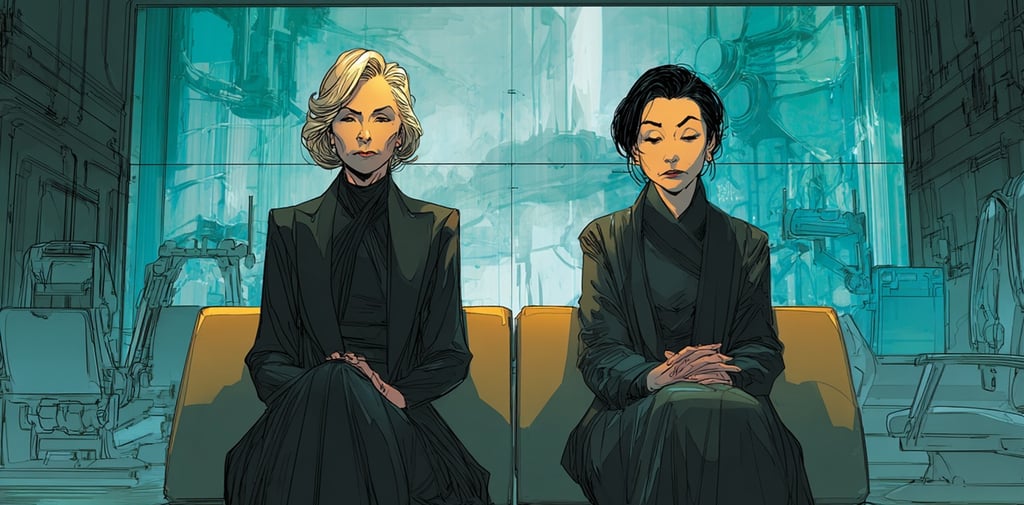
The guilt had been Margaret's oldest companion. Fifteen years, never once leaving her side. The anger was something else entirely - new, clean, cold, arriving without warning as she sat in the waiting lounge of the Chronic Health Nexus and listened to Sook-ja describe what they had done to Min-ji's program.
She hadn't expected fury. She hadn't known she still had room for it.
The lounge was designed for contemplation: low light, soft materials, a large pane of smart-glass that looked in on the recovery suite where Jamila lay surrounded by machines that blinked steadily in the silence. A beautifully decorated tomb. Imran sat beside his mother's bed, pale as paper, barely moving. He'd returned from Bombay like a man already half-haunted. Margaret and Sook-ja had kept watch here for two days - not because anyone had asked them to, but because the world had streamlined away every other ritual of comfort, and this was all that remained.
"They did not even call it a punishment, Margaret-ssi." Sook-ja's hands lay still in her lap, folded over dark fabric. Her voice was measured, careful, but the pain beneath it ran deep. "They called it 'programmatic restructuring for synergistic alignment with university-wide strategic goals.'" A pause. "So many fine words. Just to say they are silencing my daughter."
Margaret said nothing. She watched Sook-ja's jaw, the rigid set of it.
The Heritage Language Program had been years of Min-ji's life. Gutted by the budget committee in a single meeting, the timing so precise, so obviously retaliatory, that the bureaucratic language was almost impressive in its cruelty. An insult dressed in the vocabulary of institutional care.
Margaret's own return to Virginia sat in her chest like a stone. Willow Creek. Magnolias in bloom over a world that had never once questioned itself. Aunt Eleanor, dying and still unreformed, rigid to the last. The dinner at the Carters', the open accusations - corrupted by foreign notions, by strange influences - delivered by people who had known her since childhood. She had stood there and taken it. Had seen herself in their faces and not recognized the woman they described.
Not belonged there. Not belonged here. A ghost, haunting the edges of a life she could no longer lead.
We all went back seeking something. Her hands clenched in her lap, a small, tight gesture. Clarity. Connection. Closure. And all we found was proof.
The bitterness of it was almost elegant. Sook-ja's Joseon - mourned for its simplicity, its tradition - had turned on Min-ji's complex, brilliant future. Margaret's Virginia - fled for its moral rot - had rejected her present-day, hard-won conscience. And Jamila's Bombay, the home she ached for, had sent back a verdict through the mouth of her own sister: traitor. Stranger. Excluded.
We have no home back there. The thought arrived with the finality of a door closing. Not anymore.
She looked at Sook-ja. The quiet dignity in the set of that jaw. The profound sadness held behind composed eyes. This woman, from a world utterly unlike her own, whose ancestors had known entirely different hardships and different graces, was the closest friend Margaret had in this bewildering future. Not because of shared customs or shared language. Because of shared children. Shared sleeplessness. Shared dread. They were matriarchs of fallen kingdoms, and they were huddled together in a sterile waiting room that had no real use for either of them.
The familiar weight of her guilt began to feel different.
"Thomas," Margaret said. The words came out tight, sharper than she intended. "They dismissed him from his mentorship role. 'Restructuring.' The timing - just after our return - was precise." She watched Sook-ja's expression. "A 'problematic historical profile,' they said. No longer a suitable influence for newly arrived children."
Sook-ja turned to her, dark eyes sharp. "So they punish all of them."
"All of them."
"Min-ji, for her defiance. Your Thomas, for his history." Sook-ja's voice had shed its softness. "And Imran - Jamila told me, before she fell so ill. Chronic has 'concerns' about his dream-worlds. They call his creation isolating."
"Isolating." Margaret tasted the word. "Divisive. Unsuitable." Poison, all of it. "They have a label for any child who refuses their mold. They are being punished for their mixed identities. For daring to be the complicated, messy, brilliant people they are, instead of the neat success stories Chronic wants to write."
That was when it happened. The shift.
Fifteen years of guilt - the burden of her ancestors, the weapon Elara and her kind had wielded with such expertise - began to change. In the humming, sterile air of the Health Nexus, it curdled. Hardened. Became something with edges.
For what? The voice in her head was new, and it did not apologize. What did the quiet obedience buy? The de-assimilation rules followed to the letter. The condescending sensitivity trainings endured. Thomas told to soften his accent, not speak of their past, to shrink, to blend, to disappear. And what did it earn him?
He was still the boy from the slaveholding timeline. Still judged everywhere, belonging nowhere. Still shrinking.
My silence has not protected him. It has only taught him to be ashamed.
She looked at Sook-ja. "For years," she said, and something in her voice had changed - a new register, harder, cleaner - "I have let Chronic define the terms of my repentance. Let Elara define them. I have tried to be the person they wanted: the regretful historical relic, grateful for their enlightened guidance. Quiet, unnoticed, obedient." A sharp shake of her head. "That ends."
Sook-ja studied her. "They hold the power, Margaret-ssi. They control everything."
"They control the official channels." Margaret's mind, so long clouded, felt suddenly, startlingly clear. "The funding. The positions. The public story. They do not control us. They do not control our homes, our hearts, our minds." She thought of the Shepard family money - wealth she had always kept at arm's length, ashamed of its origins. A fortune she'd preserved as penitence, never once weaponizing it for anything good. "My atonement will not be defined by them. Not anymore."
Sook-ja waited.
"Think of what they've taken." Margaret leaned forward, her voice dropping, charged. "From Min-ji - her platform. Her program for saving the very languages Chronic claims to respect. From Thomas - his one small chance to reach other lost children through his music. From Imran - they are trying to gut the soul out of his creation, turn his worlds into another tool for their auditors." She watched the understanding move across Sook-ja's face. "Chronic wants them separate. Isolated. Easier to manage. They want Min-ji to be the angry activist, Thomas the guilty artist, Imran the irresponsible escapist. Neat little boxes. Neat little labels."
A pause.
"What if we refuse to let them?"
Sook-ja's expression was still, measuring. The woman had survived Joseon, displacement, widowhood, and fifteen years of this alien world - all with an unbreakable quiet about her. She knew how to build community from nothing but shared need and stubborn hope. She knew how to stretch a single measure of rice, how to weave strength from shared sorrows. A builder of people.
And Margaret - Margaret understood power. She understood money, influence, the art of constructing something that appeared respectable to those in authority while quietly undermining them. She had learned it in the drawing-rooms of Virginia, in the cold math of managing a vast and monstrous estate. She had always felt ashamed of that knowledge. Now, sitting in this humming sterile room, it felt like a tool.
"Combine what we have," she said. "Your wisdom, your resilience - my resources. An independent foundation. Small. Outside Chronic's oversight. We fund Min-ji's language work. We give Thomas a space to teach music, to build the mentorship they stripped from him. We support Imran's worlds - on his terms, not their auditors'." She met Sook-ja's eyes. "We stop trying to survive inside Chronic's system. We build our own."
The idea hung in the air between them.
For a long moment, Sook-ja said nothing. Then - slowly, almost imperceptibly - a nod. And something appeared in her eyes that had been absent for a long time. Not peace. Not certainty. A spark. The specific, stubborn light of a woman who has decided to fight.
"A foundation," Sook-ja murmured. "For our children."
***
Margaret returned to her apartment that evening to find Thomas as she had left him: still, quiet, his synth-lute untouched at his side. In other years, she would have approached him with soft words about perseverance. Hollow comfort. Her own helplessness dressed as kindness.
Tonight was different.
She sat beside him without crowding him. Waited. When he finally looked up, his eyes flat with exhaustion, she did not offer sympathy.
"Chronic has decided your mentorship is no longer a budgetary priority," she said. Her voice was steady - no tremor, no apology. "Their priorities are not ours."
A flicker in his eyes. Confusion. Interest, just barely.
"That composition - Echoes of Liberation." She pressed on. "The piece they ignored because of our name. I want you to expand it. I want you to build the multimedia project you proposed to them, the one they wouldn't fund. And I want you to create your own mentorship program - independent, free from Chronic's oversight. For any temporal migrant child who wants to learn storytelling and music. For any child who needs someone who understands what it is to not belong."
Thomas stared at her. "Mother, that would require - "
"A fortune. I know." She met his gaze without blinking. "The Shepard money has caused enough suffering in one world and in the last. It is time it was used to build something of beauty. Something that honors memory instead of erasing it." A pause. "This is not a gift, Thomas. It is an investment. In you, in your art, in the idea that we can build something of our own. I will be your first patron."
The silence stretched. Then - slowly, like the first light after a very long night - something shifted in his face. A spark she hadn't seen in weeks. He was speechless, but his hands moved almost unconsciously toward the synth-lute.
She left him to it.
At her personal console, she composed a message to Sook-ja. Short, simple:
I have spoken with Thomas. The first stone has been laid. Jamila will need our strength, and our children will need our support. We will be their foundation.
She sent it.
The act was small. It felt enormous. More defiant than anything she had done in fifteen years of careful, compliant atonement.
The familiar shadow of her past remained - she had never imagined it would leave. But it no longer felt like a chain. It felt like ballast. Grim knowledge. Unexpected weight that could, if she chose, become strength.
The reckoning was done. She was no longer a woman defined by what her ancestors had done.
She was a founder.
Updates
Follow for the latest on my stories.
Fiction
contact@msrayed.com
© 2025. All rights reserved.
My Substack: https://msrayed.substack.com
My Patreon: https://www.patreon.com/cw/MSRayed