
The Sky Above, the Rivers Below, Ch 19: Back to the Borderline
Chronic targets WorldWeaver. Forced to choose between his digital empire and his dying mother, Imran finds solidarity in shared persecution.
SERIALIZED FICTIONTHE SKY ABOVE, THE RIVERS BELOW
2/15/20267 min read
Imran Ahmed stepped off the Chronic Transit platform. His legs trembled. The smell of seventeenth-century Bombay - dust, sewage, woodsmoke - still clung to his clothes. Still filled his nostrils. His mother's hospital suite was three levels up. He took the elevator. Watched the numbers climb. Felt nothing.
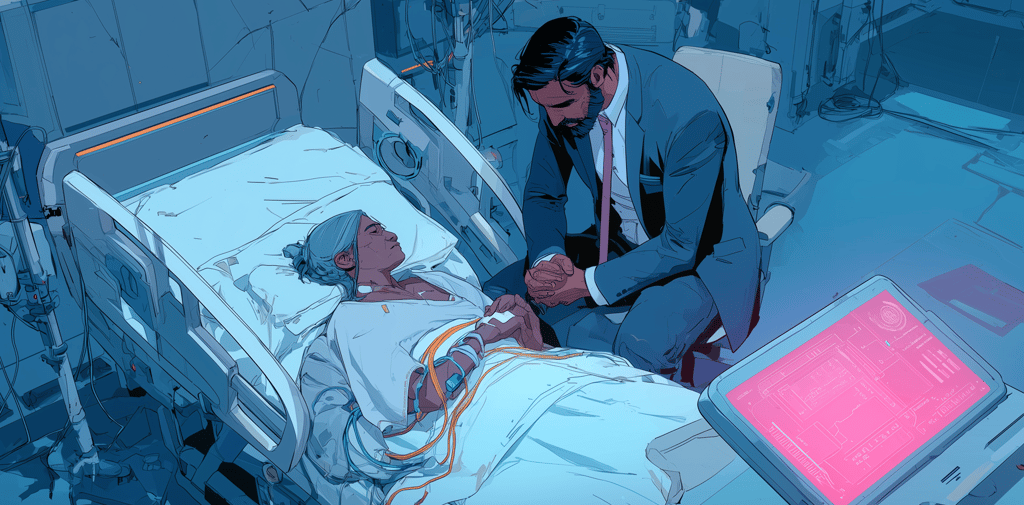
She looked smaller. The bio-bed's white efficiency made her body seem like something already halfway gone. Her eyes opened. Found him. Relief flooded her face - the kind that comes too late, when the swimmer's already swallowed half the ocean. She'd been waiting. The hours he'd spent in Bombay, confused and drowning in his own past, had been for her a suspended present. Waiting had drained her.
He told her about the journey. About the streets. About standing in the place she'd described a thousand times and feeling nothing but alien.
His data-slate chimed. He'd left it on the bedside table. The notifications scrolled past. Geta. The marketing team. WorldWeaver's automated server reports. He scanned them. User engagement: up 12%. New subscribers: 7% over quarterly goals. Quantum cloud migration: 100% successful, zero data loss. Major newsfeed mentions: 23 positive.
Wins. All wins.
Geta's face appeared in a small window. Exhaustion carved lines around her eyes. Joy lit them anyway. “Imran! You're back online! It was flawless. The migration, the new story patch, everything. The numbers are incredible. We're a success, boss. A real, measurable success.”
Imran looked at Geta's beaming face. At his mother's pale one. The distance between them made him dizzy. He'd built infinite worlds. Commanded armies of data. Made empires rise and fall with code. His mother's hand lay limp in his. He couldn't add a single drop of strength to it.
The numbers climbed. The profits grew. The virtual worlds expanded. Jamila's breathing grew shallower. Master of fake realities. Failure at this one.
He typed a reply. “Good work. Will debrief tomorrow.” Every congratulatory message after felt like an indictment. Proof of his neglect, rendered in clean percentages and growth metrics. The thriving future was a monument. Not to success. To failure as a son.
The summons arrived the next morning. “URGENT CONSULTATION” in red text. The one he'd postponed with his “family emergency” excuse. Chronic wanted him. Now. His mother's breathing had stabilized overnight. He kissed her forehead. She didn't wake. He left.
Chronic's administrative tower scraped the sky. The elevator ride felt like a descent, not an ascent. A prisoner's walk.
They didn't show him to a consultation room. A formal review chamber. Three officials from the “Department of Cultural Integration and Neurological Well-being” sat behind a curved desk. Director Valerius presided. The same woman from the Community Dialogue Forum months ago. Her smile was a blade.
“Mr. Ahmed,” she began. No pleasantries. “Thank you for finally joining us. We've been monitoring WorldWeaver's societal impact with great interest. And growing concern.”
They presented data. Charts. Psychometric analyses. A “clear, statistically significant link” between long-term WorldWeaver immersion and what they called “Socio-Emotional Disengagement Syndrome.” Their data showed high-frequency users - especially temporal migrants - displayed less real-world social interaction. Dulled emotional responses. Declining participation in “productive, society-building activities.”
“Your creation,” one official said, voice flat, “functions as a social drug. Curated, frictionless experience makes real-world integration seem unappealing. We're designating it a potential societal health risk to the populations we protect.”
Imran's blood went cold. The same clinical language he'd used to describe Bombay to his mother. Unproductive. Isolating. A health risk. The same detached judgment. The same dismissal of the need for escape, for refuge from pain. Karma, delivered in sterile administrative prose.
“We are mandating,” Valerius continued, “implementation of new Cognitive Safeguards and Reality-Tethering Protocols. Mandatory immersion time-limits. Periodic reality-based cognitive tests within the simulation. Significant dampening of haptic feedback's pleasure-response triggers. All new narrative content must be submitted for Ethical and Pro-Social review.”
A death sentence. They wanted him to weaken the escapist appeal that made WorldWeaver work. Turn his vibrant, immersive worlds into bland educational lessons. Chronic-approved homework. The threat of penalties hung in the air. Operating license restrictions. Revocation.
He wanted to argue. To defend his creation. To speak of art and experience and the human need for stories. The fight had left him. Their words about disengagement, about retreating into simulated experiences, resonated. His mother's frail form seared his mind. He'd used his work to escape the reality of her fading. Retreated into idealized, controllable realities. They might be right. He'd been his own product's most dedicated user. Most deluded.
Imran left the tower. Walked through Neo-Kyoto's plazas. The technological marvels looked different now. A beautifully designed theme park. Ruthlessly managed. He and everyone else who didn't fit the mold were animatronics scheduled for reprogramming.
At a public news terminal, a headline caught his eye. “University Restructures Arts & Humanities Funding; Inter-Temporal Heritage Programs Impacted.” He scanned it. Bureaucratic language. Budget changes. Streamlining for future-focused projects. Buried in the details: the Heritage Language Program had its funding slashed to nothing. Min-ji Kim's program. The one she'd fought to establish. Punishment for her activism, delivered with corporate efficiency.
For the first time, he saw Min-ji clearly. Not as an opponent. A fellow fighter in a war he hadn't realized he was in. Her fire. Her refusal to be silenced. Chronic's response: quiet administrative choking. Neutralization without martyrdom. No force. Just budget cuts. A weapon for this time.
Days later, at the Health Nexus waiting area during his mother's treatment, he saw Thomas Shepard. The younger man emerged from the Community Center carrying a box. Personal items. Shoulders slumped. Their eyes met. Shared recognition replaced the usual awkwardness.
“Thomas,” Imran said quietly. “Are you leaving?”
Thomas managed a weak smile. “Restructuring,” he said. The word tasted like ash. “My informal mentorship sessions aren't a budgetary priority anymore. They're bringing in a Chronic-certified Integration Facilitator.” He didn't need to explain. His work - gentle connection with newly arrived children through music and stories - had been deemed unsuitable. Too unstructured. Or maybe the artist himself, with his problematic historical profile, was the issue.
Imran nodded. Shared injustice settled over them. Min-ji. Thomas. Himself. Chronic was punishing all of them. Each in their own way. For not being the success stories Chronic wanted. His escapism. Min-ji's defiance. Thomas's history. Nails that stuck out. The hammer was coming. They weren't isolated cases. A pattern. Children of the first generation, carrying messy, inconvenient truths. Their existence, their refusal to fit neatly into Chronic's narrative, was a problem to be managed.
The barriers between them dissolved. His defensiveness toward Min-ji. His cautious distance from Thomas. Replaced by solidarity. Frightening and new. They weren't separate people navigating private struggles. Fellow travelers in the same leaky boat. Tossed on a storm directed by an indifferent, all-powerful hand. He'd been pretending he was in a different ocean.
***
The crisis came three days later. Imran sat at his mother's bedside in her apartment. Chronic had finally allowed her to return, surrounded by intrusive home-monitoring medical tech. Jamila was having a difficult day. Disoriented. Murmuring in a mixture of Hindi and Marathi from her deep childhood. Her eyes wouldn't focus. Her hand plucked at the covers. The med-station chimed with low-level alerts. Fluctuating heart rate. Decreased oxygen saturation. Nothing critical enough to trigger emergency response. Clear signs of distress.
His slate, set to critical alerts only, began vibrating violently. A red banner flashed. “URGENT: CHRONIC COMPLIANCE DEADLINE. IMMEDIATE DECISION REQUIRED ON PROTOCOL IMPLEMENTATION. SERVER-WIDE REPERCUSSIONS IMMINENT.” Geta. He knew without looking. The deadline to implement the Cognitive Safeguards that would cripple WorldWeaver. A choice. Give in and save his business. Resist and face Chronic's anger.
His world split. On one side, his life's work. His digital empire on the verge of being destroyed. On the other, his mother. Lost in fog and pain. Her breathing growing ragged. The instinct, sharpened over years, was to grab the slate. Dive into the problem he could solve. Manage the crisis he understood. The fate of WorldWeaver, of his employees, of millions of users, rested on this decision.
“Imran?” Jamila's voice cut through. Suddenly clear. Her eyes focused on him. Brief. Lucid. Her hand reached for his. “Beta, where are the monsoons? I cannot smell the rain.”
The question shattered him. Server alerts. Compliance deadlines. The fate of his company. All of it faded to a hum. The only thing that mattered was the frail, cool hand in his. The bewildered, searching look in her eyes.
He made a choice. Conscious. For the first time in what felt like a lifetime.
He ignored the slate. Didn't check the alerts. Leaned closer to his mother. Took her hand in both of his. Pressed it to his cheek.
“It will rain soon, Ammi,” he said. His voice thick. He switched to the half-forgotten Hindi of his childhood. The intimate register. “I promise. The clouds are gathering.” He began humming a lullaby she used to sing. A simple, ancient tune about a river flowing to the sea. He smoothed the hair from her brow. His entire focus shrank to the small universe contained within four walls.
The slate on the table went dark eventually. Urgent demands unanswered. In the quiet that followed - broken only by his mother's steadying breath and his soft humming - Imran felt a shift. Profound. He felt broken. A failure as a son. Now, likely, a failure as a CEO. But beneath the breakage, a clarity. Strange. Terrifying. His old path of detached creation, of building worlds to escape this one, was a dead end. WorldWeaver's success, the praise, the profits - meaningless. Ghost-fire compared to the simple, sacred reality of holding his mother's hand.
He knew he couldn't face what was coming alone. Chronic wouldn't be easily ignored. His mother needed more than he could give. He thought of Min-ji, with her fierce strength. Of Thomas, with his quiet empathy. They were all broken. All targeted. All adrift on this strange borderline between past and future. Perhaps their broken pieces could fit together. Make something new. Something real and strong.
His time as solitary god of a virtual world was over. He didn't know what came next. Only that when morning came, his first call wouldn't be to Geta. It would be to the others. To Min-ji. To Thomas.
To figure out, together, how to build something real in the wreckage of their pasts and the oppressive reality of their present.
Updates
Follow for the latest on my stories.
Fiction
contact@msrayed.com
© 2025. All rights reserved.
My Substack: https://msrayed.substack.com
My Patreon: https://www.patreon.com/cw/MSRayed