
The Sky Above, the Rivers Below, Ch 16: Fractures Exposed
Thomas confronts the brutal reality of his family's plantation legacy. A silent encounter transforms his abstract guilt into a new resolve.
SERIALIZED FICTIONTHE SKY ABOVE, THE RIVERS BELOW
1/4/20267 min read
The guilt Thomas Shepard carried was an abstract thing, a story told in a future classroom. Then the humid Virginia soil pressed against his lungs, axes thudded rhythmic in the distant pine woods, and his stomach twisted.
The Chronic displacement field dropped them at the end of a long, oak-lined drive. Temperature-controlled nothingness to thick Tidewater heat in a heartbeat - Thomas gasped. The air hung heavy. Sweet rot of magnolias. Damp earth, rich and cloying. Nothing like the filtered air of Neo-Kyoto. His mother, Margaret, closed her eyes. Pain flickered across her face. Recognition. Old memories surfacing. Thomas felt assaulted.
They walked toward the great house. Weight settled on his shoulders with each step. Willow Creek. He'd studied the plans in Chronic's historical archives, stared at faded portraits of ancestors, listened to his mother's carefully edited stories. Data-slates couldn't capture this.
Ancient oaks stretched overhead, branches draped in silvery moss. A funeral canopy. The beauty stole his breath. That made it worse. Every leaf. Every blade of grass along the drive, cut precise. Whispers of unseen labor. Unpaid hands maintaining this pretty lie.
Across the shimmering fields, he saw them. The enslaved. Moving in slow lines, dark forms bent over tobacco rows. Efficient. Weary. A work song drifted across the heat - melodic, mournful. Something sharp twisted in his chest. Imran's WorldWeaver games had historical reenactments. Those were pixels. These were people. Muscles aching under relentless sun. Lives bounded by absolute authority. His ancestors' authority. The nutrient paste from the Millipede Craft churned in his gut. His comfortable clothes, his Conservatory education, the money funding his existence - all purchased here. This sweat. This soil. This suffering.
The great house rose before them. Grand symmetrical brick. White columns gleaming. Windows like dark watching eyes. Impressive. Testament to Shepard wealth and power. Thomas saw a monument to monstrosity.
His steps slowed. Heart pounding dull against his ribs. Every brick paid for in human suffering. Blood. Sweat. Stolen years turned into prosperity.
His mother called it "home." His aunt's crackling temporal message called it "legacy." Thomas looked at the distant smoky haze rising from rough-hewn cabins. The slave quarters. Disease of the soul, passed through blood. He felt infected.
A figure emerged from the house - older man, worn but clean uniform, back slightly bowed. He approached. Expression carefully neutral. Eyes down.
"Mistress Margaret." Voice low, respectful. "Your aunt, Mistress Eleanor, she is expecting you."
Margaret nodded. Face pale. Brittle calm. "Thank you, Samuel."
The name jolted Thomas. She knew him. Samuel. A man, standing here. Real. He'd probably known his mother as a girl.
Inside, cool dimness after the sun's glare. Air thick with beeswax, old wood, faint sweetish smell of sickness from upstairs. Relatives gathered in the main parlor - strangers with faces familiar only from wall portraits. Formal silks and powdered wigs, jarring. They rose as Margaret entered. Greetings mixed genuine affection with strained politeness, critical curiosity.
Thomas became an object. Studied. "Margaret's boy, from that… far-off place." Handshakes from men with surprisingly firm grips. Polite dismissive nods from women fanning themselves lazily, assessing his "delicate" build, his modern posture, his quiet discomfort.
He tried minding Chronic's de-assimilation modules. Bow slightly. Keep answers brief, respectful. Felt like a clumsy actor in a play he despised. Conversation flowed around him - local gossip, tobacco price complaints, casual discussions about buying and selling human beings.
"I tell you, cousin," one portly gentleman declared, "the new shipment from the Guinea coast is proving most difficult. A firm hand is required from the start."
No one blinked. Normal as discussing weather.
Eventually they were led upstairs to Aunt Eleanor's bedchamber. Large, airy room. Massive four-poster bed dominating. The old woman within - withered, bird-like. Skin thin as parchment. Eyes sharp and commanding when they fixed on Thomas. Her worldview unchanged. A perfect fossil of her time. She hadn't experienced Chronic, or the future, or the slow moral awakening that haunted his mother.
"So." Dry rustle of leaves. "This is the boy. He has your soft heart, Margaret. I see it in his eyes. Too soft for this world." Her gaze swept over him, critical. Dismissive. "He looks frail. Does he ride? Can he manage an estate? Or does he only read those strange books of yours?"
Margaret tried mediating. Returning niece, careful. "Thomas is a musician, Aunt Eleanor. A scholar. He has a fine mind."
"Hmph. Music and books." The words themselves proof of failure. "A man needs strength, a strong hand for the land and the people on it. This… this future you ran to… it has made him delicate."
Thomas stood silent. The old woman's judgment pressed down like physical weight. They speak of honor while a man gets whipped for small mistakes. God's grace while buying His children at auction. My "delicacy" as weakness. He looked at his dying great-aunt clinging to her rigid brutal world. She sees a disappointment. She'll never see her world is the sick one, the broken one.
His mother's hand touched his back. Brief. Reassuring. Heavy with her own anxiety. Trying to protect him. They were both caught. She was no longer the woman who'd left this place. He was a boy who could never belong. Outsiders. Ghosts from a future this unchanged past couldn't understand.
The gap wasn't just years. Fundamental truths about humanity. Thomas stood on the edge of that abyss, looking down.
***
The invitation to dinner at the neighboring Carter plantation arrived with expected ceremony. Declining would be grave insult, Margaret explained. A few evenings later, Thomas found himself in another grand parlor, fancier than Willow Creek's. Surrounded by powdered perfumed wealth. Air thick with roasted meat, expensive French wine, suffocating politeness. Dread knotted in his stomach. He stayed close to his mother. Silent shadow in a world of loud confidence.
Tensions boiled over the port and walnuts, after the ladies departed. Men left to cigars and "serious" talk. Thomas - too young for port, too old to leave with the women - became silent observer. Conversation turned to estate management. Managing the people they owned.
Mr. Harrison, red-faced and booming, complained about recent "disobedience" in his fields. "A good taste of the lash is the only medicine for such rudeness." Murmurs of agreement.
Margaret made her mistake then. Standing near the doorway. Perhaps the stress. The constant pressure of playing her old role. Perhaps her new-world ideas simply broke through. "Perhaps," she said quietly, carrying clearly into the sudden lull, "a bit more understanding, a bit more… humane consideration for their condition, might lead to a better result than the lash, Mr. Harrison."
Stunned silence. All eyes turned. Harrison's red face darkened. Ladies stopped fanning. Shock. Disapproval.
"Humane consideration?" Harrison boomed, dripping sarcasm. "My dear Margaret, what strange foreign ideas have you brought back from this mysterious trip of yours? We are speaking of property, of possessions. One does not 'consider' the feelings of a plow horse."
"They are not horses, Mr. Harrison." Margaret's voice trembled. Firm. "They are people. They have souls."
Too much. Cousin Lucius - wanted Willow Creek's fertile lands - saw his chance. "People with strange new ideas, it seems." Silken venom, turning to other guests. "Perhaps this explains the state of things at Willow Creek before my late cousin, Margaret's husband, passed. Always a bit… soft, wasn't he? Always more concerned with his books than crop yields. I heard tales of lax discipline, too many liberties given. It's no wonder the estate fell into such a mess. Weakness, you see. Moral weakness rotting our society's foundations."
Stunning cruelty. She was publicly shamed by her own people for daring to change. Corrupted. Turning her back. Judging from unearned superiority.
Thomas stood frozen, hands clenched. Helpless protective anger surging. He wanted to shout, defend her. But what could he say? He was the "delicate" boy. Living proof of the "weakness" they condemned.
The future condemns her for what she was. The past condemns her for what she's become. No safe place for either of us. To them, her knowledge isn't wisdom - it's betrayal, contamination. I'm the proof.
They left the Carter plantation under strained politeness. The journey back stretched long, silent, agonizing. What thin welcome they'd had wore out. After the public confrontation, relatives treated them with cold formal distance. Their presence an embarrassment, a disruption. Aunt Eleanor, told of the incident, simply turned her face to the wall. Silent condemnation more powerful than any outburst.
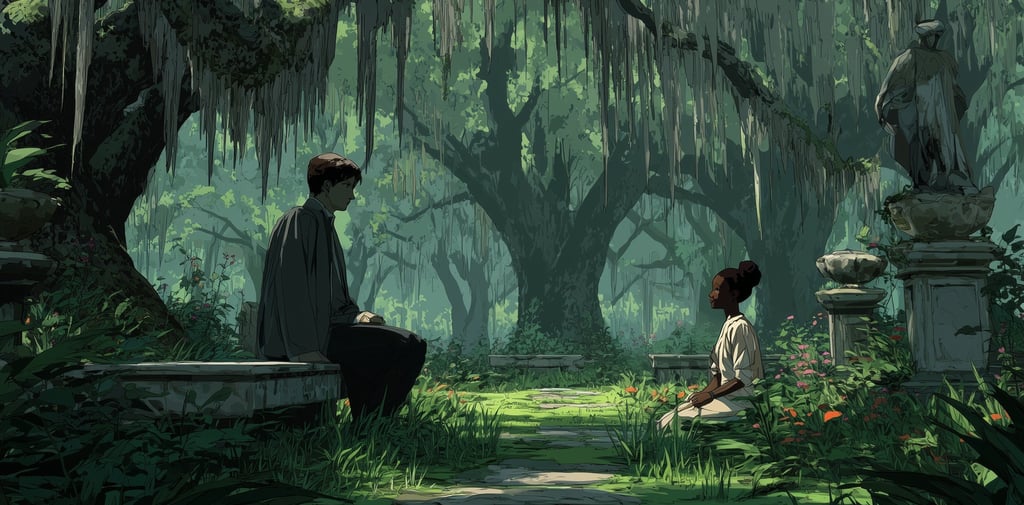
Thomas sought refuge in the sprawling overgrown gardens behind the house. Tracing moss patterns on a stone bench, he noticed her. Young enslaved girl, perhaps a year or two younger. Quietly weeding herbs. Small hands moving with practiced efficiency. Simple coarse linen shift. Bare feet. He'd seen her serving water in the house. Eyes always down. Movements swift, silent. Designed for invisibility.
He didn't speak. What could he say? Any word from him, a Shepard, would be intrusion. Assertion of power he desperately wished he didn't have. He sat. She continued working. Separate universes of silence.
She paused after a few minutes. Sensing his gaze. Looked up. Their eyes met across a few feet of garden - might as well have been a universe of social distance.
No anger in her dark tired eyes. No resentment. No fear. Deep bottomless sorrow. Weary understanding far older than his own. Something shifted in him. Recognition. Silent acknowledgment of shared suffering, vastly unequal. Her pain - source of his family's wealth. His pain - guilt of that inheritance. For a fleeting instant, they weren't master's son and enslaved girl. Just two young souls trapped in a system crushing them both differently.
She lowered her gaze. Returned to weeding. Moment broken. For Thomas, life-altering connection.
That evening, Margaret decided. "We are leaving, Thomas." Voice brittle. Resolved. "Aunt Eleanor is… she is in God's hands now. There is nothing more for us here."
Their departure tense. Somber. Quiet. None of the ceremony that greeted their arrival. They walked down the oak-lined drive again. This time like exiles being cast out.
As their Chronic transport was summoned, Thomas took one last look. The great house. Fields shimmering in late afternoon sun.
He was changed. Abstract historical guilt burned away. Replaced by visceral reality. That shared silent look in the garden. Making amends wasn't about grand apologies or public gestures - things this world would never accept anyway. It was acknowledging quiet individual humanity. Those who suffered. The girl in the garden whose name he didn't know.
The displacement field began enveloping him, disorienting. Pulling him from humid Virginia air back toward sterile future. New heavy resolve formed. He could never erase his family's past. Never undo the pain. But perhaps through his art, through his music, he could honor the memory of victims. Give voice to the silent sorrow he'd witnessed in a young girl's eyes.
The fractures of his identity had been ripped open by this painful journey. In that very breaking, he felt, for the first time, the possibility of a new more honest foundation. A purpose entirely his own.
Updates
Follow for the latest on my stories.
Fiction
contact@msrayed.com
© 2025. All rights reserved.
My Substack: https://msrayed.substack.com
My Patreon: https://www.patreon.com/cw/MSRayed