
The Sky Above, the Rivers Below, Ch 15: Outsiders at Home
Min-ji returns to Joseon Korea, only to find "home" is a myth. She realizes she belongs to neither the past nor the future.
SERIALIZED FICTIONTHE SKY ABOVE, THE RIVERS BELOW
12/21/202510 min read
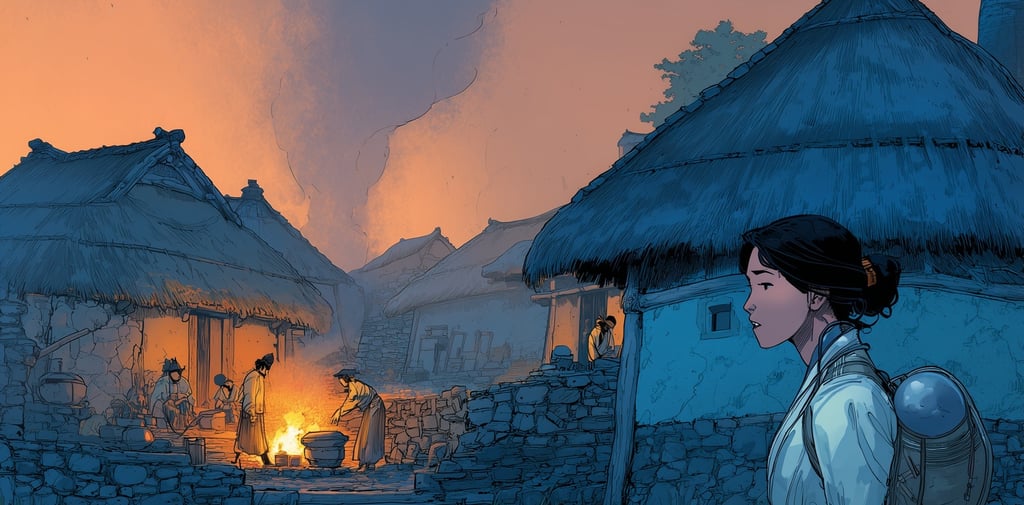
Home, Min-ji thought as unfamiliar sounds and smells washed over her, was a story whose ending had already been written somewhere else, in another time.
The displacement field from the Millipede Craft's lander vanished with a faint ozone crackle. Min-ji's boots hit rutted dirt. The ship's recycled air died in her lungs, replaced by something thick, complex, overwhelming. Damp earth after recent rain. Woodsmoke clinging to thatch roofs. Fermenting soybeans from clay pots. Chickens and pigs and oxen. Life lived close to soil and to each other. Her historical data-slates had called it "pre-industrial olfactory landscape" - a polite, clinical term for a world that stank, inescapably, of itself.
Beside her, Sook-ja crumpled to her knees. Her hands pressed into dark earth as if testing its reality. A sob broke from her chest, raw and deep, containing fifteen years of grief in a single sound. Her shoulders shook. The careful composure she'd maintained since winning Chronic's lottery dissolved.
Min-ji stood apart. The empathy was there, aching in her ribs for her mother's joy, for that release of longing so powerful it bent her mother's spine. For herself - nothing. An observer at a reunion meant for someone else.
Her sociologist's training kicked in automatically. The strict neo-Confucian ranks governing every interaction here. The delicate balance between yangban gentry and common folk. Seasonal farming rhythms dictating village life. She'd studied the clothing, the buildings, the food in climate-controlled classrooms. Standing here, though - the damp chill bit through her travel clothes, a cold no temperature-regulated apartment could replicate. The weathered faces of villagers emerging from mud-walled homes carried lines no database image captured, tiredness etched deep. The weight of its layered silences pressed against her chest like a physical thing.
Shrieking women surrounded Sook-ja - aunts, cousins, their cries and laughter chaotic, beautiful. A stoic man who had to be her uncle helped Sook-ja to her feet. They hugged, voices overlapping in reunion. Min-ji felt like an actor stumbling onto stage mid-play, knowing the historical context, missing every emotional cue.
Sook-ja's worn travel chima jeogori was smoothed by loving hands, the women fussing over her like she was precious, breakable. Min-ji cataloged what she saw: worn-out farm tools leaning against walls, their wooden handles darkened by generations of sweat and use. Patched clothing on every body, careful stitches extending the life of fabric that should have been replaced seasons ago. The respect bordering on fear in lower-class villagers' eyes when they glanced toward the headman's larger house on the hill. Paradise, her mother had called this place. Min-ji saw survival systems, carefully ordered. Beauty and kindness, yes. Also casual, ingrained injustice as inescapable as the air itself.
A young woman approached, face bright with curiosity. Jisun, the bride-to-be. Round-faced, quick-eyed, pretty. "You are Min-ji?" Her voice shy, head properly bowed. "Eomeoni has told us so much. The great scholar from the future-land."
Min-ji forced a smile. She attempted a respectful bow that felt stiff, unnatural - her body knew the easy, upright posture of advanced-time living. "It is an honor to meet you, Jisun-ssi. Congratulations on your upcoming marriage." The formal language felt clumsy on her tongue, academic rather than natural.
Jisun giggled, hand flying to cover her smile. The sound was genuine. The invisible wall between them already solid, though - the vast gap of their different realities. Min-ji suspected she wasn't entirely real to them yet. A curiosity. A story. A marvel.
The initial welcome swept them into her uncle's small, tidy home. The main room crowded with relatives talking at once, their voices a chaotic babble more authentic than her Chronic chip's filtered translations. They offered barley tea, rough honey cakes, dried persimmon slices. Simple, rustic food that tasted intensely real, nothing like Chronic dispenser paste.
Sook-ja, seated in the place of honor, blossomed. Her face radiant. Her laughter freer than Min-ji had heard in years as she traded stories with her sisters.
Min-ji became the object of intense, respectful fascination. The "great scholar." The "future-child." Living proof of the almost mythical stories about their kinswoman who'd won the great lottery and traveled across time. Older women studied her face, her hands, her posture, searching for signs of the future written in her flesh. The younger women like Jisun whispered shy questions, their eyes wide with a mixture of awe and curiosity that made Min-ji feel less like a person and more like a walking legend come to life.
"Is it true that in your land, machines do all the work?" Jisun asked as they sat preparing vegetables for the wedding feast.
"Not all." Min-ji searched for a simple comparison. "Many things, yes. Machines help us build, clean, even cook."
Amazed gasps rippled through the group. "Aigo," an older aunt murmured, shaking her head. "What a world of lazy women it must be!"
The comment carried good humor. Also the first subtle crack in her welcome. Her world lay so far beyond their understanding it could only be interpreted through their own framework - ease bordering on laziness.
The cracks multiplied. Min-ji, used to academic debate and free idea exchange, kept forgetting herself. She looked directly at her uncle when speaking, her gaze meeting his instead of respectfully lowering. Asked direct, analytical questions about local customs - why this ritual, what purpose did that gesture serve - questions that sounded like challenges rather than polite interest. Stunned silence would follow before Sook-ja subtly coughed or nudged her - silent reminders of a young, unmarried woman's proper, respectful role. Her posture, her confident stride, her unconscious habit of clasping hands behind her back while observing like some wandering scholar - all signs of her otherness, visible to everyone.
The men discussed wedding arrangements while women listened in silence, their eyes downcast, hands folded in laps. Min-ji watched, cataloging the dynamic. They saw her as exotic, prodigious. Also as someone who didn't quite fit their mold, who didn't understand the complex dance of submission and influence these women had perfected over generations. Every question she asked, every independent thought voiced, seemed to ripple through their established norms, creating subtle unease like a stone dropped in still water. They tried to categorize her, to place her within their understanding of the world's proper order, and failed.
Her mother became her constant, anxious editor. "Min-ji-ya, do not stare so directly when Uncle speaks," Sook-ja whispered later as they prepared their sleeping mats. "It is not respectful." Then, "Daughter, when elders speak, you must not interrupt, even if you think you know a better way." And, "Your bow, it is too shallow. You must show more humility."
Min-ji tried. She consciously lowered her gaze, softened her voice, attempted to copy her cousins' graceful, self-effacing movements. The effort felt like wearing a costume two sizes too small. A painful squeezing of a self shaped by fifteen years of radically different reality.
Sook-ja's joy at being back warred with something else now - a need to force Min-ji into a shape she no longer fit. To prove to relatives she hadn't failed, hadn't raised a stranger. The stranger was obvious, though. To them. To Min-ji.
The welcome was genuine, born of love and family ties. Extended to a visitor, though. A guest. A story.
***
The initial happiness crumbled into ordinary, harsh village realities. Wedding preparations should have been joyful. For Min-ji, they became uncomfortable, infuriating lessons in social structures she'd only studied.
The village headman - a minor yangban official with self-important bearing and silk-trimmed robes - took a "contribution" of rice from her uncle's already small stores for the wedding feast. Two large sacks hauled away by servants while the headman stood watching, hands clasped behind his back. A "request" backed by the full weight of the class system. Her uncle bowed low, spine bent until his forehead nearly touched his knees. His face a mask of polite agreement, but Min-ji saw the flicker in his eyes, the jaw clench, the whitening of his knuckles where they gripped his sleeves. Later, when she tried asking about it using careful, indirect language she'd been practicing, he waved a hand dismissively. "It is the way of things, Min-ji-ya. The headman is of higher station. We show our respect."
The casual cruelty of it made Min-ji's blood boil. Her hands clenched into fists as she helped female cousins grind soybeans, a physically demanding task her body didn't know. In Neo-Kyoto, injustices hid behind algorithms and bureaucratic policies. Here, they walked to your door and took your food. You thanked them for the privilege.
Women's positions were harder to accept. Jisun was treated less like a person starting a new life, more like valuable property being moved between households, checked for defects before final transfer. Her future mother-in-law visited, a stern woman with sharp eyes and thin lips. She inspected Jisun's needlework with critical attention, holding embroidered fabric up to sunlight to check for uneven stitches. Examined Jisun's teeth by making the girl open her mouth wide while she peered inside, checking for rot or weakness. Scrutinized her posture, watching how she walked, how she knelt, how she held a tea cup. The merchant's critical eye checking livestock. Jisun bore the scrutiny with practiced, calm smile that never quite reached her eyes. Min-ji caught glimpses of fear and anxiety in her cousin's face during their rare moments alone - quick flashes before the mask returned.
One afternoon, sitting with Jisun and other young women, Min-ji tried bridging the gap. "In the land I come from," she began carefully, "a woman has a say in who she marries. Sometimes, she chooses not to marry at all. Follows her own learning, her own work instead."
The women stared. Faces showed shock, complete confusion. One giggled nervously. "Not marry?" she whispered, the idea scandalous. "But… what would a woman do? Who would she belong to?"
"She would belong to herself."
The words felt radical. Dangerous in the quiet, sun-dappled courtyard.
Jisun shook her head, sad little smile on her lips. "You speak of a dream-world, cousin. Such things are not for women like us." She looked down at her hands. Brief curiosity gone, replaced by weary acceptance.
The interaction left Min-ji frustrated, deeply helpless. When she spoke of equality, of rights, of having a say, they looked at her like she was speaking a madman's language. Her knowledge, her "advanced" view - useless here. An alien language with no shared grammar.
Sook-ja watched these exchanges. Her face a mask of growing anxiety. She would interrupt, change subjects, laugh off Min-ji's "strange ideas" as products of her "unusual education." Trying to mediate. Protect Min-ji from the social disapproval she attracted. Also silencing her, though. Reinforcing the very boundaries Min-ji questioned.
The gap between them wasn't just years. Entire worldviews. The education her mother was so proud of made Min-ji's presence here disruptive.
The wedding day arrived - bright color, chaotic energy. Drums and pipes filled the air, rhythms pounding through Min-ji's chest, mixed with excited village chatter. Children ran between adults' legs, shrieking with laughter. The smell of cooking meat and sweet rice cakes drifted from cooking fires.
Min-ji, dressed in borrowed formal hanbok that felt stiff and ceremonial, the fabric scratching her neck, moved through rituals with a keen, observant eye. The heart of a deep, lonely alien. She watched elaborate bowing - precise angles for each relationship, each rank. Gift exchanges wrapped in specific colored cloths that signified meaning she'd studied but didn't feel. Symbolic wine sharing from lacquered cups passed with both hands, proper respect shown in every gesture. She cataloged each step, analyzed its social meaning, felt completely detached from its emotional core. A ghost at this feast. A visitor from another plane, able to observe, unable to truly join.
She and Sook-ja were treated with utmost respect. As visitors from the almost mythical "future-land," they received seats of honor, best food portions, speech carrying reverence and awe. The reverence given to strange spirits, though. Honored yet ultimately unknowable guests. They were spectacle, not family in the way others were.
Understanding came during the paebaek - private ceremony for the bride to pay respect to new in-laws. Min-ji and Sook-ja, as close family, were invited to watch in the inner room, screens pulled back to allow family viewing. As Jisun, face painted in traditional bridal mask of red dots on forehead and cheeks, began complex series of deep, prostrating bows before her new parents-in-law, her elaborate wedding hanbok spreading around her like a flower opening, an elderly great-aunt of the groom's family leaned toward Sook-ja.
"Your daughter," the old woman rasped, voice perfectly audible to Min-ji, "she is very learned, very bright. A blessing she was not raised here, though. Such a spirit… she would never have learned to bow so low. A branch that does not bend, breaks."
The comment wasn't unkind. Simple, practical observation. Statement of fact in their world.
For Min-ji, sharp, final pronouncement of her otherness. Acknowledgment that her very essence, the spirit and intellect her mother was so proud of, was fundamentally incompatible with this world she was supposed to call her ancestral home. By her very nature, a broken branch in their forest.
She looked at her mother. Saw not just joy at being home, but a flicker of similar, painful realization. Sook-ja smiled, nodded at the old woman's words. Her eyes held new sorrow, though. Perhaps she was seeing, with clarity that had escaped her until now, that she no longer fully belonged here either. Her own posture too straight. Her acceptance of this world's hardships no longer absolute. Fifteen years in the future had changed her too, in ways she was only just beginning to understand.
Later, as celebration spilled into the courtyard, air filled with laughter and wedding party sounds, the scrape of bowls and chopsticks, voices raised in song and increasingly drunken toast, Min-ji found herself standing apart, near the torchlight's edge where shadows started. The sights and sounds of Joseon were vivid, intoxicating, real - the orange glow of torches painting faces in warm light, the rhythm of traditional instruments creating patterns her body didn't know how to move to, the smell of makgeolli and roasted meat heavy in night air. They weren't hers, though. She felt an almost physical separation, as if watching through a pane of unbreakable, invisible glass that let her see everything but touch nothing.
The realization settled, hard and cold in her stomach, heavy as a stone swallowed whole: she was an outsider here, in the land of her ancestors, just as she was an outsider in the sterile, glittering future she lived in. The "home" she was supposed to reconnect with was a phantom. A story belonging to her mother, written in a language Min-ji had never learned to speak fluently.
She was irretrievably, irrevocably a hybrid. A creature of two worlds, belonging fully to neither.
Sook-ja detached from a group of laughing women and walked toward her. Steps slow, deliberate. Her mother's face, lit by flickering torchlight, no longer just filled with nostalgic joy of return. It held something new, more complex - shared, dawning understanding of their mutual, unmoored existence.
The great homecoming was over. For both of them, the true, lonely journey was just beginning.
***
Updates
Follow for the latest on my stories.
Fiction
contact@msrayed.com
© 2025. All rights reserved.
My Substack: https://msrayed.substack.com
My Patreon: https://www.patreon.com/cw/MSRayed