
The Only Gods We Know, Vol. 2 Ch 6: The Witch’s Knot
A necrotic hex turns Asgard’s food to rot and gold to static. As the gods resort to tyranny, Shield-Captain Brynja seeks answers from the dead.
SERIALIZED FICTIONTHE ONLY GODS WE KNOW
5/31/202612 min read
They had braced for the sky to fall. For fleets to burn, for citadels to crack under bombardment. No one had thought to brace for the bread.
Shield-Captain Brynja Vingfalk sat in the Alpha Mess of Himinbjörg Secundus and watched her ration refuse to be food. The orbital fortress hung above the trade lanes of the Myrkviðr sector like an anchor dropped from heaven, and it never stopped humming—a sub-sonic thrum out of the atmospheric processors that lived in the deck plates, in the teeth, in the marrow. The mess stank of disinfectant and old sweat and the flat metallic tang of Nutrient Paste #4. Three centuries in uniform. Brynja knew that smell the way she knew her own pulse.
She dragged her spoon through the gray sludge. It held its shape. A gelatinous cube, engineered for calories, not joy.
Across the table, Sigrun tore open a packet of dehydrated flavor-crystals and dumped the red dust over her tray.
“Tastes like rust,” Sigrun said, stirring red into gray. “But it’s spicy rust.”
“Eat it.” Brynja’s eyes moved over the room out of habit. You watched the doors even at home. Especially at home. “Folkvangr’s shipments are delayed. This is the menu until they aren’t.”
Two hundred Einherjar and support staff ate around them with the mechanical patience of soldiers. Food was fuel. Trays clattered. Deck crew laughed near the dispensers, and one of them was beating a fist against a synthesis unit that hummed a half-tone too high.
“Piece of junk.” He kicked the housing. “Come on. Spit it out.”
The machine gurgled. Something tore inside it, wet and long.
Brynja’s spoon stopped halfway to her mouth. The deck’s hum changed pitch. A hitch in the station’s heartbeat, there and gone.
At the next table, a trooper from the 4th Cohort gagged.
His spoon hit the floor. His hands went to his collar, clawing. His face went purple, mottled, veins standing up his neck like cords pulled taut. He could not get air.
“Medic!” His tablemate shot up so fast the bench went over behind him. “He’s choking—”
Brynja was over the table before the bench landed, boots skidding on the slick linoleum.
The trooper dropped to his knees and brought up black bile. Not food. It steamed when it hit the cold deck.
The smell reached her a half-second later and stopped her like a fist. Not vomit. Rot. Wet, ancient, opened-grave rot, a week of rain in it.
“Back.” She shoved the tablemate clear, got a hand on the trooper’s shoulder plate, rolled him onto his side. His eyes were blown wide, the whites gone to red threads. He looked at her and saw nothing. Black ran from his nose, then his ears.
The dispensers started screaming.
The deck crewman was scrambling backward, going down on the slick floor and clawing up again. The synthesizer wasn’t making paste. It was vomiting it—a gray-black torrent out of the nozzle, slapping the wall, pooling, moving with a thick living slowness, like mud that had learned to crawl.
“Bio-hazard.” Brynja’s voice tripped the local comms. “Seal the mess. Nobody leaves.”
The retching spread, table to table, a chorus of wet heaves and breaking panic. On her own tray the cube she’d been stirring lost its corners. It slumped. It went to black oil, and the stink off it was sulfur and dead meat.
“Sigrun—doors. Mist, I want to know what this is.”
Sigrun hit the emergency bulkhead release and the blast doors slammed down, sealing two hundred people in with the smell. Soldiers backed off their benches with weapons drawn, aiming at their dinner like it might charge.
Mist was already at the dispenser, datapad hard-linked to the diagnostic port, her face lit red by the code scrolling up the screen. A professional’s face, doing professional things over a drum of horror.
“Not a malfunction.” She had to shout over the heaving. “The protein chains are coming apart. The synth isn’t building matter—it’s killing it. Necrosing it the instant it forms.”
“Sabotage?” Brynja wiped bile off her chestplate with the back of her glove.
“Infection.” Mist’s eyes ran the readout. “It’s in the source. Targets the genetic markers of Asgardian nutrient algae—nothing else. It’s a command. It tells the food to die.”
Klaxons opened up across the station. The lights dropped to amber.
WARNING. HYDROPONICS FAILURE. SECTORS 4, 5, 9. CRITICAL BIOMASS LOSS.
“It’s not just us.” The trooper at her feet had stopped convulsing. He lay panting, white as the deck, black pooling under his cheek. The cold in Brynja’s gut pulled tighter.
“Water and paste both,” Sigrun said, counting the sick. She’d stopped at twelve.
Brynja stood. The rot coated her tongue now, thick as a second skin. The synthesizer kept retching its black slurry onto the floor.
The Architect hadn’t fired a shot. Hadn’t scratched the hull. He had reached past three meters of armor, past the shield grid, into their guts, and turned their supper to poison.
“Sick to the med-bay.” Her voice came out flat. She wanted to draw Storm-Singer. There was nothing to point it at. “Tell the Quartermaster to lock the water reserves. Hard rations, all hands, until I say otherwise.”
She looked at the black on her boot.
“If we’ve got any left.”
* * *
The Strategium of Himinbjörg Secundus was built to be a quiet place. A temple to commerce and the orderly application of force. Today it was a kennel.
Brynja came through the blast doors with Sigrun at her shoulder. The air was scrubbed clean here, no mess-hall stink, but the panic was sharper for it—dry, electric, the smell of men sweating through fear.
“Captain on deck,” a sentry called. Nobody turned.
In the center of the room the primary holotank—a column of light that should have shown troop lanes and supply routes—was showing a different kind of massacre. Lord Tyr stood over it, his prosthetic hand clamped on the table edge, the metal fingers shrieking against the composite. He had the look of a man trying to argue a flood into receding.
“Explain it.” Tyr rounded on a logistics comptroller the color of paste. “Where is the gold. Where are the reserves.”
“Gone, my Lord.” The comptroller’s hands wouldn’t stay still. “Not—not stolen. Corrupted.”
Brynja stepped to the table. The display held the Asgardian exchange: planetary tithes, mercenary contracts, shipyard payouts, all of it. The gold icons were going to lead-gray and then to static, column after column folding into noise.
“Sitrep.”
Mist answered without lifting her head from the financial subnet. “Simultaneous spike across the whole banking grid. Hit the ledger nodes first. Every certificate of bullion, every credit transfer authorized this cycle—integrity’s at zero.”
“A hacker,” Tyr said. “A glitch.”
“A hex.” Mist pulled a thread of the thing loose and froze it in the light. It wasn’t binary. It coiled—a serpent swallowing its own tail, spun out of fractal math. “Gullveig-class. Old economic warfare. The Golden Witch. Thrice burned, thrice reborn.”
Brynja knew the name. Every child of the Nine did. Gullveig, the Vanir sorceress whose hunger for gold had lit the first war between the gods. The Architect wasn’t being subtle. He was holding up a mirror and naming what he saw in it. Greed. Their wealth, their need for it, made into the wire that carried the charge.
“And the outcome,” she said.
“Total liquidity freeze.” The comptroller swallowed. “The mercenary fleets in the Outer Rim—their contract payments bounced. Registering void. Blood-Axe Company’s already signaled they’re standing down. The yards on Nidavellir lost automated payroll. The crews are walking off the line.”
Tyr’s flesh fist came down on the table. “I command them to work. We are at war.”
“They aren’t soldiers, my Lord.” Brynja kept her voice level. “They’re contractors. No pay, no ships. No ships, no supply lines.”
“No food,” Sigrun said.
Nobody had to draw the line between the two. The rot was the fist. This was the knife slipped between the ribs. The Architect was cutting the tendons of the empire one at a time and letting it learn, joint by joint, that it could no longer stand.
“We have physical gold,” Tyr said. “In the vaults.”
“Sealed.” The comptroller’s voice cracked. “Vault security runs off the same ledger. It reads the bullion as worthless lead. They won’t open without a full reset of the banking architecture.”
“How long.”
“Weeks. Months.”
Brynja watched the red tide take the map. Mercenary marks blinked out. Production quotas flatlined. The golden empire, the one that had sold the Nine Worlds on infinite wealth and perfect order, was showing its joists.
“He’s not fighting us,” she said. “He’s foreclosing on us.”
Tyr turned from the table and paced, a wolf measuring a cage it already knew the size of. “I have dreadnoughts. I have legions. I can break a planet’s crust. And I am losing to bookkeeping.”
“To resource denial,” Brynja said. “The Vanir don’t hit the shield wall. They wait for winter.”
“Then we’ll make summer.” His voice had gone quiet, and quiet was worse. “We find what we need. We take it.”
The shouting had bled out of the room. What replaced it was worse—the low, careful arithmetic of frightened men deciding what they were willing to do.
Tyr stood at the head of the table and the map changed under his hand. Not military targets now. Farm worlds. Trade hubs. Independent stations. Green dots, all of them.
“We can’t shoot a famine,” he said. “Can’t put inflation in chains. But we have guns. And we have hungry men. That’s a kind of math too.”
He looked to Astrid. The Wing Commander stood at parade rest, pale, her eyes flat as struck coins. She had burned Folkvangr Prime to the bedrock. She knew exactly what “necessary measures” weighed on the scale.
“The army eats first,” Astrid said. Not a proposal. A reading of fact. “Strategic reserves are compromised, production’s halted. We have paste for two weeks at current rationing.”
“And the civilians?” Brynja asked.
“Secondary.” Astrid did not look at her. “If the fleet starves, the empire falls. If the subjects starve, they riot. Rioters can be shot.”
The heat climbed Brynja’s neck. “You’re describing mass requisition. Stripping the vassal worlds at the harvest. Those people live cycle to cycle. Take their winter stores and you’re not robbing them, you’re killing them slow.”
“Better them.” Tyr set a finger on a cluster of green at the fringe—worlds that had bent the knee without a fight, worlds flying Asgard’s protection. “Sector G-7. Harvest is coming in now. Send the 4th.”
“My Lord.” She came forward, hands fisting at her sides. “G-7 is loyal. We drop troops and empty their silos at gunpoint, we prove every word the Architect’s ever said about us. We become the parasite he calls us.”
“We are survivors.” Tyr spun on her, the prosthetic catching the light. “You think the Vanir weigh loyalty? They’re poisoning us. They’re laughing while they do it.”
“That’s the trap.” She put both hands on the table and leaned into it. “He wants us to turn on our own subjects. He wants the monster. Every grain you take at gunpoint is a recruit handed to his army. You won’t be feeding the fleet. You’ll be feeding the rebellion.”
“I am feeding my men!” Spit flew. “You want Einherjar dropping off the wall from hunger? You want the shields to fail because the techs are too weak to stand a watch? We are at war, Captain. In war the strong take what they must.”
He turned back to the map.
“Operation Harvest. All fleets authorized to requisition from local systems by any means. Resistance met with lethal force.”
“There’s another road.” She heard the plea in it and hated it. “We ration. We open trade with the Weavers, with the neutrals—”
“The Weavers are laughing at us. The neutrals are watching us bleed and taking notes.” He shook his head, once. “No. We take it, and we show the Nine that Asgard does not beg.”
His eye went to Astrid. “Commander. Your wing leads the requisition in the Kryll sector. Durable stock. They’ll survive a lean winter.”
“Understood, my Lord.” Astrid’s gaze brushed Brynja’s and held nothing at all. “We’ll secure the assets.”
Brynja looked at the map. Every green world wore a targeting reticle now. Not a campaign. A raid. A pillage with the whole galaxy for a granary.
“We aren’t gods anymore,” she said, to no one. “We’re bandits with good ships.”
Tyr didn’t hear, or didn’t care. “Dismissed. Ready your wings. We’re hunting bread.”
The officers filed out heads down, none of them meeting another’s eye. The shame in the room had weight. They were the sworn shield of the Nine Worlds. They had just been ordered to rob it.
Brynja stayed. She felt scraped out, scoured down to the hull.
The holotank still burned with the dying economy and the marked worlds. And above it, in the upper tier of the projection, a channel had gone live that almost never did.
The Allfather’s.
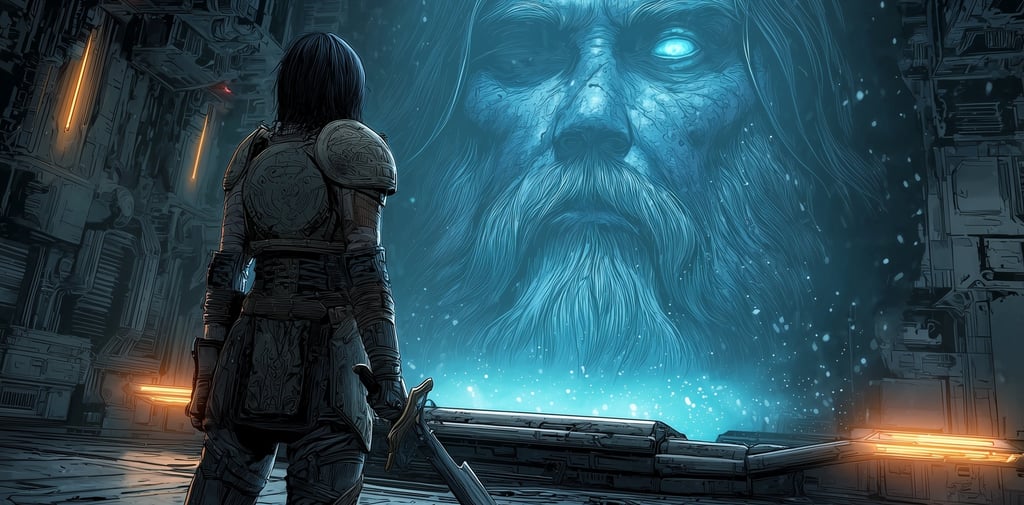
A vast spectral head hung in the digital dark. Gray beard. A single eye lit blue from within. The fidelity was perfect—every line of the face, every flicker of thought behind that eye.
Odin.
He had watched all of it. The rot in the mess. The gold turning to static. Tyr’s fury. The order to strip the loyal worlds bare.
He had not said one word.
Brynja looked up at him and waited for anger. For grief. For a command to stop this.
The eye looked back. It did not blink.
It wasn’t angry. It was interested. The look a man gives a sealed jar when the things inside it begin to eat each other. Cold. Patient. Cataloguing. Will the organism hold under load. Will the wolf chew through its own leg to leave the trap.
Tyr was impotent. This was something else. This was indifference with a ledger of its own.
“You knew,” Brynja said to the hologram. “You let it come. You set the table for it.”
The eye watched. Nothing moved.
A cold went through her that had nothing to do with bone. The Architect called the Aesir parasites. Standing under that one blue eye—the eye of a god who would starve his own people to see how they took it—she could not find the words to call him wrong.
She turned and walked out. The blast doors shut behind her with a long, final weight.
The corridor was full of soldiers checking weapons. Tired. Hungry. They trusted their officers. They trusted her. She kept her face still and walked through them.
She keyed her comms to a channel encrypted three ways, to none of her commanders.
“Freyja.”
Static, then a settling. “I’m here, Brynja.”
“The knot’s pulling tight.” She stared down the long gray throat of the corridor. “Tyr’s ordered the subject worlds stripped. We’re going to starve them to feed the war.”
A silence. Then a breath, heavy down the line.
“He plays the part the Architect wrote for him,” Freyja said. “Predictable as a stone falling.”
“If we don’t cut this soon”—Brynja’s hand found the pommel of Storm-Singer and rested there—“we all hang from it. Aesir. Vanir. The whole damned galaxy.”
“Do you have the thread?”
“Finding it. But I have to go to the graveyard first.” A beat. “I need to talk to the dead.”
“The Corpse-Gate.” Freyja did not say be careful. She didn’t have to. “Bad ground.”
“The living have lost their minds.” Brynja started toward the hangar, toward the Skittermule waiting in the dark. “Maybe the dead kept theirs.”
She cut the link.
The war had changed shape. It had stopped being about worlds and lines on a map. It was about who would still be breathing at the end of the winter. And somewhere between the mess-hall rot and that one unblinking eye, Brynja had finally let herself know the thing she’d been refusing: that saving the Empire might mean burying the men who ran it.
* * *
Glossary
Military & Strategic Terminology
Alpha Mess: The primary dining facility on a military installation, often reserved for frontline combat units and ranking officers.
Bio-hazard / Critical Biomass Loss: Emergency designations indicating a severe threat to biological life or the destruction of essential organic material (like hydroponic food supplies).
Hard Rations: Non-perishable, tightly packed emergency food reserves issued when automated food synthesis or fresh supplies fail.
Mass Requisition: The forced, legally sanctioned seizure of civilian goods, food, and resources by the military to supply the war effort. Often a sanitized term for pillaging.
Quartermaster: The officer responsible for managing, storing, and distributing military provisions, rations, and equipment.
Resource Denial: A warfare strategy focused on starving the enemy by destroying or corrupting their economy, supply lines, and food, rather than fighting their armies directly.
Sitrep: Military shorthand for "Situation Report." A demand for an immediate summary of the current tactical or operational status.
Asgardian Ranks & Units
Cohort: A mid-level organizational unit of soldiers (e.g., the 4th Cohort).
Einherjar: The standard heavy infantry and shock troops of the Asgardian empire. (Derived from the mythic warriors of Valhalla).
Legion: A massive, planetary-scale deployment of Einherjar troops.
Logistics Comptroller: A specialized officer tasked with managing the vast, complex financial ledgers, mercenary payouts, and planetary tithes that keep the empire running.
Shield-Captain: A high-ranking field officer (like Brynja) who bridges the gap between frontline combat leadership and broader strategic command.
Wing Commander: A senior naval/aerospace officer commanding multiple fleets or squadrons of warships (like Astrid).
Tech, Ships & Infrastructure
Blast Doors / Bulkheads: Massive, heavily armored automated doors used to seal off sections of a ship or station during hull breaches or internal emergencies.
Datapad: A handheld, ruggedized military tablet used for everything from slicing diagnostic ports to reviewing combat intelligence.
Dreadnought: A massive, heavily armored capital warship capable of breaking a planet's crust. The ultimate hammer of the Asgardian fleet.
Holotank: A large, central command table that projects high-fidelity, three-dimensional tactical maps, troop lanes, and economic ledgers.
Klaxons: Extremely loud, automated warning sirens used to signal station-wide emergencies.
Local Comms: Short-range, localized communication networks used within a specific sector of a ship or station.
Med-bay: The central medical and trauma facility on a military installation.
Skittermule: A rugged, utilitarian transport vehicle used in military hangars and cargo bays.
Strategium: The heavily secured, sound-dampened command-and-control center of a fortress or flagship; the master "war room."
Synthesis Unit (Synth): An automated machine that processes basic biological matter and algae into engineered, calorically dense (though tasteless) food, such as Nutrient Paste #4.
Updates
Follow for the latest on my stories.
Fiction
contact@msrayed.com
© 2025. All rights reserved.
My Substack: https://msrayed.substack.com
My Patreon: https://www.patreon.com/cw/MSRayed