
The Omission Index, Ch 32: Iron Widow Pt. 2
Agent Hale races to stop a grieving widow using devastating ferrokinetic powers to avenge her husband's death. Only one target remains.
SERIALIZED FICTIONTHE OMISSION INDEX
7/11/20269 min read
The garage smelled like a wreck: ozone, coolant, the copper tang of blood. Hale stood just inside the door and let it settle into him, the corrosive hum of Elena Rostova's wrath still ringing at the back of his skull—days old now, and constant, a tuning fork struck once and never silenced.
Arthur Penn's Lincoln Continental sat crushed against the far wall, its chassis folded like a soda can. The antique radiators from Penn's own basement had done it, driven upward with a force that made no physical sense. Outside, a bewildered patrol officer kept the neighbors back. Inside, nobody spoke above a murmur.
Knopff crouched over the ruptured concrete, running a hand along a fracture line, tactical read and grudging awe fighting for space on his face. It took a certain kind of force to send several hundred pounds of iron radiator straight up through a floor and a chassis. Reid moved through the wreckage with his sensor array, chasing the ferrokinetic signature like a man late for a train. Kwan had a shaking neighbor by the elbow, his voice pitched low under the wail of sirens two streets over.
Hale pulled on his gloves. This part never got easier.
He put his palm on the buckled driver's door, where they'd found Penn, and braced for the usual: terror, pain, the last confused seconds of a man who didn't understand what was happening to him. It was there—a thin, panicked shriek at the edge of his senses—and it was nothing. Buried under an ocean.
Rage. Pure, white-hot, focused. Stronger here than at the other scenes, close enough to the act that it nearly buckled his knees.
He felt her. Elena Rostova, standing at his shoulder though she'd been gone for hours. Grief first—a black, bottomless thing, the kind that comes from losing everything at once. But the grief wasn't the weapon. It was the forge. Somewhere inside it, her wrath had been hammered down into something hard and clean and absolutely certain.
This wasn't murder to her. It was a debt collected. Somewhere in that certainty was a kind of peace he almost envied—the peace of a person who had stopped asking whether they were right.
He pushed further and found a mirror he didn't want. Her fury at being dismissed, her loss reduced to paperwork by men in good suits—and something in him answered before he could stop it. Susan's face across a conference table. Her lawyer's smooth voice: equitable distribution, parental responsibilities. His children folded into a spreadsheet.
He yanked his hand back like the metal had burned him.
He stood there a moment, breathing, letting his own kitchen table swim up out of the dark—Susan's ring on the counter where she'd left it, the movers coming Tuesday. He shoved it down. Not now.
"Hale? Tom, you with us?" Kwan, sharp with concern, cutting through the noise in his skull.
"I'm fine." A lie, and a bad one. "Strong imprint." He made himself stand straighter, made himself sound like an agent and not a man who'd just watched his own rage stare back at him. "She had this whole garage moving like it was her own hand. Grief's the engine. Wrath's the weapon. And she thinks she's an avenging angel." He looked at what was left of the Lincoln. "She's not finished."
He could still feel it—her focus, narrowed to a point, aimed at the next name on a list only she could see. Understanding her felt like gripping a live wire. It might also be the only thing that saved whoever was next on that list.
To catch her, he was going to have to learn to think like her. That scared him more than anything with a name and a power level ever had.
***
While Hale wrestled with ghosts, Kwan did the unglamorous work: names, addresses, motive.
Reid had the pattern by lunchtime. David McCluskey, Stanislaw Grabowski, Arthur Penn—all three had signed off, in one form or another, on the "accidental" death of Dmitri Rostova at Jefferson North. McCluskey approved the equipment report. Grabowski took the union's cut of a quiet settlement. Penn wrote the paperwork that made the whole thing legal, on behalf of a client named Charles Foster Weyland.
"It's a kill list," Reid said, tapping three names on his monitor, each stamped DECEASED in red. "She's working up the chain."
Kwan wanted more than a list. He wanted to understand her, and understanding meant knocking on doors nobody else wanted to knock on. It was a grim tour of Detroit's grieving suburbs—vinyl siding, casserole dishes still in the fridge, framed photographs turned face-down because nobody could look at them yet. McCluskey's widow couldn't imagine who'd do this—Dave was a company man, respected. Penn's son cared more about the will than the murder, more annoyed than grieving. Grabowski's daughter, though, poured out a decade of resentment over two cups of bad coffee at her kitchen counter. "My father wasn't a bad man. He was a weak one. He took their deal because it was easier than fighting them." A pause, a swallow. "He told me once it didn't sit right. But he buried it anyway. I guess it didn't stay buried."
Then Hamtramck. A small brick house, kept immaculate, before Reid had confirmed what everyone already suspected. Kwan went alone—one man asking questions, not a task force. He needed to be Ezra today. Not Agent Kwan.
Elena Rostova opened the door already wearing her grief like a coat she couldn't take off. Strong features, dark hair going silver, eyes that had given up trying to hide the bottom of themselves. She let him in anyway. Dmitri's photograph watched from every wall—Dmitri at the plant gate, Dmitri at a picnic table with a beer and a grin, Dmitri young and dark-haired and laughing at something out of frame.
Kwan started with condolences and a half-truth—irregularities at the plant, other families with concerns. He didn't say murder. He didn't have to. She wanted to talk.
Dmitri wasn't a victim to her. He was a man who hated shortcuts, who wrote letters nobody read about faulty hydraulics and ignored protocols and near-misses that piled up in the weeks before the press finally killed him. She had the letters, still in their original envelopes, the union's rejection stamps still on them. She spread them across the kitchen table like evidence at her own trial, her fingers lingering on the paper the way some people touch a rosary.
"They called it an accident." Her voice barely rose, and that was worse than shouting. "Like weather. Like ice. It was a calculation. My Dmitri's life against a hydraulic pump. His life came up short." Her hands closed into fists on the table. "McCluskey signed the paper. Grabowski took their money and called it the best we could hope for. Penn looked me in the eye and said closure, like my husband was a deal to be closed."
Kwan sat with it, and it hurt more than he expected. He was looking at a woman who'd killed three men, and he heard nothing that sounded like madness. Just grief with nowhere left to go—and a house gone quiet enough, for long enough, that grief had learned to fill every room of it.
"These men didn't just kill my husband," she said, quieter now, and colder. "They tried to kill the truth of it. They tried to say his life meant nothing." She looked straight at him, and the air in the room changed—pressure, weight, something Hale had tried and failed to describe. "It meant everything. I will make sure they understand that. Not with their words. With something as hard as the steel he spent his life bending."
Kwan left shaking, and certain. Not madness. Resolve, the terrible unbreakable kind. There was nothing he could have said to her that would have mattered.
One name left on her list. No way to reach her before she reached it.
***
It came in over the scanner as a scream. "Ambassador Bridge—my God, it's moving, cars are falling—" A traffic controller's voice, shredded with panic.
Hale went cold. Not another quiet kill in a junkyard or a garage. A show. In public. Escalation with an audience.
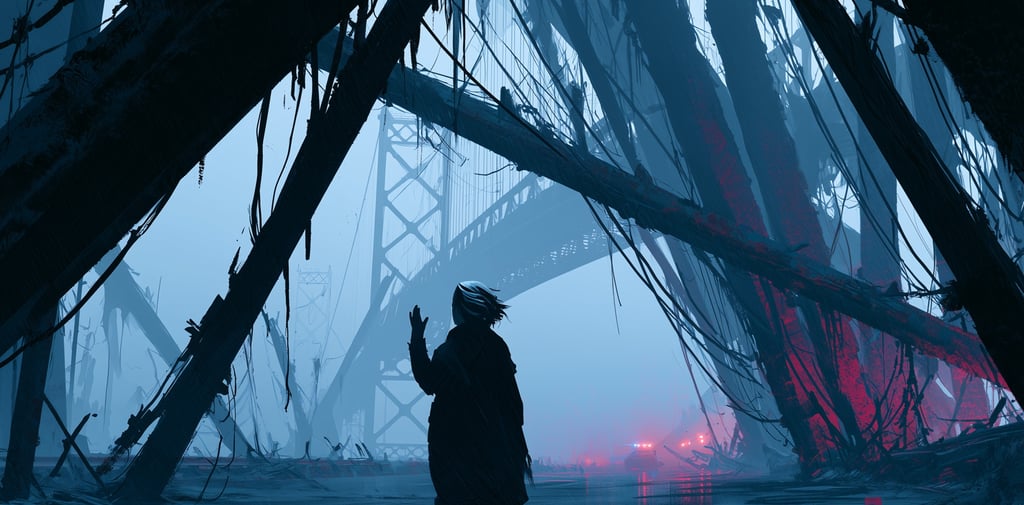
They hit the bridge approach to find it already past the worst of the chaos—stunned quiet where there should have been screaming. The bridge itself, a hundred-year-old monument to industrial ambition, had been wrung out like a rag: steel beams twisted into shapes steel shouldn't make, cars hanging off the buckled roadway, others crushed flat on the ground below. Red and blue light strobed off wet metal. Somewhere below, the river kept moving like nothing had happened at all.
"Her target must've been up there," Kwan said, staring at it. "She'd risk all this for one man?"
"She doesn't see the rest of it." Hale was already moving. "To her, everyone else is noise. Only the justice is real."
Reid had his sensor rig up in under a minute, cables snaking across pavement still littered with broken glass. "Massive discharge. Fifty yards of main span. This isn't a yank, it's sculpture—she picked the beams, picked the angle, built a trap." His voice had gone flat with something like awe.
They pushed through to the epicenter: a sedan, intact, caged in rebar and suspension cable pulled straight out of the bridge itself, cables still humming faintly with tension. The driver, mid-fifties, well-dressed, dead from a single shard of steel through the heart, through glass that was supposed to stop bullets. His briefcase sat undisturbed on the passenger seat, latched.
Hale put a hand on the cage. This one was fresh, still burning. He felt her reach out, felt the steel answer her the way a hand answers a thought. He felt her contempt as the car rolled toward the trap. Gregory Shaw—an insurance man who'd signed off on the accident ruling, buried Dmitri's complaints under a stamp. Another liar. Another cog.
He felt her triumph when the trap closed—god-like, exhilarating, a symphony built out of tons of steel. And underneath it, something new. Not just another kill. A prelude.
"Weyland." Hale pulled his hand back, dizzy with it. "This was the opener. She's coming for the top."
Kwan looked over from where he'd been steadying a woman in shock, face gray. "She's getting stronger every time, Tom. Next one's worse."
Hale knew it. Cromwell's pressure, once a background hum, now screamed. This wasn't a murder case anymore.
They were trying to stop weather. A widow who'd made a weapon out of a city's bones, and she wasn't finished building it.
He looked at the ruined bridge—love, turned into something that could tear down the world—and felt the shiver of a man who understood exactly why.
***
"Well, Cromwell's thrilled," Reid said, not looking up from his monitors. "Our girl just graduated to domestic terrorism. Official story's a freak earthquake. Nobody's buying it, and my seismic readouts are screaming bullshit."
The command post smelled like burnt electronics and old coffee. Knopff was gone, coordinating with a tactical team inbound from Chicago. Kwan was at the hospital, working survivors gently. Hale had gone quiet since the bridge, wrung out like everything else that day.
Which left Reid to connect the dots. They knew who. Proving it was another matter—SHEPARD didn't kick down doors on the strength of a psychic hunch. He needed a chain that would hold.
He started with Dmitri. Union files, employment history, financials, medical records nobody outside the agency was supposed to see. He built the web on a corkboard nobody else could see, red string in his head instead of on the wall, then laid the dead men over it. McCluskey: direct superior, documented safety disputes. Check. Penn: wrote the settlement for Weyland's company. Check. Grabowski: pushed the deal through, history of trading safety for labor peace. Check. Shaw took more digging—insurance investigator, final report, the one that closed the file for good. Check.
Motive, solid all the way down. Means was the harder part.
The energy signatures didn't spread wide, the way most kine discharges did. They pinpointed. Reid ran a triangulation—same math you'd use to find a hidden transmitter—and watched four wildly scattered locations converge on one unremarkable block in Hamtramck. He pulled the property record. 1417 Carpenter Street. Rostova, free and clear.
"Gotcha," he said, and meant it.
He kept digging anyway. Elena, born in Lviv. Immigrated in the fifties. Seamstress, then homemaker. Not so much as a parking ticket, right up until it mattered. Then a flag—a great-uncle in a Soviet parapsychology program from the forties, chasing a genetic marker SHEPARD's own files linked to ferrokinesis. The file itself was thin, half-redacted, more rumor than record. A latent gene, maybe, sitting dormant her whole life until grief cracked it open.
He had it now. A widow. A gene she never asked for. A trigger with her husband's name on it. Her house was ground zero. Her grief was the engine. The whole rusted skeleton of Detroit was the weapon in her hand.
He packaged it—financials, victimology, triangulation, the genetics—into a file circumstantial enough to make a lawyer nervous and solid enough to make Reid sure. No video, no confession. In SHEPARD's world, it was as close to certain as anything got.
He sent it to Hale and Kwan with one line: Iron Widow Identified. Location Confirmed. Final Target: Charles Foster Weyland.
Not a ghost anymore. A woman with an address. And one act left to finish.
***
Updates
Follow for the latest on my stories.
Fiction
contact@msrayed.com
© 2025. All rights reserved.
My Substack: https://msrayed.substack.com
My Patreon: https://www.patreon.com/cw/MSRayed