
The Omission Index, Ch 31: Iron Widow Pt. 1
The SHEPARD team hunts the Iron Widow, a grieving woman using deadly ferrokinetic powers to avenge her husband's tragic death in Detroit.
SERIALIZED FICTIONTHE OMISSION INDEX
6/23/20269 min read

1984
McCluskey arrived early to his own deal, which was the first mistake.
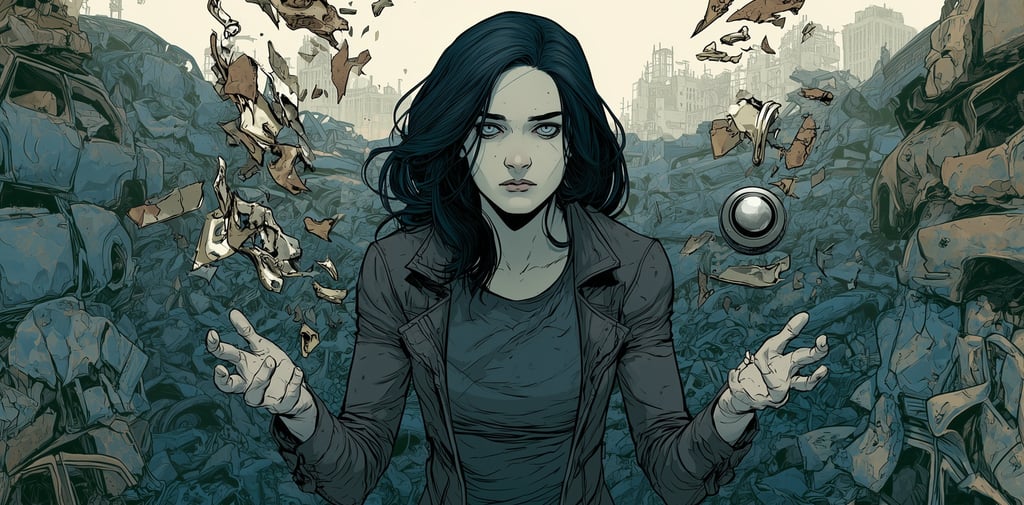
The junkyard sprawled across ten acres on the city's ruined west side — a graveyard of flattened cars stacked in narrow canyons, their paint bled to rust. Ford Falcon blue. Impala turquoise. Cadillac crimson. All of it fading into the same brown nothing. The air smelled of leaking oil and old metal and something slower, more permanent. A cold wind moved through the aisles of crushed steel and made a sound, low and almost human, that he didn't care for.
His contact was late. McCluskey kicked a hubcap. The clatter came back to him too sharp for the open space, and he stopped moving.
He thought about Rostova. He hadn't meant to. The Ukrainian had been dead three months, the incident report clean, the files closed. A hydraulic press malfunction — unforeseeable mechanical failure, a tragic accident, everyone agreed. McCluskey had signed off on all of it, had repeated the right phrases to the right people, and had not thought about Rostova's face since. The plant had gotten quieter. That had been the arrangement, even if it was never put in those words.
A creak of metal — close, deliberate — spun him around.
"Manny?" His voice came out thin. "Cut it out."
The driver-side door of a wrecked Chrysler New Yorker had begun to shudder, its rusted hinges screaming. Then the door tore free.
It hung in the air.
His mind cycled through explanations rapidly and without success. Crane. Magnet. Prank. The door began to move — level, unhurried, with the deliberate patience of something that had already made up its mind. He turned and ran. He heard it whistling behind him through the canyon of steel. He hit a patch of gravel, went down hard, his knee detonating in white light. He looked back, gasping.
The door wasn't following. It slammed across the mouth of the aisle and embedded itself between two stacks of crushed cars with a sound like a cannon. His exit, sealed.
Around him, the junkyard assembled itself into something else. Fenders peeled from car bodies. Chrome bent and snarled into jagged shapes with no innocent interpretation. Lengths of steel cable uncoiled from the beds of wrecked trucks and moved with a cold, deliberate grace. At the far end of the narrow canyon, a massive engine block began to swing from the hook of a derelict crane — slowly at first, finding its arc. Not random. Aimed.
McCluskey screamed. He scrabbled backward at the gravel, his ruined knee useless beneath him. The metal around him rose, tightening into a cage, piece by piece, each jagged component filling its place with terrible precision.
In a shard of rearview mirror, he saw a face. Dark hair. Pale skin. A grief so total it had become something else — something colder, harder, and without limits. He recognized her. He'd seen her at the inquest, sitting in the back row and saying nothing. Rostova's wife. Elena.
The engine block completed its arc.
***
The file arrived on Reid's terminal tagged ANOMALOUS MORTALITY EVENT – DETROIT. SHEPARD's clinical shorthand for: someone died in an impossible way.
Reid opened it between sips of cold coffee. Most of these turned out to be explicable — equipment failures, unusual weather events, the occasional unhinged but thoroughly human perpetrator. He read through the PD preliminary: David McCluskey, 52, foreman at Jefferson North Assembly Plant, cause of death blunt force trauma at a privately owned junkyard on the city's west side. The official theory was a failed crane, a cascading pile-up, a junkyard avalanche. Boring, but plausible.
Then he reached the crime scene photos.
"Plausible, my ass," he muttered.
McCluskey was a mess. That part tracked. The scene around him didn't. A steel car door — ripped from a Chrysler with rust patterns that placed its last movement in the Carter administration — was embedded between two car stacks twenty feet from the body, its hinges sheared as if by a force applied simultaneously along the full hinge line. Rebar bent into clean right angles. Sheet metal shards buried in surrounding vehicles at angles suggesting they'd been launched, not tumbled. The engine block that had done the killing showed thermal stress from rapid heating and rapid cooling, with zero scorch marks on anything nearby.
"Hale, Knopff, get in here," he said into the lab intercom. "Detroit. Looks like Magneto's angrier, less fashionable cousin redecorated a junkyard with a factory foreman."
He had the 3D schematic assembled by the time they gathered around his console. "This is a murder. The perpetrator is a ferrokinetic, high-level. These stress fractures on the I-beam indicate force applied from multiple non-contiguous points simultaneously — mechanically impossible. The chrome bumper here was heated to near its melting point and then rapidly cooled, with no corresponding fire damage to anything around it." He paused. "Our suspect isn't just moving metal. They're rewriting its structural properties in real time."
"Other incidents?" Kwan asked. He already looked tired.
"Two. Same city, same month." Reid pulled up the files. Greg Lanfield, a union official, killed when a fire escape collapsed around him like a closing fist. Harrison Wight, a corporate lawyer, whose brand-new Lincoln was crushed flat in his own garage by a series of cast-iron radiators that had moved upward through the floorboards. "All three victims were connected to the official investigation of a worker's death at Jefferson North Assembly Plant three months ago. Man named Dmitri Rostova."
Hale had not spoken. He was looking at the crime scene photographs with the particular distant focus that meant he was no longer entirely in the room. "They're connected," he said. "McCluskey, Lanfield, Wight. All tied to what happened to Rostova." A pause. "The source is his widow. Elena Rostova. His death triggered the activation."
Reid cross-referenced the names. McCluskey had signed the safety report. Lanfield had accepted the company's settlement, closing the union inquiry. Wight had expedited the legal paperwork on the other end.
"Revenge campaign," Kwan said quietly.
"Grief campaign," Hale said. He was looking at a small photograph from Rostova's file — the couple in some happier, ordinary moment, both of them smiling. His face was neutral in the specific way that meant it was being held there deliberately.
Director Cromwell's voice on the secure line was flat. "High-level ferrokinetic, active kill list, grief-driven. Detroit is built from her ammunition. Full team deployment. Wheels up in thirty. Find the Iron Widow. Shut her down."
Reid began packing his kit. He glanced at Hale, still standing, still looking at the photograph. Something moved behind the professional stillness. He didn't name it, and Hale didn't offer one. Detroit was going to be loud.
***
The city announced itself from the highway. The skyline was half-collapsed — grand art deco towers flanked by the skeletal hulks of abandoned auto plants, their empty windows catching the grey afternoon light. From the road they looked like monuments. Closer, they looked like bones.
Hale felt the city before he saw it clearly. Not just observed it — absorbed it. A low, constant pressure against the edges of his mind. The compressed grief of a place that had built its identity around a single industry and watched that industry dismantle itself and move on, leaving the people behind. Tens of thousands of individual losses, each one quiet and legitimate and tremendous in aggregate. It pressed against him like weather.
It resonated with things he was not thinking about.
The Detroit PD precinct smelled of old coffee and institutional discouragement. Detective Korski looked as though he'd been assembled from the same tired materials as the building itself. His face was a map of things he'd decided not to be surprised by anymore, and his eyes held the flat, assessing gaze of a man who had long since stopped being disappointed by human nature and had arrived somewhere past disappointment, at a kind of grey determination to do the job anyway.
He regarded the SHEPARD team, their equipment, and their deliberately vague federal credentials, and gestured at the evidence board without ceremony. McCluskey. Lanfield. Wight. Each dead and photographed in their specific, terrible condition.
"You're the Washington spooks here to tell me my accidents aren't accidents," Korski said. Not a question.
"We're exploring—"
"UAW is screaming union-busting. Corporate lawyers are threatening suits. I've got press camped outside and a captain who wants answers by Friday." He looked directly at Hale. "I don't need theories. I need a name."
"We're working on it," Kwan said.
While Kwan held the room, Hale let his attention drift. He focused on the crime scene photographs pinned to the board and let what clung to them surface. The victims' final moments came first — shock, pain, the cognitive collapse of a person whose understanding of physical reality had been made suddenly and permanently obsolete. Then the perpetrator's signature, overwhelming everything else.
It wasn't rage. Rage was chaotic, explosive, undirected. This was something that had been compressed under immense pressure over a long time and refined into something precise. A grief with a purpose and a list. He'd felt anger before — in interrogation rooms, at crime scenes, in himself, especially lately. But this was a different temperature and a different kind of clarity. A woman who had loved someone without reservation, watched him destroyed by the casual negligence of men who could afford not to think about it, and had arrived on the other side of that loss at something like terrible resolution.
The shape of it was not unfamiliar. That was the part he refused to examine.
"Rostova," Hale said. His voice sounded distant to him. "The file said he was vocal about safety violations at the plant."
"Pain in management's ass," Korski said. "But by all accounts, a good man. Solid worker. His death quieted the line down considerably." A pause. "Lot of people benefited from that quiet, even if they didn't say so." His eyes stayed on Hale. "You think the wife is behind this."
"We're exploring all possibilities."
They left the precinct into a grey, cold afternoon. Hale stood on the steps for a moment and let the city's weight settle back around him. Somewhere inside it, burning very quietly and very specifically, a woman with a list and a set of abilities she hadn't asked for and had not refused. A woman who had remade herself around a single, terrible clarity and was working through it with methodical patience, piece by piece, name by name, each death a sentence in a language she had not invented but had been given no choice but to speak.
He understood what drove her. He was not going to say so.
***
Elena moved through the house in Hamtramck without turning on the lights. She had stopped needing them.
Dmitri's armchair still held the impression of him. The slight depression in the cushion, the place where his head had rested — she knew every contour. She didn't sit in it. She passed it, acknowledged it, and moved on. The Easter eggs they'd painted together one spring sat on the mantel, careful and bright, a life ago. His photograph was on the kitchen table: work coveralls, easy smile, some ordinary weekday that had not known it would be preserved. She could not look at it for long.
On the table beside it: a sheet of lined paper. Three names, crossed out in neat, deliberate strokes. One name, circled in red.
Charles Foster Weyland. Plant owner. He had sent a card after the inquest — Deeply regrettable, the company would honor Dmitri's memory. She had held the card over the kitchen sink and let it burn. She had watched it very carefully while it burned.
Elena picked up a ball bearing from the ceramic bowl beside the photograph. She closed her eyes.
The power had terrified her at first. It had come with the call about Dmitri — sudden and volcanic and screaming through her without permission, filling the kitchen with hovering, humming metal. Madness, she'd thought. Some final fracturing of the mind under unbearable weight. But madness didn't have this precision. Madness didn't let her feel the rebar in the walls of buildings two streets away, or the rails under the street, or the iron in the plumbing of houses she had never entered. Madness didn't improve with practice.
She had stopped calling it madness.
The ball bearing lifted from her palm. It hung in the air and turned slowly, maintaining itself without effort, a small planet of steel in the kitchen's quiet dark.
She had thought carefully about each of the three men. McCluskey, who had filed the paperwork and gone home to dinner and not thought about it again. Grabowski, the union rep who had accepted the settlement money and called it closure. Penn, the lawyer who had expressed condolences in a voice practiced to warmth, the words costing him nothing. Each had made a calculation in which Dmitri's life was a manageable variable, a line item in a system built to produce line items. She had answered them in the only language such a system understood. There had been no pleasure in it. Only a necessary, joyless precision.
Weyland was more difficult. His house sat behind gates in a suburb far from the city he'd spent thirty years extracting a living from. But she had been extending her range every night, reaching outward through the city's metallic nervous system — the pipes, the rails, the rebar in concrete, the thousand forgotten car bodies rusting in a dozen junkyards. It spread out from her like a second circulatory system, one she could feel to its edges. On still nights she could sense the iron in the frame of Weyland's house from a kilometer away. She was learning its weight.
She let the ball bearing drop into her palm.
"Almost done," she said, in Ukrainian. She was looking at the photograph. His smile, caught and preserved, unchanged by everything that had come after. "One more. For you."
She folded the paper with the names on it and slid it beneath the photograph. Outside, the neighborhood was quiet. She could feel the city around her — iron in the pipes, steel in the rails, the accumulated weight of ten thousand discarded machines, patient and available, waiting for direction.
She had never asked for any of this. She had only wanted Dmitri to come home from work.
She went to the window and stood there a long time in the dark. The Iron Widow had one final requiem to perform.
Updates
Follow for the latest on my stories.
Fiction
contact@msrayed.com
© 2025. All rights reserved.
My Substack: https://msrayed.substack.com
My Patreon: https://www.patreon.com/cw/MSRayed