
The Omission Index, Ch 29: Imperfect Forms Pt. 2
SHEPARD hunts a twisted bio-artist turning LA dreamers into dying masterpieces, only to uncover a terrifying corporate conspiracy backing the horror.
SERIALIZED FICTIONTHE OMISSION INDEX
5/24/202610 min read
The conference room smelled of bad coffee and fluorescent light. Hale stood at the far end, arms crossed, staring at the projection screen. Ellie Chen's transformed body. Morfydd's anatomical sketches. The gleaming row of custom-made tools. He'd been staring for ten minutes. Hadn't blinked enough.
Knopff hadn't moved either. He stood with his arms folded tight across his chest, jaw set, eyes fixed on the photographs with the expression of a man actively choosing not to feel something.
Reid was talking. He'd been talking since they sat down—cellular regeneration, bio-catalysts, tissue rejection—the words precise and quick, a wall of technical language between him and what he'd actually seen in that studio.
Kwan said nothing. He'd just returned from the medical facility. Ellie's screams, he'd told them quietly, hadn't stopped.
"Morfydd isn't a sadist." Hale kept his voice flat. "Not primarily. What I pulled from that studio—from the residue on Ellie—was something closer to religious conviction. They believe they're creating. Elevating." He paused. "The suffering is incidental. Aesthetically interesting, maybe, but incidental. The form is what matters. The vision."
He'd spent two days trying to put that mental landscape into words. He still didn't have them exactly right. The closest he could get: a god who'd decided people were clay.
"The victims," Kwan said. Low, careful. "You mentioned willing participation."
"Early on. Some of them." Hale pushed off from the wall, moved closer to the screen. "Morfydd picks people who already want to be unmade. Artists. Outsiders. People who look at their own bodies and see a limitation. They offer a dream—transcendence, notoriety, beauty beyond the ordinary. And some people step onto that platform believing they're choosing it."
He could still feel the echo of it. The seductive pull, the whispered promises. You could be extraordinary. You could be unforgettable. You could be more.
"The dream turns," Kwan said.
"Always." Hale turned from the screen. "Because Morfydd's vision isn't a collaboration. The moment a subject deviates—resists, or just fails to match the internal blueprint—they're forced into compliance or discarded. Left to collapse." He looked at the image of Ellie. "In whatever state they happen to be in at the time."
Reid pulled up his datapad. "The biology confirms it. The alterations are radical—cellular restructuring at a speed we haven't documented before. But they're inherently unstable. The modified tissue is fighting itself. Without constant biokinetic intervention, the transformations degrade. Rapidly." He set the pad down. "They're not building new lifeforms. They're building things that are already dying."
Knopff uncrossed his arms. "They're leaving them to un-become." He said it like he was reading a sentence he'd rather not have understood. "That's its own kind of thing."
The room went quiet.
Hale felt it then—the thing he'd been keeping at the edge of his attention since the studio. The bodily transformation, the external force rewriting flesh without permission, the self made unrecognizable. His divorce proceedings had resumed last week. His lawyers had started using the word irretrievable.
He pushed it down. Focused on the screen.
"Kwan." He kept his voice even. "Walk us through the psychological model."
Kwan straightened slightly. "Morfydd doesn't rely purely on the power. They groom. Flattery, manufactured intimacy, a cultivated aura of genius and vision. They make their targets feel chosen. Seen. Like becoming Morfydd's subject is a privilege, not a trap." His jaw tightened. "The betrayal, when it comes, is total. They've trusted Morfydd with their body. With the thing they most wanted to change about themselves."
"They offer their prey the illusion of godhood," Hale said. "Then devour them."
The words sat in the room. Nobody disagreed.
Somewhere in Los Angeles—dream-haunted, sun-bleached, full of people who'd come there to be transformed—Morfydd was already looking for the next canvas.
***
The new Vernon studio smelled of industrial antiseptic and rare earth compounds. Clean. Blank. The way it should be.
Morfydd stood before the projection on the far wall and studied Kenan.
Twenty-two. A dancer turned barista, auditioning for every avant-garde troupe that would have him, which had recently been none. He had a bird-like frame, a dancer's disciplined economy of motion, and eyes that gave everything away. Wide, expressive, hungry. He moved through the mundane—serving coffee, crossing a street—with an unconscious liquid grace that most people never noticed and Morfydd had noticed immediately.
The relocation from the old studio had been an irritant. Marco had forced that. But perhaps the disruption was useful; the old space had accumulated too many remnants of near-successes, of visions abandoned mid-execution. A clean studio bred cleaner thinking.
Morfydd traced a finger along the projected line of Kenan's collarbone.
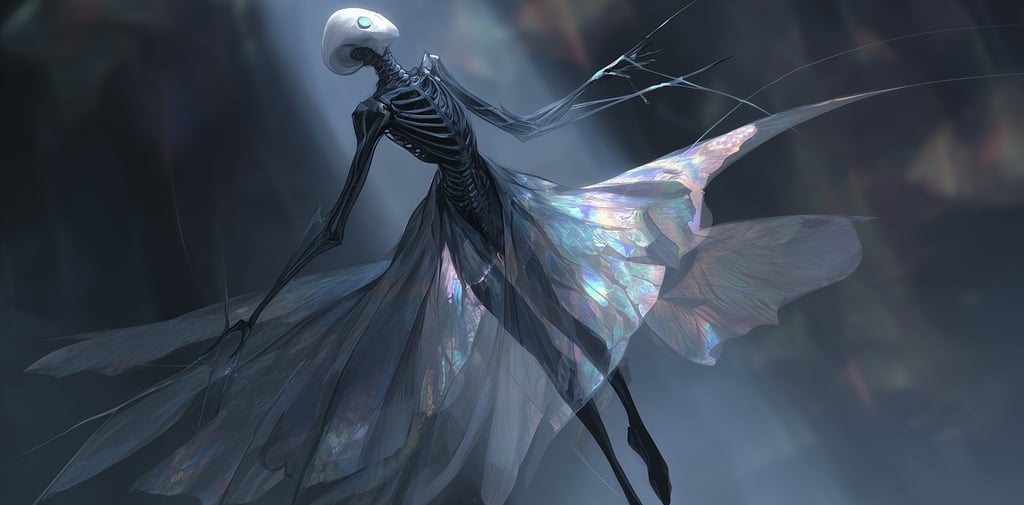
The form they envisioned was their most ambitious. Not bat-leather. Not the heavy muscle of a ground bird. Something translucent—iridescent membranes stretched over elongated, hollowed bones, capturing light like broken rainbows. A torso streamlined down to its essential purpose. A pelvis restructured to support actual flight. Legs built not for walking but for perching, for the moment of launch before the earth became irrelevant. A body that had shed every unnecessary thing.
The grooming had begun three weeks ago. Morfydd had attended Kenan's showcase performance in Silver Lake under a deliberately modest identity: Anna Krakov, an older choreographer, obscure by choice, quietly devastated by the limitations of conventional dance. After the show, Anna had found Kenan near the exit and offered him not praise—anyone could offer praise—but a kind of sorrowful recognition. The human form, Anna had said, can almost express what the soul wants. Almost.
Kenan had latched on like he'd been waiting for exactly that sentence.
They'd talked for hours. Anna wove the tapestry carefully—shared frustration, visionary ideals, the possibility of going further than any conventional company would allow. There are techniques, Anna had whispered eventually, known to very few. Ways to unlock what the body is actually capable of. To become the art, not just perform it.
The images Morfydd had shown him were curated. Digitally perfected representations of past work, showing only the transcendent moments before the inevitable collapse. Skin like polished obsidian. Eyes like faceted stone. Limbs that moved like water. Nothing of the screaming. Nothing of the smell.
Kenan had believed all of it.
He was coming tomorrow evening. A preliminary consultation, Anna had called it. A bio-energetic assessment. He thought he was on the verge of the breakthrough he'd spent his whole adult life auditing for. He had no idea the studio was a slaughterhouse. No idea that his body was already the material.
Morfydd smiled. Slow, cold, satisfied.
The Ellie Chen disappointment had already faded. The interference of law enforcement—irritating, but manageable. None of it mattered now. What mattered was tomorrow. What mattered was the work.
The fleeting nature of the pieces wasn't a failure. Morfydd had decided this long ago. It was the point. A Tibetan sand mandala is destroyed when it's finished. Its beauty lives in the making and the dissolution, not in any permanent holding. Each subject was a prayer. A momentary, agonizing, exquisite reach toward a perfection that couldn't be kept—only pursued, again and again, with better materials.
Kenan, with his dancer's grace and his desperate eyes, would be the most beautiful prayer yet.
***
The Los Angeles underground art scene wasn't a community. It was a collection of competing, often hostile subcultures that shared only geography and a shared contempt for the mainstream. Kwan had spent three days learning its shape.
Warehouse galleries reeking of spray paint. Performance spaces vibrating with engineered transgression. Body-modification studios tucked into forgotten industrial corridors, operating in the gray space between art and surgery. He moved through all of it quietly, under the name Ezra Kim, freelance journalist, researching fringe art forms—vague enough to get him in, specific enough to justify questions.
Hale had mostly stayed back. The mental noise of this particular subculture—the combined psychic weight of desperation and longing and self-constructed mythology—was hitting him harder than usual. So Kwan listened.
He listened to artists whose statements outran their actual work. To performance artists who used pain as medium and called it catharsis. To people whose skin was a decades-long document of modification—each piercing, each cut, each implant a sentence in an argument with the body they'd been given. In a city built on reinvention, these were the people reinventing at the cellular level.
Morfydd's name moved through these circles like smoke. Hushed. Weighted. Some said it with reverence. Some said it with a fear they quickly dressed up as admiration.
There were stories of earlier work. Years ago, before the transformations had become total. Subtle enhancements—skin that held an inner light, eyes that shifted with mood, a temporary sensory elevation that felt, people said, like being more awake than you'd ever been. Those early subjects were fiercely loyal. They remembered only the peak. The subsequent crashes, the strange illnesses, the persistent unease—these got folded away somewhere quiet.
He found one of them in a Goth club downtown. Starlight. Her skin still held a faint, unnatural sheen—a residual gift, she said, though her eyes were ringed with something that looked like chronic fatigue. "For a week," she told him, her voice low and practiced, "I was luminous. People couldn't stop looking at me." She didn't mention the migraines. When Kwan pressed gently about Ellie Chen, about the more recent work, she shrugged. "Art demands sacrifice. Some canvases can't hold the vision."
He heard that phrase again and again. In different mouths, different registers. Always the same casual burial of suffering under the language of artistic necessity.
A young man whose friend—a model, ambitious, easily flattered—had disappeared weeks ago after describing a career-defining collaboration with a mysterious sculptor. The friend hadn't come back. A gallery owner who had briefly, unknowingly, exhibited what he now suspected was an early Morfydd piece: a sculpture that had seemed, he said slowly, almost alive.
Kwan felt each of these stories land in his chest. He was an empath. He didn't just hear what people told him—he carried the emotional residue of it. Ellie Chen's screams were still there, somewhere behind everything. The weight of cases accumulated like scar tissue.
He ended up in a body-modification studio in a derelict block near Skid Row. The air was antiseptic and incense and something copper underneath. The artist—heavily pierced, teeth filed, eyes with a predatory patience in them—claimed to know Morfydd. Not by that name.
"The Flesh Weaver," the man said, smiling with a mouth that had been modified past smiling comfortably. "A true visionary. Pushes further than any of us." He gestured to a blurry photograph on the wall: a figure with impossibly elongated limbs and jade-toned skin. "An early study, I think. Magnificent." He leaned closer. "They say the Weaver can give you any form you want. Make you a god. Or a demon. The price is just your old self."
Kwan left without getting what he came for. Which was normal. He was building a picture from fragments, and the fragments were taking something from him each time.
He wondered, walking back to his car through streets that smelled of exhaust and night-blooming jasmine, whether there was a point at which you looked at enough monstrous transformations that you stopped being sure what you were holding onto. What part of yourself stayed fixed when everything around it kept changing shape.
He didn't have an answer. He got in the car and drove back toward the field office.
***
Morfydd was meticulous about the obvious things. Cash transactions. Short-term anonymous studio rentals. No digital footprint worth the name. Reid had spent two days confirming this before he stopped looking for what wasn't there and started looking for what had to be.
The art required materials. Restricted biochemical agents, experimental tissue stimulants, custom-fabricated surgical tools—none of it available at the local hardware store. Somewhere in LA's shadow supply chain, Morfydd was a customer. That was the way in.
Knopff had helped. His particular brand of persuasive conversation—which Reid had tactfully never witnessed directly—had loosened several reluctant pharmaceutical suppliers enough to share client lists. Reid cross-referenced, compiled, traced, and on the third day hit an encrypted shipping manifest.
Twelve hours of work and enough coffee to make his hands shake. The manifest detailed a recent delivery to a shell corporation called Chrysalis Innovations: cryo-preserved genetically modified amphibian cell cultures, a restricted neural growth hormone, a custom bio-compatible polymer resin with rapid self-healing properties. The delivery address was a P.O. Box in Vernon.
"This is black-budget biotech," Reid muttered to his screen. "You don't just order this."
He ran a deeper trace on Chrysalis Innovations. The digital trail was a masterpiece of concealment—cutouts, offshore accounts, anonymous data havens stacked like nesting dolls. So he stopped following the money directly and started looking at methodology. Encryption signatures. Communication patterns. The specific type of untraceable currency used for certain transactions.
And found it.
A string of code embedded in a payment authorization for a batch of custom neuropeptides. He recognized it. He made himself look twice before he let himself believe it.
He pulled up the Appalachia files. Daniel Pearsall. The young ash-bender whose powers had been artificially, brutally amplified. He cross-referenced the code string.
Match.
"Son of a bitch."
Advanced Genesis Initiatives. Their proprietary digital watermark, embedded in Chrysalis's transaction chain. A.G.I. He'd hoped the Yakama disaster had slowed them down. Apparently their appetite for weaponizable superhuman talent didn't slow.
He opened the team comm link.
"Hale, Kwan, Knopff. Our flesh-sculptor isn't freelancing." He kept his voice level. "Morfydd's supply chain runs through an A.G.I. cutout. Either A.G.I. is their supplier—running them as a deniable research asset—or they're tracking Morfydd and planning to acquire them once the technique matures." He paused. "Imagine what A.G.I. does with someone who can sculpt living soldiers. Or build biological infiltrators that look exactly like whoever you need them to look like."
Hale's voice came back tight. "You're certain."
"The signature is unmistakable."
A beat of silence. Then Knopff: "So they either see us coming and move Morfydd, or they just decide we're inconvenient and deal with us directly."
"Or both," Reid said. "Sequentially."
He stared at the A.G.I. watermark on his screen. Morfydd was a monster, no question—a self-styled god with a lust for biological creation so absolute it had burned through everyone it touched. But A.G.I. was something colder. More systematic. Patient in the way that organizations with unlimited resources can afford to be patient, because they had already decided that human beings were a category of asset rather than a category of person.
Morfydd wanted to make art. A.G.I. wanted to make weapons.
The grotesque gallery of LA's underground had just become an opening move in something much larger. And SHEPARD, as usual, was standing in the middle of the board.
Updates
Follow for the latest on my stories.
Fiction
contact@msrayed.com
© 2025. All rights reserved.
My Substack: https://msrayed.substack.com
My Patreon: https://www.patreon.com/cw/MSRayed