
The Omission Index, Ch 28: Imperfect Forms Pt. 1
A biokinetic visionary is turning LA artists into horrifying living sculptures. Hale's team races to stop Morfydd's next dark masterpiece.
SERIALIZED FICTIONTHE OMISSION INDEX
5/4/20268 min read
1983
Marco didn't scream. The sound died somewhere before it could form.
He stood in the doorway. The studio was clean. That was the first wrong thing—Julian's studio was never clean. Brushes stiff with paint, takeout containers three weeks old, canvases stacked like arguments. Not now. Someone had cleared the floor. Arranged things. The black-draped platform sat at the center of it all, lit by a focused beam of violet light that had no business existing.
Ellie was on it.
He knew it was her from the hair. Or what was left of it—red, yes, still red, but fused into something thorn-like that curved up from her skull as if it had always grown that way. Her chest moved. Barely. The ribs had changed: longer, curved outward, iridescent, like the struts of an insect wing stretched beneath skin that was almost translucent now. Blue-violet veins pulsed beneath. Her limbs were wrong. Too long. They ended in tendril-like structures that curled and twitched against the platform with slow, involuntary grace.
Her face was calm.
That was the worst part. Her eyes were open, fixed on the light above her, and her mouth was parted in a silent O that could have been ecstasy or agony or the point where both became indistinguishable. Marco had seen Ellie laugh until she wept. He had heard her rant about Artaud at three in the morning. He recognized the arrangement of her features. He did not recognize what they were doing.
A wet, low sound escaped her lips. One of the tendrils scraped the platform.
The room smelled of blood, antiseptic, and something floral and wrong, like overripe fruit cut with a chemical he had no name for.
He moved closer. He didn't know why. His legs made the decision. He could see the tools now—a steel tray near the platform, scalpels thin as thought, vials of glowing compound, a device that looked like a jeweler's loupe mated to a soldering iron.
"Ellie."
She didn't move. Didn't blink.
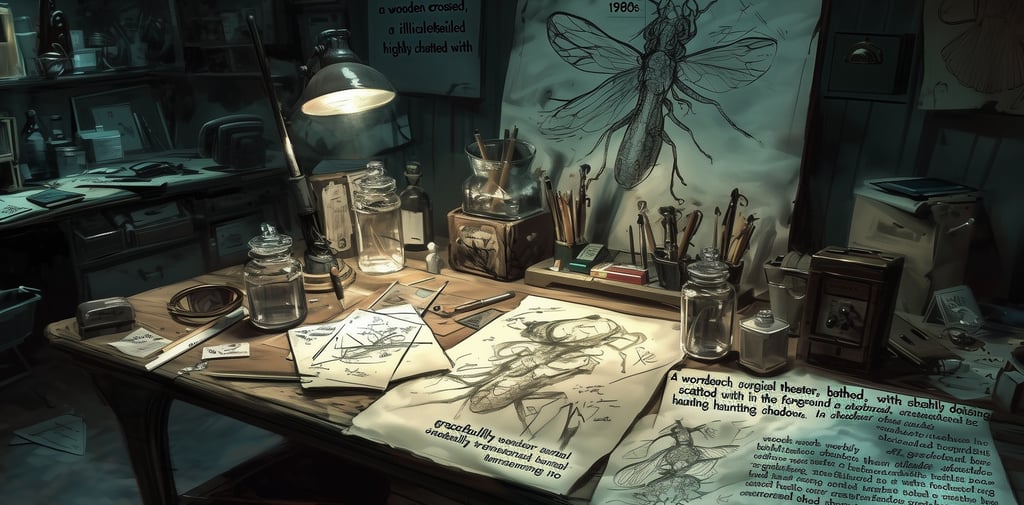
The sketches were on the wall behind her. Anatomical studies, dozens of them, charcoal on paper, each depicting a human form remade into something else. More extreme than what lay on the platform. He recognized one of the faces in the drawings—a young man from their collective who had mentioned, with naive excitement, an upcoming collaboration with someone called Morfydd.
Marco had thought Ellie was exaggerating when she'd talked about it. Transcendent collaboration. Living sculpture. Radical becoming. He'd tuned it out as performance art noise.
He didn't tune things out anymore.
He turned and ran. Down the stairs, through the lobby, out onto the street, where the afternoon sun was indifferent and the traffic didn't stop and no one looked up. The image of Ellie's face—calm, fixed, ecstatically broken—was already permanent.
He needed to call someone. He needed to explain it to someone who would believe him.
He had no idea how to begin.
***
Reid had been staring at the crime scene photos long enough that the cold burrito in his hand had lost all relevance.
The LAPD report was a study in institutional vertigo. Unusual physical alteration, it said. Unknown cause. Possible ritualistic activity or exposure to mind-altering substances. That last one made Reid snort. He'd seen what bad acid did to a person. This wasn't it.
He zoomed in on the image of Ellie Chen. Even through the lens of a police photographer who clearly hadn't known what to do with what they were seeing, the craftsmanship of it was undeniable. The ribs. The skin. The altered limbs.
"This isn't a back-alley biomod job," Reid said. "This is someone who can rewrite cellular structure like they're editing a manuscript."
Knopff, across the room, was assembling a flashlight. He grunted.
"Class Four at minimum. Maybe Five. Biokinetic. Not random mutation—look at the intentionality. Every modification serves an aesthetic function. This person isn't maiming. They think they're making something beautiful."
The coroner's report had come through on the secure channel. Non-human protein markers. Bone density at crystal-lattice composition. A bio-energetic signature that had burned out two diagnostic instruments.
He pulled up the West Coast case log—six months of it. Missing persons from fringe art scenes. Bodies found with unexplained physical modifications. Local PD had filed them as overdoses, ritual killings, one-off aberrations. No one had cross-referenced them. No one had seen the pattern.
"They signed their work," Reid said. He pulled up a scan of one of the charcoal sketches from the studio. In the corner: Morfydd. "That's either arrogance or a calling card. Either way, it's useful."
The door opened. Cromwell entered. Hale and Kwan behind him. Hale had the look he got before a migraine—or before something worse.
"Los Angeles," Cromwell said, skipping everything else. "LAPD has formally requested assistance. Reid, your read?"
"High-level biokinetic. Methodical. Aesthetically motivated—they're not experimenting, they're executing a vision. Call themselves Morfydd. Ellie Chen is alive, in SHEPARD medical in LA, but the transformation is destabilizing. Prognosis is not good." He gestured at the monitor. "And I'd bet next month's paycheck she's not the only one."
Hale hadn't looked away from the photos since he'd walked in. His voice came out rougher than usual.
"The mental residue. There's a lot of it. The victims go willingly, at first. Morfydd seduces them with the idea of transcendence. Becoming something more than what they are." A pause. "Then the process begins, and the consent becomes irrelevant. By that point they can't stop it."
Kwan looked ill. "They want this to happen to them?"
"Some do. At the beginning. The extreme body-modification crowd, the performance artists who've already pushed every other boundary—Morfydd knows exactly who to recruit." Hale finally looked away from the screen. "But the vision always exceeds what any person could willingly survive. What Morfydd calls art, the body experiences as total, irreversible destruction."
Cromwell's jaw tightened. "A.G.I. interest?"
"No direct markers yet. This reads as a lone actor. But a biokinetic this refined won't stay off their radar long."
"Which is why we move now," Cromwell said. "Wheels up in one hour. Identify, locate, neutralize. Secondary: any victims still in progress. Tertiary: full capability assessment and organizational links." He looked at Hale. "Maintain your protocols. I don't want a repeat of Memphis."
Hale nodded. Said nothing.
Reid turned back to the photos. LA. Of course it was LA. A city built on the premise that reinvention was possible, that you could shed one self and build another from nothing. Morfydd hadn't invented the hunger. They'd just found a way to feed it.
***
LA hit Hale differently than other cities.
New York pushed. Memphis ached. LA wanted—a low, constant, almost desperate wanting that saturated the mental atmosphere and made his shields work harder than they should have on a car ride from the airport. The city's particular frequency was transformation. Reinvention. Escape from what you were into what you might be, if you were willing to pay for it.
He kept his walls up. His own life was too close to that frequency right now.
Kowalski met them in a corner office at Parker Center that smelled of old coffee and stalled momentum. The detective had the look of a man who had seen everything LA could produce and had, until recently, assumed that was sufficient.
"Victim's roommate is still at County Psych," Kowalski said, gesturing at the corkboard. "Still talking about transcendent beauty. The ME's report reads like a Clive Barker adaptation of a biology textbook. Whatever you people specialize in—I hope it covers this, because we're out of options."
Kwan took the lead on Kowalski. Hale looked at the photos on the corkboard.
Even at one remove—photographic paper, fluorescent light, the institutional distance of evidence documentation—the residue was strong. He felt Ellie Chen's excitement first, naïve and real, the specific joy of someone who believed they had found the person who could finally see what they were capable of becoming. Then the surrender. Willing, at first. Then the moment it stopped being willing and became simply what was happening to her.
He pulled back before the pain hit him full. He knew what it would feel like. He didn't need to confirm it.
Morfydd's signature was everywhere in the room. Cold, precise, exhilarated. Not cruel—cruelty implied awareness of the other person's suffering. This was different. Absorbed. An artist so completely inside their own vision that the medium's experience simply didn't register.
"The studio," Hale said. "We need to go to the studio."
***
The warehouse district. Decay and ambition, the standard LA combination.
The forensic lamps had replaced the violet light Marco had described. The platform was still there, dark stone stained with things Reid was already sampling. The sterile smell mixed with something sweet and wrong that Hale associated, now, with this specific kind of violation.
The sketches stopped him.
They were extraordinary. He didn't want to think that, but it was simply true. Anatomical studies of impossible forms, each drawn with a precision that suggested the artist knew exactly what they were drawing—not imagined, not approximated, but observed. Planned. Each form had an internal logic. Each transformation followed rules that existed only in Morfydd's taxonomy of the possible.
The corner signatures were small. Almost modest.
He read the room. The emotional record of what had happened here was dense—Ellie's terror layered over Julian's helpless adoration layered over Morfydd's sustained, rapturous concentration. The process had taken a long time. Morfydd had not rushed.
"They don't see victims," Hale told Kwan, quietly. "They see raw material. The suffering is—incidental. A side effect. They're not indifferent to it because they enjoy it. They're indifferent to it because it's not part of what they're making."
Kwan looked at the sketches. "How do we find them?"
"They'll have a new space already. They don't stop. And they'll have a new subject." Hale scanned the sketches again—the progression of forms, bird-like structures, flight mechanics adapted to human anatomy. "They'll be looking for someone specific. Someone they've already chosen."
He filed that thought.
***
The Vernon facility was quiet. That was its primary virtue.
The Ellie Chen situation had been inconvenient, not because of Ellie—the work had been progressing well, certain aspects of the rib formation genuinely promising—but because of the roommate. Marco. Hysterical, ordinary Marco, who had not understood what he was looking at and had responded, as ordinary people responded, by involving other ordinary people with badges.
Morfydd had relocated before they arrived. Standard practice.
The new studio was larger. Better equipped. The suspension tanks along the east wall held three previous studies—partial transformations, stabilized, suspended in nutrient solution. Incomplete, yes. But even incomplete work had instructional value.
They stood at the holographic projector now. The next form rotated slowly in the air before them: a study in avian skeletal structure adapted for the human frame. Shoulder blades reconfigured to anchor cartilaginous wing-structures, light-refracting rather than opaque. Legs elongated. Feet restructured into something more efficient, more honest about what feet could be.
Beautiful. In the abstract. The question was always the canvas.
Ellie had been promising. Her initial commitment was genuine—she'd wanted it, had understood something of what was being offered. But her pain responses had been conventional. The screaming had disrupted the process. True transformation required a specific quality of endurance, an aesthetic courage most people did not possess no matter what they believed about themselves.
Morfydd paced. The studio smelled of compound and metal and the faint residue of previous work. They paused at a tray of instruments and touched one of the thinner scalpels without picking it up. Just contact. Confirmation.
They had been watching Kenan for three weeks.
Gymnast. Dancer, perhaps—the movement suggested dance training but also something more instinctive, a physical intelligence that went beyond discipline. Lithe. Androgynous in proportion. A body that seemed, to anyone who knew how to read bodies, to be asking for something. More. Not in the ordinary sense of more—more muscle, more definition, more of what it already was. Something categorically different. Something it didn't yet have language for.
Morfydd had language for it.
They returned to the projector. The winged form rotated. They studied the shoulder articulation, the weight distribution, the necessary reconfiguration of the spine to support the new structures. There were three possible approaches to the initial incision sequence. They had been refining toward the cleanest one.
The authorities were an inconvenience, not an obstacle. They didn't know what they were looking for. They had no framework for what Morfydd was doing or why. By the time they developed one, the work would be complete.
And the work was what mattered.
Morfydd picked up the charcoal. The blank paper waited. Outside, the city moved through its ordinary routines, beautiful in its ignorance, full of forms that didn't know yet what they could become.
They began to draw.
Updates
Follow for the latest on my stories.
Fiction
contact@msrayed.com
© 2025. All rights reserved.
My Substack: https://msrayed.substack.com
My Patreon: https://www.patreon.com/cw/MSRayed