
The Omission Index, Ch 25: Ashfall Saints Pt. 1
Mysterious volcanic ash buries machinery on sacred land, drawing federal agents to investigate siblings wielding ancient earth powers.
SERIALIZED FICTIONTHE OMISSION INDEX
3/25/20267 min read
The birds stopped first.
Jedediah Franks noticed it before anything else—the sudden absence of the morning sparrows, the silence where robins should have been. Seventy-three years of these mountains had taught him what that kind of quiet meant. He didn't like it.
He was checking his third trapline, moving through the ponderosa pines near the new access road. The raw bulldozed earth made him look away. He knew this slope—the berry patches his grandmother had named, the game trails that hadn't shifted in a generation. Now it was a wound, red and steep, bleeding gravel into the creek bed below.
He stopped.
The air had gone wrong. Too still. The kind of still that pressed against the ears. He knew volcanic country. He knew the difference between mountain quiet and something else.
A smell reached him. Rust and heat. Volcanic smoke without any source.
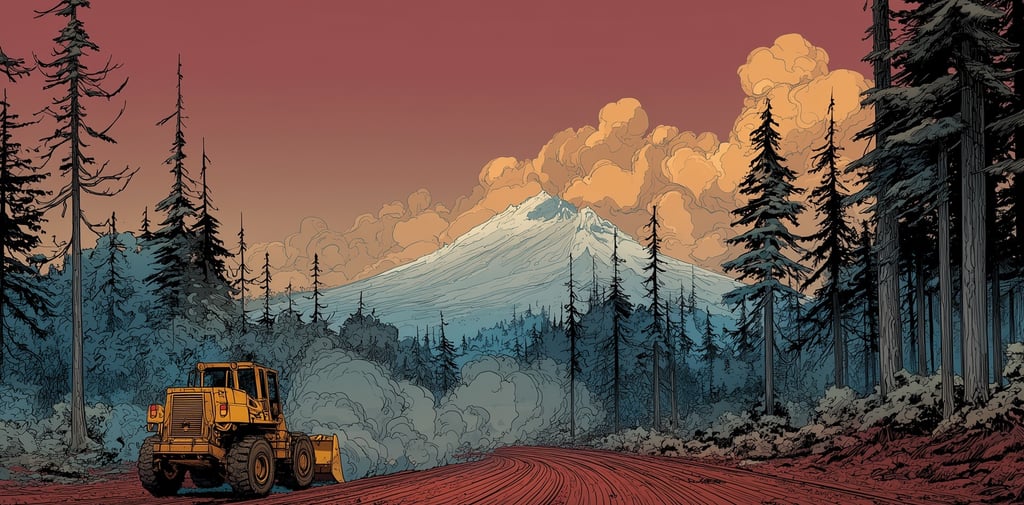
Then, from the bare road dirt, the ash began to rise.
Not blown. Not drifting. Rising—straight up, against nothing, defying every rule of wind and weight he had ever learned. Fine grey particles lifting in slow spirals, thickening into a low curtain that hung over the road's ugly scar. He watched from behind a ponderosa trunk, one hand pressed flat against the bark. His heart was loud in his own chest.
The cloud moved.
Slowly. Deliberately. It flowed down the road toward the parked equipment—the yellow bulldozer, the grader with its cab door hanging open. It didn't scatter. It wrapped. It climbed the blade of the bulldozer, worked into the grille, settled along the cab roof in thick packed ridges, shaping itself until the machine was gone. Just grey. Just ash. Like it had never been anything else.
The hissing. He hadn't noticed when it started. A sound like a thousand disturbed things, a low continuous sigh from the earth itself.
Then it stopped.
The ash fell. All at once—not drifting, not dispersing—dropped straight back down. The cloud dissolved. The birds started again, a single sparrow, then more.
Jedediah stood at the tree for a long time after. His hand hadn't left the bark.
He made the gesture his grandmother had taught him. Small. Just the fingers.
Then he walked back the way he'd come. He didn't look at the buried machines. He didn't tell his nephew that evening when he stopped by for coffee. He didn't call the tribal offices or the rangers or the county paper, even though he knew men at all of them.
Some things you carried.
Some things you left to the mountain.
***
The alert hit Hale's screen at 0340. He read it twice.
ANOMALOUS GEOLOGICAL EVENT – YAKAMA NATION VICINITY, WA. Localized ash displacement. No seismic precursors. No weather event. Duration: approximately four minutes.
He pulled the satellite stills. Ash patterns in perfect arcs. No radial scatter, no wind dispersion. Someone had shaped this.
Reid's note was already attached. Hale, check this out. The ash patterns aren't natural. Too organized. Too fast. This is kinesis—someone moving earth with their mind. Very, very weird.
Hale leaned back in his chair. The coffee at his elbow had gone cold at some point. He didn't remember making it.
Eleven years working superhuman cases. He knew what raw unguided power looked like on a satellite image—the scatter pattern, the blast radius, the way untrained ability left its own kind of wreckage. This wasn't that. This was controlled. Angry in a way that knew what it wanted. Not the undirected anger of someone losing grip. Something older. Something certain of itself.
He pressed his fingertips together and thought about the location. Yakama Nation. Ancestral territory. A new resort development on contested ground.
The intercom cut on.
"Hale, Kwan, Knopff, Reid. Briefing Room One. Now."
Cromwell didn't use excess words.
Neither did Hale, walking the corridor at 0345.
The briefing was short. Geokinetic activity, Yakama Nation land, sovereign territory—tread carefully. Assess and contain. No profile on the subject. No prior incidents in the system. Hale listened without notes.
Wheels up in ninety.
He went to pack his bag. He thought about the location while he did it—the land claims, the broken treaties, the construction permits, the thing on the satellite image that had moved like something that knew exactly what it was doing.
The case didn't feel like the others. He couldn't say why yet. He left it alone.
***
The airstrip near Toppenish was a single strip of cracked tarmac and a wind sock going sideways. Hale stepped off the unmarked jet and the land hit him before his second breath.
He'd worked cases in a dozen states. Blast zones and cordoned wreckage and the edge of things that left marks. But this plateau reached in through the soles of his boots in a way he hadn't expected. The sage. The dry wind with something older in it. The way the peaks sat on the horizon—Pahto to the northwest, enormous and patient. Not threatening. Watching.
His psychic senses flared without being invited. He pulled them back in.
Kwan was already talking to their contacts by the Tribal Police SUV. Officer Ahtanum—tall, broad, maybe forty—stood with his arms loose at his sides and his eyes doing all the work. Watchful. Decided. A BIA agent named Peterson stood slightly behind him in a suit that made no sense for the weather.
Hale hung back and let Kwan work. His partner had a way of walking into a room—or in this case, a windy airstrip—and making people feel heard before he'd said anything. Not the power. Just Kwan. He was using careful language. Geological phenomena. Public safety. Ahtanum answered in short flat sentences that gave nothing away but didn't close any doors either.
Peterson talked too much.
Reid set up the monitoring equipment in the van, moving with unusual quiet. Knopff stood near the vehicle's front bumper and scanned the horizon. Old habit. Looking for exits, or threats, or both.
The psychic echo of this place was not subtle. Hale kept his senses pulled in and focused on the practical: the site coordinates, the access roads, the proximity of the construction zones to the anomaly's origin point. He let the rest wash past him. Almost.
When Kwan came back he was already reading Hale's face.
"All the sites are significant," Kwan said. "Sacred ground, berry patches, land under active dispute with the development company. Ahtanum confirmed the locations. He didn't offer theories." He paused. "He mentioned the stories. Mountain spirits. Protectors waking up."
Hale looked at the peak.
It didn't move. Didn't do anything. It was a mountain. And yet he had the persistent, irrational feeling it was paying attention.
"We need to see the sites," he said.
They drove out in the afternoon light.
***
Cold at the lava tube. Always cold here, even in summer—a breath of deep earth moving upward through the stone. Tahoma stood at its mouth and felt the mountain's pulse through the soles of his boots. Slow. Old. Patient in a way that made human urgency feel small.
He had been coming here since he was nine. His grandfather had brought him. Not to the tourist trailhead, not to the marked path—here. The real place. Where the veil between worlds thinned enough to feel with your hands.
Talulah stood a few feet back, watching the sky. Her face was bright with something that wasn't quite peace. She'd had that brightness since the ash had moved. He recognized it. He was careful around it.
"They saw it," she said. "The men with the machines."
"They saw something," Tahoma said. "Whether they understood it is different."
She turned. "Does it matter if they understand it?"
He thought about that. The wind moved through the pines below. Somewhere down the slope, a creek he couldn't hear from here was running cold over the same stones it had always run over.
"Yes," he said. "It matters."
She made a short sound. Not quite a laugh.
"The Council met yesterday," she said. "They want us to stop."
"I know."
"They're afraid of the government response."
"I know that too."
Talulah's jaw tightened. She had their father's jaw—hard lines, decided. She'd been decided about everything since she was twelve. He loved her for it and worried about it in equal measure.
"We could do more," she said quietly. "We could make them actually stop. Not just pause and look around and then come back with bigger machines."
Tahoma was quiet.
He thought of the road. The raw cut of it. The section where the bulldozer had broken through the old berry ground—the soil there was deep and dark and kept its own kind of memory. He had stood on that ridge and watched it happen and felt something older than anger move through him. Not rage. Older. More settled.
"The warning was meant to make them think," he said finally. "The next message has to make them stop and wonder. Not run. If they run, they bring a response we can't manage. If they wonder—if they can't explain what they saw—then we have time."
Talulah held his gaze. She had her own opinions.
"And when time runs out?" she asked.
"Then we'll know."
She looked back at the mountain. Its snowfields caught the last of the afternoon light and held it—white going gold, then orange, then a deep bruised rose as the sun dropped behind the ridge. She was quiet for once.
Tahoma watched it with her.
The mountain didn't care about schedules. It didn't care about what the development company had filed with the county or what the Tribal Council had voted or what the federal government's lawyers were preparing to argue. It had been here before any of that. It would be here after.
He felt the power low in him—coiled, patient, the same temperature as the rock beneath his feet. Not urgent. Present.
He had not chosen this. The eruption of Loowit three years ago had chosen him and Talulah both. He had spent a long time asking why. He had stopped asking. The mountain hadn't erupted in a century. When it did, it had given them something that felt less like a gift and more like a responsibility handed down without asking. He had accepted it the same way his grandfather had accepted things. Without drama. With attention.
The ash would speak again. More clearly this time. Not in the language of disaster—not fire, not collapse. In the language the mountain itself used. The language that said: this ground knows your name, and it does not forget.
He turned from the peak and walked back into the dark of the lava tube.
Talulah's footsteps in the gravel behind him.
The mountain was still.
Still watching.
Updates
Follow for the latest on my stories.
Fiction
contact@msrayed.com
© 2025. All rights reserved.
My Substack: https://msrayed.substack.com
My Patreon: https://www.patreon.com/cw/MSRayed