
The Omission Index, Ch 24: Blue Room Pt. 3
Agent Hale confronts weaponized sorrow when a blind musician unleashes a devastating sonic attack of pure grief to punish a cruel landlord.
SERIALIZED FICTIONTHE OMISSION INDEX
3/9/20266 min read
Mama Rose didn't say good morning. She slammed the coffee pot down and looked at Kwan like she was deciding whether he deserved the truth.
"Henderson's down at Daisy Lane right now." Her voice was low and flat, the kind of flat that meant fury compressed past the point of explosion. "Thugs, eviction papers, and that giant you got following him around. Thirty days, maybe less, on every door." She picked up the pot again, set it down more gently. "He stood outside Gideon's window, son. Shouted about backbone. About hiding behind songs."
Kwan said nothing.
"You gonna do something about that man or not?"
He didn't have an answer she'd accept, so he left her the truth: nothing. He paid for the coffee he hadn't finished and walked back out into the Memphis heat.
Knopff confirmed it over comms. His voice had the particular flatness of a man holding himself very still. "Strutting like he owns the zip code. Which, technically - " A pause. "I'm following orders. Just so we're clear."
It was deliberate. All of it. Henderson wasn't collecting rent, he was drawing blood, and he'd picked his target. The whole community would feel the wound, but Gideon would feel it like a blade in the chest. That was the point.
The guitarist found Kwan near Beale Street an hour later, pale under his dark skin, eyes scanning the street behind him. He was maybe twenty-two. Looked younger.
"He's gonna play tonight," the kid said. "Not his regular set. Something new. Something for Henderson." He swallowed. "Said he's gonna make the man feel every tear ever cried on Daisy Lane, right there in his own office."
Kwan let the silence sit for a moment.
"Folks scared?" he asked.
"Not of him." The guitarist shook his head. "For him. And for what comes after."
***
Henderson's office was a monument to itself. Mahogany. Smoked glass. Framed certificates arranged with the careful pride of a man who needed to be reminded of his own importance. The junior associate hovered near the desk like he was hoping to dissolve into the wallpaper.
Reid had the portable dampeners set up near the ventilation shafts by the time Hale arrived. Hopeful, maybe. Probably not enough. Knopff had maneuvered Henderson inside under the pretext of a security sweep - the landlord had interpreted this as further proof of his own indispensability and was currently explaining his eviction strategy to no one in particular.
Hale stood at the picture window, Memphis spread out below him, and tried not to listen.
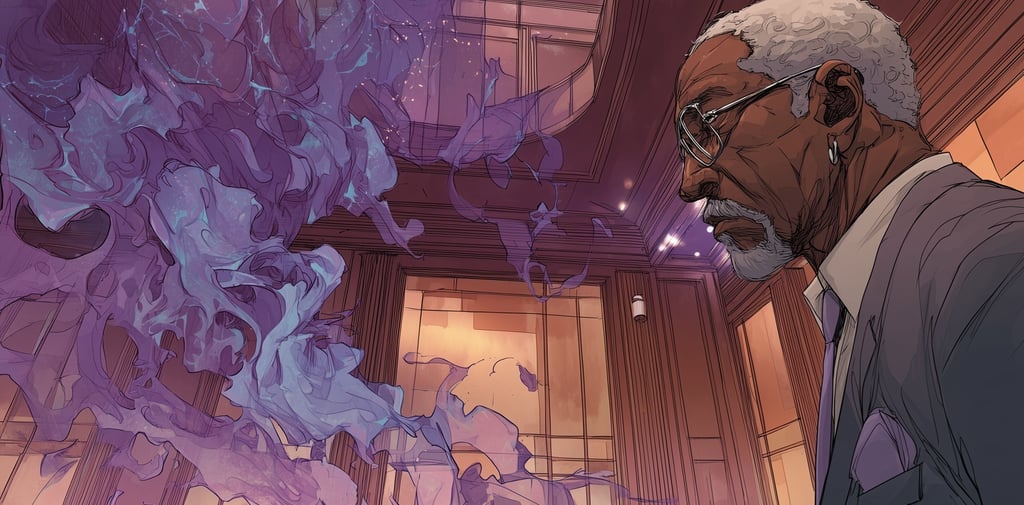
He could feel Gideon coming. Not footsteps. Not sound. A pressure - distant at first, then gathering, the way a storm announces itself by changing the quality of the air. Hale had been running mental shielding drills in his head since Mama Rose's café. He ran another one now. The familiar architecture of professional detachment, built and maintained across twenty years of SHEPARD fieldwork, braced itself for impact.
Susan's voice found a gap anyway. It always did.
He reinforced. Held.
The doorway was empty. Then it wasn't.
Gideon had the presence of a man who had been weathering things for a very long time. Frail frame. Unseeing eyes aimed at some fixed interior point. He carried the harmonica like it was an ordinary object. The guitarist stood three paces behind him, terrified, loyal, very young.
"Evening, Mr. Henderson," Gideon said. "Heard you was celebrating. Thought I'd play you a little victory tune."
Henderson scrambled to his feet. His face went through fury, disbelief, contempt. "Get out. Get out of my office - Knopff, do your job - "
Knopff didn't move. His gaze stayed on Gideon. Unreadable, but coiled.
Gideon raised the harmonica.
The first note wasn't sound. It was something that bypassed the ears entirely, landed somewhere in the sternum like a fist. Low. Precise. One distilled drop of something Hale didn't have a clinical word for.
Then the wave came.
Hale's shields lasted less than a second.
It wasn't Memphis this time, diffuse and ambient. This was aimed, concentrated - fired directly at Henderson like a round through a rifle bore. But Hale was in the way. He caught the undertow and went under hard.
He felt Henderson's life in flashes. Small meannesses accumulated over decades. Rent collected from people with nothing left. A kind of satisfaction taken from watching that nothing become less. It hit Hale like cold water and then it twisted, and suddenly it wasn't Henderson's life at all. It was his own.
Susan's face, but wrong - carved out of his worst fears of her, contemptuous, certain she'd always been right about him. His sons' bedroom, empty. The ache in his chest where they used to be, ripped open and raw and enormous.
He heard himself make a sound he didn't plan to make.
Henderson was on the floor, fetal, howling. The junior associate was unconscious. Reid was behind his dampening field, shouting something into comms that Hale couldn't parse. Knopff stood like a load-bearing wall, jaw clenched, face white.
Kwan was projecting calm into the room, hands open at his sides, and Hale could feel it - thin and clean against the wall of sound - a counter-note, patient, human.
Hale fought for footing. Clinical, he told himself. Find the center of it. He pushed his emotion-dampening ability to its limit, trying to filter the flood rather than stop it, searching for the shape beneath all that weaponized sorrow.
He found it. Injustice. The specific pain of speaking into a silence so complete it made you wonder if you existed. He pushed toward it, not against it. I hear you, he thought, knowing it was probably nothing, probably just his own mind inventing an exit. I hear you. But not like this.
Something fractured in the barrage. One beat of silence, thin as a crack in ice.
Then Knopff moved.
The takedown was controlled - barely - and Gideon went down clean, the harmonica spinning away across the polished floor. The silence that followed was total. Not peaceful. The kind that comes after something breaks that can't be fixed.
Henderson sobbed in the corner. Hale breathed.
***
Gideon came back to himself slowly. Hard floor. Trembling hands. The taste of copper at the back of his throat.
Hands helped him sit up. Gentle, which surprised him.
He didn't need to see to read the room. Fear - ragged, medicinal Henderson fear, still leaking from the corner. Something quieter near him. Watchful. The man kneeling beside him had a complicated aura: disciplined control layered over something personal and barely managed, a grief with calluses on it.
"Mr. Gideon." Not local. Federal. "It's over. Why Henderson?"
Gideon exhaled. Long and rough.
"You walk Daisy Lane?" he asked. "You see Mrs. Walker's face when that notice comes? Young Thomas whispering to his babies about rent he ain't got?" He shook his head. "Henderson's just the boil. The sickness runs deeper. Always has. A man like him owns other folks' lives and calls it business, calls it his right, and nobody blinks." He found his harmonica. Someone placed it in his palm - the calmer one, warmer. He didn't play. "My music is the truth. All our tears, all our anger, all our hope, right there in it. Henderson don't hear words. Don't see us as human. So I made him feel it. A little piece of what we carry every day." His voice held steady. "That ain't a crime. That's leveling the scales."
He heard the quiet one absorb this. Felt something shift in the man's aura - a fractional softening, a note of recognition neither of them acknowledged aloud.
It didn't matter. He'd played his song. He'd spoken his truth.
The rest was just the blues of what comes next.
***
SHEPARD processed Gideon Jones with the detached efficiency of an organization that classified everything it couldn't explain. His harmonicas went into evidence bags labeled unusual energy channels. He didn't resist. He sat in the transport with the stillness of a man who had put down something heavy and wasn't planning to pick it back up.
Henderson went to a private clinic. Acute stress reaction, officially. Kwan suspected Henderson would function, eventually - but the carefully constructed indifference would be thinner from here on, more brittle. The eviction notices on Daisy Lane were quietly shelved by a city council that had no explanation for what they'd heard and didn't want one. A temporary reprieve. Bought at a terrible price.
The Daisy Lane community knew. You couldn't keep a thing like this from the people who lived inside it. They wouldn't talk - not to anyone with a badge or a notepad. But they'd carry it: the image of Alistair Henderson on his hands and knees in his own office, broken by an old blind man with a harmonica. That story would outlast all of them.
The debrief ran long. Reid had four pages of field notes on Gideon's ability - sonic-empathic projection, collective amplification, focused delivery - and concluded with unlike anything currently in SHEPARD's catalogue, which was either impressive or damning depending on your perspective. Knopff said very little. He had the look of a man recalculating something.
Hale sat through all of it and contributed just enough to satisfy the record.
Kwan found him on the hotel balcony later, the city spread below in purple and orange, Beale Street sending up its nightly harmonica wail. It carried more weight than it used to.
They stood without talking for a while.
"Heard from my boys," Hale said finally. His voice was careful with it, the way you're careful with something that might crack if you press too hard. "They miss me."
Kwan nodded.
Below, Memphis played its grief into the evening air - the same grief it had always played, patient and unresolved, the kind that doesn't ask for resolution. Just acknowledgment.
Hale looked out at it for a long moment. Then he went back inside.
Updates
Follow for the latest on my stories.
Fiction
contact@msrayed.com
© 2025. All rights reserved.
My Substack: https://msrayed.substack.com
My Patreon: https://www.patreon.com/cw/MSRayed