
The Omission Index, Ch 23: Blue Room Pt. 2
A bluesman's weaponized grief paralyzes Agent Hale. As SHEPARD investigates a loyal community, Hale is forced to confront his own fractured past.
SERIALIZED FICTIONTHE OMISSION INDEX
2/23/20269 min read
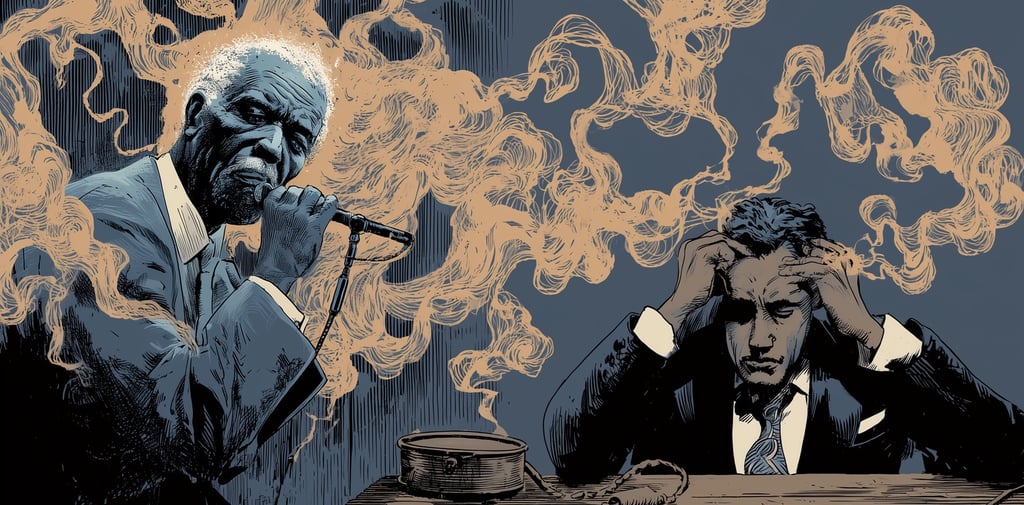
The Crossroads Tavern smelled like the inside of someone else's grief—stale beer, cigarette smoke, and something older underneath, something human and desperate. SHEPARD had chosen it deliberately. Captain Beaufort had confirmed two prior incidents here. Hale had doubled his brown noise feed before walking in.
Knopff took the exit. Reid settled at a hidden table near the wall with his modified briefcase, already checking frequencies. Kwan found a spot at the bar, his expression that of a man watching a ball game he'd already bet on. Hale took the wobbly table in the far corner, back to the wall. He'd been in worse rooms. The crowd's noise was low, almost sullen. Memphis had a particular grief to it, and on Beale Street after midnight, it settled into the bones like weather.
Blind Gideon came in guided by a young woman—granddaughter, maybe, or just a neighbor. He was slight, almost skeletal beneath a too-large jacket. He found his battered stool and sat. Just sat. The club went quiet around him the way rooms go quiet around old men who've earned it.
Then he played.
A single chord. Repeated. It found Hale in his chest before his ears registered it—a resonance more than a sound, low and insistent. Then the voice: gravel scraped across something tender. He sang of levees and lost children, of a faith that kept being tested anyway. The room contracted around the music. The crowd's mental energy shifted, leaned toward the stage, drawn by something it couldn't name. Hale could feel it even through the static in his ears—the slow, collective lean of forty people toward one old man's truth.
Then Gideon raised the harmonica.
One note. Hale's breath stopped.
The brown noise dissolved. The careful walls he'd spent twenty years building—the ones that let him walk through a room full of grieving strangers without drowning—gave way like wet paper. Not gradually. All at once.
What hit him wasn't Gideon's sorrow. It was worse: it was Gideon's sorrow poured through his own open wounds like a solvent. The weight of a sharecropper's eviction and Susan's face at the kitchen table, her voice that particular controlled calm that was always worse than shouting. A lifetime of accumulated racial indignity and the hollow ache of his sons' silhouettes in the doorway the last night he'd been home. The professional compromises SHEPARD filed away and pretended weren't there. All of it collapsed into a single, undifferentiated mass pressing down on his sternum.
His vision narrowed. The sounds of the club became a roar. His hands had stopped working.
Knopff was looking over, brow furrowed. Reid's face had gone pale above his equipment. Then a hand landed on Hale's shoulder, firm and grounding.
"Tom." Kwan's voice, close. "Breathe. My voice. Stay with it."
He tried. The muscles in his legs had locked. He recognized it from his file, the clinical term surfacing from some distant, still-functioning corner of himself: echo-storm. His own suppressed grief, amplified and trapped in feedback with Gideon's projection. The file had called it rare. The file had been optimistic.
Kwan's second hand pressed against Hale's temple. A faint tingle, cool and deliberate—the Analeptic Hymn. Hale felt it work at the edges of the storm without reaching the center. Then something else: a slow drawing-off of pressure, a careful siphoning. Nothing about it was comfortable. But the roaring receded.
He slumped forward, gasping. Sweat plastered his shirt to his back. His hands were shaking in a way he'd have to decide, later, not to remember.
The song ended.
The oppressive weight lifted all at once, leaving the room stunned and blinking—men emerging from a tunnel. Hale looked up. Kwan's face was pale, his expression very still. Knopff was already crossing the room, his usual stoniness doing nothing to hide something that looked close to alarm. Reid stared at his readouts.
"Subject's empathic projection is off the charts." Reid's voice had dropped to something approaching awe. "Sonic frequencies tuned to resonate directly with emotional centers. This isn't amplified sound." He looked up. "It's a directed weapon."
Hale nodded. He'd faced pyrokinetics, a shapeshifter who had worn his commanding officer's face, a telepath who'd left three agents catatonic. None of them had done this. Gideon hadn't breached his defenses. He'd found the door Hale had left unlocked and walked straight through.
The night had barely started.
The grief of The Crossroads Tavern clung to Kwan through the next morning, the way a particular smell does—present even when you can't locate its source. Watching Tom come apart had been its own lesson. Gideon's power left no marks anyone could photograph or file in triplicate. It worked in the gap between a man's walls and his wounds, and Tom had lately had both in unusual abundance.
Hale rested. Kwan worked.
He started three blocks from Gideon's last known address, at a soul food cafe where the smell of frying catfish was thick enough to cut. He ordered coffee, sat with it, let the rhythm of the place settle around him before he said anything at all. He was not Agent Kwan today. He was Ezra—a visitor, curious about the music scene, passing through.
Mama Rose behind the counter had the eyes of a jeweler examining a stone: patient, assessing, waiting for the flaw to show.
"Blind Gideon?" she repeated when he finally asked. "Sure I know Gideon. Known him longer than I care to count." She refilled his cup without being asked. "Man's got the blues in his soul, deep down where it counts."
"I heard him play last night. At The Crossroads." Kwan kept his voice level. "It was powerful."
"Gideon's music speaks the truth," Mama Rose said. "Sometimes a truth folks aren't too keen on hearing." She wiped the counter with a slow, deliberate hand. "You a promoter?"
"No, ma'am. There were incidents during his sets. People taken ill."
Something moved behind her eyes and went still again. "Folks get overwhelmed by the blues all the time, mister. That's what it does. Reaches inside you, stirs things up." She moved toward another customer. The conversation was over.
He tried the domino table in the corner—four older men with faces worn to their essential expressions: watchful, patient, privately amused. He brought up Alistair Henderson and the eviction notices. The banter stopped, not abruptly but gradually, the way a room goes quiet when something significant has been said and everyone in it already knows it. One man set a domino with deliberate care.
"Henderson gets what's comin' to him." A pause. "One way or another."
That was all.
At Daisy Lane the eviction notices were tacked to a dozen doors, stark white against old wood. Kwan counted them as he walked. Mrs. Walker received him politely, offered sweet tea, and watched him with the careful attention of a woman who had learned, across many decades, that official-looking visitors rarely arrived with good news for people who looked like her. When he steered toward Gideon, she set her glass down.
"Mr. Gideon is a good man," she said quietly. "A kind man. He looks out for us." Her eyes moved toward the thin wall separating her apartment from the next. She didn't say anything else.
It was the same everywhere he went. Not in what they said—in what they didn't: the shared precision of their silence, the way every conversation arrived at the same comfortable dead end. They knew what Gideon's music did. They understood the weapon. And they had drawn a circle around their bluesman with a collective quiet as solid as brick.
Kwan returned to the safe house in late afternoon and sat with the weight of it. SHEPARD was here to contain a superhuman threat. The paperwork was clear on the matter. But the people of Daisy Lane were not wrong about what Gideon was to them, and the thing about being right and wrong simultaneously was that it didn't simplify anything. It just left you sitting in a sweltering apartment wondering which side of the line you were actually working on.
The waveforms on Reid's monitor looked like a seismograph reading from somewhere deep and personal—jagged, agitated peaks where the harmonica had peaked, long trembling valleys where the grief had simply settled in. He'd been staring at them since morning. The audio capture from The Crossroads, stripped of background noise and run through SHEPARD's analysis stack, had left something that shouldn't exist: clean, almost surgical construction. Sub-harmonic frequencies layered beneath tonal variations, tuned to bypass the auditory cortex entirely and arrive, uninvited, at the emotional center of the brain.
"Not your grandmother's sad harmonica tunes," Reid muttered.
The safe house AC unit had entered its third hour of slow mechanical deterioration. Knopff had been conducting a private war with it across the afternoon. Reid watched him slap the side panel once more and coax a wheezing sigh of cool air from the vents.
"Can you block it?" Knopff straightened, wiping grease from his hands. "Some kind of noise-canceling field? For a whole room?"
"The sound's the delivery system. The problem is the cargo." Reid turned the monitor so Knopff could see the comparative data alongside SHEPARD's profiles on other known empaths—most of them receivers, overwhelmed by outside emotion, or projectors of their own internal states. Gideon was neither. He was a channel: pulling down the aggregate misery of this city, refining it, focusing it through the music like a lens focusing light until it could burn. "I can try to disrupt the carrier frequencies. Maybe. What I can't do is shield someone in the blast radius from a direct empathic hit of that magnitude." He paused. "Especially not someone as receptive as Hale."
The comm unit chirped. Director Cromwell arrived crisp and without ceremony. Henderson had formally requested police protection. Local PD was stretched thin. Knopff was assigned to the landlord's personal security detail, effective immediately.
The silence that followed lasted three seconds.
"Babysitting a slumlord," Knopff said.
"Consider it close-up observation of a repeat target, Agent Knopff." The line went dead.
Knopff picked up his tactical vest with the controlled movements of a man preventing himself from throwing it. He left without another word.
Reid watched the door, then turned back to his monitors. The waveforms scrolled in their quiet, devastating loops. This case had its own particular wretchedness. The suspect was a broken old man pouring legitimate pain through an instrument with no safety mechanism. The primary victim was a man who'd built his fortune on other people's desperation. And their lead mental operative was somewhere in the back of the safe house, listening to old records with an expression Reid had seen before—on men deciding whether they were still okay.
He cracked his knuckles. "Right. Let's see what you're made of."
He didn't really believe he'd find a counter-frequency. The sound was engineering. The grief was seventy years old and had deep roots. But you had to start somewhere.
The safe house offered nothing. White walls. The smell of someone else's cleaning products. The refrigerator's mechanical hum pitched just close enough to music to be annoying.
Hale's head still rang with Gideon's harmonica. Not literally—no frequency Reid could measure. More like a loosening, as though something had been adjusted and hadn't quite settled back into place.
He found the portable record player in Reid's case, surrounded by old blues LPs—field recordings, mostly, raw and plainly captured. He put one on without looking at the label.
The man on the record had an untrained voice and a single guitar. Whatever he'd lived before that recording, it had made it into the grooves. Hale sat and listened. He wasn't analyzing. He wasn't filing a mental report. He was just a man in a room in Memphis at eleven in the evening, listening to someone dead for forty years sing about floods.
He noticed when his own grief surfaced—not with alarm, just noticed it, the way you notice weather coming in. Susan's voice in the kitchen, measured and final, the morning she first said the word separation. His sons at the window. A dozen moments from the last year, stripped of context, just their emotional residue, floating up to meet the music.
He understood Gideon better than he wanted to.
Not the method. The method left people paralyzed on bar stools and would eventually land the old man in a SHEPARD containment facility, which was a particular kind of ending for a particular kind of life. But the impulse behind it—forcing the indifferent world to feel the weight it imposed on others—Hale could follow that impulse step by step back to its source. He'd had his own version of the feeling. He just hadn't had Gideon's instrument.
Susan's lawyers were painting him as an absent, emotionally unavailable husband. A caricature. The SHEPARD career that had made him unavailable was the part no lawyer could argue in court, the part that existed in no filing and could be defended to no one. He had been unheard, misrepresented, his own truth declared inadmissible. And in that shared sense of having one's reality denied, he found a disturbing, unwelcome kinship with the old bluesman they were hunting.
His duty was clear. Identify, assess, contain. He'd done it dozens of times without this much interference.
The record ended. He sat in the silence it left behind.
The case tomorrow would be the case tomorrow. Tonight, he was just another man in a bad year, in a city that had been singing about exactly this for a hundred years and showed no sign of stopping. He was supposed to be the one analyzing the echoes.
He was becoming one instead.
Updates
Follow for the latest on my stories.
Fiction
contact@msrayed.com
© 2025. All rights reserved.
My Substack: https://msrayed.substack.com
My Patreon: https://www.patreon.com/cw/MSRayed