
The Hot Mess Collective, Vol. 2 Ch 9: Cease and Desist
Nori scores an explosive scoop on vampire blood farms, only to discover her corporate contract is a gilded cage when the network kills the story.
SERIALIZED FICTIONTHE HOT MESS COLLECTIVE
7/21/202610 min read
Nori had always believed truth was a weapon. She was about to learn a harder lesson: a weapon is useless when the people who own the armory won't let you fire it.
But for now, it felt wonderfully heavy in her hands. She sat tucked into a dark, private booth at The Navel, the leather cracked and cool beneath her palms, the air humming with its usual low current of contained magic. Across the table, Leo—the young vampire whose anonymous story as "Julian" had powered her explosive first episode—hunched forward, his fingers wrapped tight around a glass he hadn't touched. His voice stayed low, nervous, a murmur pitched just under the bar's ambient noise. But his words were pure, high-grade ammunition.
This was a different kind of high than the first one. The initial, exciting rush of success—the flood of DMs and GlimGlam mentions after episode one—had been a sweet, addictive drug. This was better. Cleaner. Sharper. The thrill of an investigation closing in on its quarry. She wasn't just a voice offering opinions anymore. She was a journalist, a real investigative reporter standing on the edge of breaking a story big enough to shake a powerful Court to its foundations.
She'd made her choice. Seraphina's smooth, tempting offer of insider information still sat unanswered in her encrypted DMs. Accepting it would have been easy, a clean surgical strike paid for by a rival power. But it would have been a tainted victory. Nori was determined to win this fight on her own terms, with her own sources, with her own integrity intact. Leo was the key.
Encouraged by the response to the podcast, he'd reached out again. He had more, he'd said. The full story. Now, in the booth's quiet, he laid it out.
"They call them Vitae Cultivation Centers." Leo's eyes darted around the empty bar, though no one could have heard them over the ambient hum, and his knuckles had gone pale around the glass. "Sounds clean. Professional. They're not farms. They're prisons."
He described a network of secret facilities buried in the Undercity's deeper, more lawless underlayers—places where desperate, magically-weak Foldfolk and unlucky humans were tricked in with promises of shelter and food. In exchange, they signed contracts—thick, magically-binding documents written in impossible legal language—that quietly turned them into blood sources trapped in service.
"The contracts do the real damage." Leo's hands shook as he slid a folded, grimy page across the table—a copy he'd smuggled out. "They promise a 'sustainable donation schedule.' The fine print gives the facility managers total control. They take what they want, as often as they want. People are kept weak, sick, just alive enough to keep producing." He tapped the page. "It isn't a donation. It's a harvest."
Nori's pulse beat hard and fast, predatory. This was it. The smoking gun.
"And the Cour du Sang Précieux," she prompted, her voice a low, focused murmur, "the Court of Precious Blood—they're behind this?"
Leo nodded, swallowing hard. "Not directly. Of course not. They're too smart for that. They run it through a series of fake companies and Low-Court proxies. But the blood, the high-quality, 'ethically sourced' blood they're so famous for serving at their parties—it all comes from there. They built their entire noble reputation on the veins of the most desperate people in the Undercity."
He gave her names. Two facility locations, marked in cramped handwriting on the back of the grimy page. The name of the Low-Court proxy who ran the operation—a goblin known for cruelty even by Undercity standards, where cruelty was practically currency. It was a perfect, self-contained bomb. Not just hypocrisy exposed, but organized exploitation running straight back to the Court that had already sent lawyers after her.
Her silver bullet. Not just enough to make the threats stop—enough to end them, to burn the Court's polished reputation down to the studs.
She felt it settle in her chest, sharp and clean as a blade drawn from its sheath. Righteous. Powerful. For the first time since she'd started this whole reckless project, she was holding a truth sharp enough to actually cut something.
* * *
Cauldron Media's offices felt like a different planet. Nori crossed the sleek glass-and-concrete lobby, her boots ringing against polished stone, the story live in her veins like a current she couldn't switch off. She felt like a conqueror carrying treasure to a grateful sponsor—about to hand her producers the biggest story of their careers, the one that would turn Blood & Boundaries from an edgy podcast into a real, essential voice for change.
She strode into the glass-walled conference room where Tara, the producer, greeted her with a bright professional smile. "Nori! I hear you've got something big for episode two. Can't wait."
Nori laid it out—the farms, the contracts, the shell companies, the line running straight to the Cour du Sang Précieux. She watched, expecting Tara to catch fire the way she had.
Tara didn't catch fire. Her bright, enthusiastic smile went rigid, then strained at the edges. Color drained slowly from her face, like water pulling out of a basin. Her stylus, poised and ready over her tablet, froze in mid-air and stayed there.
"Nori," Tara said, her voice a tight, high-pitched whisper. "This is—this is explosive."
"I know," Nori replied, grinning. "Isn't it brilliant?"
"Brilliant? Nori, this isn't just Court politics, which is already a huge risk. This is accusing a major, powerful, and very wealthy group of organized criminal behavior. This is—this is a declaration of war."
"That's the point," Nori said, her grin faltering slightly at Tara's obvious terror.
"Our legal department will have a complete, five-alarm heart attack," Tara continued, her voice rising in pitch. "Do you have any idea how much money the Cour du Sang Précieux and its related houses invest in human businesses? High-end fashion, luxury goods, tech companies—some of which are our sponsors, Nori! We can't—we can't touch this."
Before Nori could even begin to form a response, Tara was already on her internal phone. "Mark? I need you in conference room three. Now. We have a situation."
Mark arrived a minute later, moving with the unhurried calm of a man who ate crises for breakfast. He listened, hands folded, while Tara rushed through a frantic, half-coherent summary, then turned his cool, practical gaze on Nori. He wasn't angry. That would have been easier. He was something worse—patient, the way you're patient with a bright but foolish kid who's just lit a match in a room full of gas cans.
"Nori," he said, his voice calm and steady. "This is excellent investigative work. Truly. It's exactly the kind of fearless voice we hired you for."
A flicker of hope ignited in Nori's chest.
Mark put it out immediately. "And we absolutely cannot air it."
"What?" Nori sputtered. "Why not? It's the truth! It's an incredible story!"
"It's an incredible risk," Mark corrected her gently. "We love your fearless voice, Nori. We do. But you have to understand, we are a media company, not a revolutionary group. We have a brand to protect. We have a board of directors to answer to. We have sponsors to keep happy. We cannot, as a business, expose ourselves to this level of legal and financial risk. The story is killed. It's that simple. Find something else. Something—less legally sensitive."
He wasn't arguing with her facts. He wasn't even pretending to. He was just handing her the terms of the system she'd signed up for.
The armory was closed, and its owners had just told her, calmly, precisely, exactly how dangerous her favorite weapon was.
The calm, pragmatic finality of it landed like a splash of ice water. Then the fire in her gut sputtered back to life, roaring louder than before—incandescent, uncontainable.
"Less legally sensitive?" she repeated, her voice dangerously quiet at first, then rising with every word. "Are you listening to yourselves? You hired me for my 'edgy, authentic voice.' You praised me for kicking the hornet's nest. You built your whole marketing campaign around the idea that Blood & Boundaries was going to be fearless. And the first time I bring you a real story, a story that actually matters, a story that could expose real, systemic corruption, you want me to back off because it might upset your sponsors?"
She was on her feet now, leaning across the polished table, knuckles white where her fists pressed the surface. Tara flinched back. Mark's expression stayed placid, a mask of patient, paternalistic calm that didn't crack even slightly.
"This is hypocrisy," Nori said. "You don't want a fearless voice. You want the aesthetic of one. A safe rebellion you can sell. You want a sideshow, not a threat." She pointed at him. "I fought for creative control. You don't get to kill this."
Mark didn't raise his voice. He didn't have to. He picked up a tablet from the table, tapped the screen twice, and slid it across to her without a word. On the screen, highlighted in a bloodless corporate yellow, sat a single paragraph from the contract she had once so proudly signed.
Section 7, Clause 4b: Brand and Network Integrity. Host maintains primary creative control over episodic content, subject to Network review. The Network reserves the right of final cut and approval on any content deemed by its Legal and Executive departments to pose an unacceptable legal, financial, or reputational risk to Cauldron Media, its parent company, or its affiliated partners.
Nori read it twice, then a third time. The legalese was a dense, suffocating thicket, but the meaning cut through it clean. A kill switch. A corporate emergency brake. Her "creative control," the principle she'd gambled her entire career on, had always been an illusion—a pretty cage with a door that locked from the outside whenever they pleased.
They weren't asking her to compromise. They were reading her the terms of her surrender.
The fight went out of her in a single, devastating rush, leaving her hollowed out, her rage collapsing into a cold, heavy despair. She sank back into her chair, trapped, her choices laid out before her like two paths to the same gallows. She could kill the story, swallow her principles, and become the exact kind of self-censoring, toothless media personality she'd built her entire brand on despising. Or she could quit—walk away from the podcast, the platform, the contract, and crawl back to her blog admitting defeat, her one big shot ending not with a bang but with a whimper of corporate legalese.
"I see," she said. The words came out dead.
"We believe in you, Nori." Mark's tone was matter-of-fact, not triumphant, which somehow made it worse. "You'll find another great story. One that works for everyone."
Works for everyone. The phrase would echo in her skull for days. It was the sound of her own voice, neutered.
The worst part came later that night, a physical sickness twisting low in her gut. She sat alone in her apartment, the city lights glittering past the window like a thousand mocking, indifferent eyes, and made the call. Leo picked up on the second ring, his voice bright with nervous, hopeful energy.
"Hey! Did you talk to them? Are we doing it?"
Nori closed her eyes. Guilt sat metallic on her tongue. "Leo. I'm so sorry. There's been a change of plans."
She stumbled through the corporate-approved euphemisms. "Legal concerns." "Financial risks." "Revisiting the episode's focus." She didn't tell him about the brand integrity clause; she was too ashamed to admit the true nature of her own gilded cage. Each word felt like a small betrayal, sharp and quiet.
A long silence stretched on the line. When Leo finally spoke, the hope was gone from his voice, replaced by a quiet, brittle fear she recognized all too well—the fear of someone who had dared to stick his neck out above the parapet, only to watch the cover fire go quiet.
"Oh." One syllable, carrying a whole world of disappointment. "So it's not happening."
"I'm going to keep fighting for it," Nori lied, knowing full well it was a promise she couldn't keep.
"Right," Leo said, his voice flat. "Time." He knew, just as she did, that the story was dead. He had risked everything to come forward—his safety, his precarious existence in the Undercity. He had trusted her. He had trusted her platform, her power, her promise to give voice to the voiceless. And she, constrained by her corporate masters, had failed him completely.
"Leo, I'm so sorry," she whispered. It sounded pitiful even to her.
"Yeah." A pause. "Be careful, Nori. They know I talked to you. If the story doesn't run, they're going to wonder why. They're going to come looking."
He hung up. Nori sat holding a dead phone, the weight of his fear settling into her stomach like a cold stone she couldn't put down.
She hadn't just lost a story. She had potentially endangered a source, betrayed the trust of her own audience, and become an unwilling accomplice in the very system of silence she had sworn to destroy.
* * *
The next day she found herself back in Rhys's studio. The space, which had once felt like a sanctuary of creative collaboration, now felt like a beautifully appointed prison cell. She was there to record the next episode, but she had nothing. Her silver bullet had melted down into a corporate paperweight. Her righteous fire had gone to a pile of cold ash.
She was staring at the sleek Cauldron microphone, at its smug professional sheen, when Rhys came in holding two mugs of tea. They took one look at her face and their expression softened into immediate concern, setting both mugs down without a word.
"Talk to me." They sat beside her, steady.
She told them everything—the meeting, the contract clause, the phone call with Leo. She braced for an I told you so, a gentle reminder of their earlier warnings about playing the Courts' game. Rhys didn't offer one. They just listened, their face settling into a mask of quiet, empathetic anger on her behalf.
"So what do we do?" Rhys asked when she finished. "New topic?"
The question, so practical, made her want to cry. They were still a we. But finding something new felt like a second betrayal. "I don't know," she said. "Mark suggested something less legally sensitive. History of Fae fashion. A blood-substitute cocktail review." The words came out bitter.
Rhys dragged a hand through their hair. "Okay. We make it work. Weave the politics in sideways. Keep it subversive."
They tried. For an hour they brainstormed, throwing out safer, corporate-approved ideas, hunting for the sharp, critical edge buried somewhere inside them. But every idea came back flat and hollow, a pale ghost of the explosive story she'd been forced to kill. The creative, joyful energy of their first session together was gone completely, replaced by grim, professional necessity. It felt like trying to write a revolutionary anthem using only major chords.
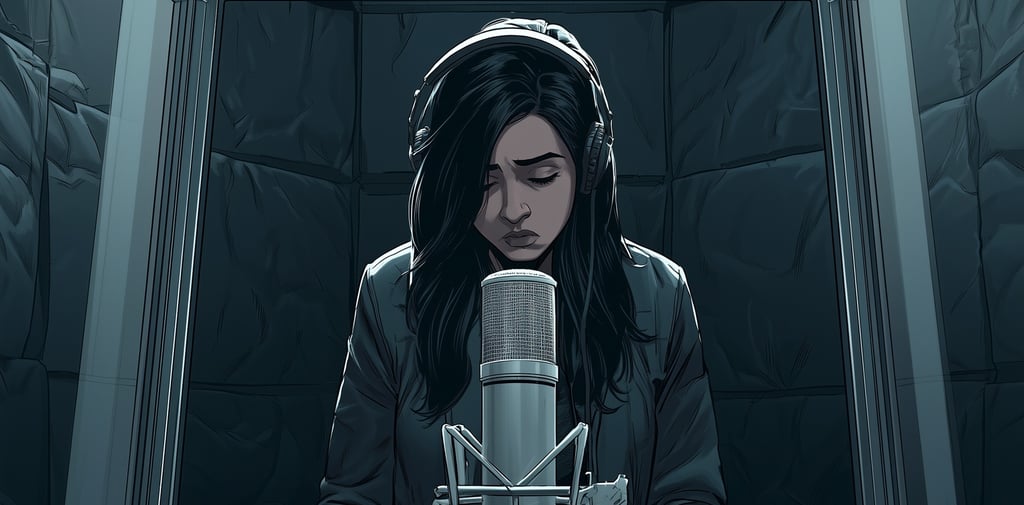
Finally, defeated, they settled for recording basic narration—some intros and outros for a future, undecided episode. Nori stepped into the soundproof booth, the heavy door closing behind her with a soft, final thud. The sleek microphone waited, a silent silver sentinel. Through the glass, Rhys gave her a thumbs-up.
She put on the headphones. Opened her mouth to read the simple script in front of her.
Nothing came out.
The words were in her head, but they wouldn't form on her tongue. A profound, absolute silence filled the booth. It was the sound of her fearless voice being censored—not by a Court, not by a lawyer, but by the pragmatic, unassailable logic of her own success. The echo chamber she had so desperately wanted to build had become a padded cell, and she was the one holding the key.
She stood in the perfect, professional quiet, her own silence the loudest, most damning sound of all.
* * *
Updates
Follow for the latest on my stories.
Fiction
contact@msrayed.com
© 2025. All rights reserved.
My Substack: https://msrayed.substack.com
My Patreon: https://www.patreon.com/cw/MSRayed