
The Hot Mess Collective, Vol. 2 Ch 4: Static Cling
In a magical museum, Kai’s question about Sayo’s glamour triggers old defenses. Alone, Sayo finally admits the painful truth behind their mask.
SERIALIZED FICTIONTHE HOT MESS COLLECTIVE
5/11/20267 min read
The museum smelled of cold stone and old parchment and something chemical beneath—preservation charms holding time in a fist. Sayo had always preferred it this way. Facts behind glass. History flattened into placards. The past was a safe country. It didn't reach back.
Kai was standing across from them in the low light, studying the GutterMage display. Still. Patient. Where Drusick had burned and Maeve had detonated, Kai simply was—a presence like distant starlight, requiring nothing. No performance asked for. No hunger behind the attention. Sayo's shoulders had dropped three degrees without them noticing.
"The curators got this wrong," Sayo said. Their finger moved toward the tapestry—the Seelie procession, faded gold and blue, the main figure picked out with a sun symbol. "They've catalogued her as Titania the First. Obvious. But the weaving technique—the shading especially—that's Unseelie work. Artisans she famously had banished."
Kai leaned in. Did not immediately agree. Thought. "Or they were hired before the banishment," they said, voice low and even. "You could read this as a record of the failed alliance. Not mockery. A document. Something caught between two moments before they collapsed into one."
This was how it went between them. Argument as intimacy. They moved through the exhibits trading theories, and the silence between debates was comfortable in the way silence only is when neither party is performing. Sayo's glamour—the constant, invisible maintenance of it, the deep muscle-work of their human shape—began to ease. Subtle. Dangerous. A loosening they wouldn't have permitted themselves to notice anywhere else.
A week since Drusick. Since that meeting that had left Sayo feeling cracked along seams they'd thought were sealed. The anger had settled, but the residue hadn't. Here, at least, the air was still and controlled and the lighting was respectful. The past couldn't wound you without your permission.
They paused before the Kelpie's shattered water-mirror—three large shards and a scatter of smaller fragments, each edge preserved perfectly, the splintering frozen at the instant of impact. Sayo found themselves explaining the binding magic: the way the glass retained the emotional residue of its owner after death. Not memory exactly. Something more physical. The terror or grief or final fury pressed into the structure of the thing. Kai listened with the focused quiet of someone who already knew how to pay attention. No performance in their interest. No searching for leverage. Just attention.
The space between them was a delicate, growing thing. Sayo felt their defenses power down to standby. It was a relief with a specific texture—like taking off shoes that had been wrong for so long they'd forgotten what right felt like.
The alcove appeared without warning.
Sayo turned the corner and the lighting changed—cooler, more clinical. No stone. No thread. The display cases here held cast-off flesh. A full serpent's skin coiled behind crystal, scales still faintly iridescent where the preservation charm caught them. The hollow, papery bones of a Púca's wing. A Selkie's pelt thick and salt-grey with age, one edge curled slightly as if trying, still, to fold.
To the museum, these were artifacts. To Sayo, they were confessions.
The cold moved through them before they could stop it. A tightening they felt in their jaw first, then their sternum. The glamour—that seamless, constant, exhausting work—pressed against the inside of their skin like a reminder.
Kai stopped before the Kitsune case. The tail inside was spun gold, each strand of fur still catching the light. "My great-aunt shed one like this on her five-hundredth birthday," Kai said, voice softer now. "She said it felt like losing a piece of recorded history. Something she'd written in her own body, year by year, and then one morning it was just gone. Left behind."
Sayo said nothing. They were looking at the serpent's skin. At the complexity of its pattern—the way the scales overlapped, each one slightly different, the whole thing a map of something private and interior now displayed for anyone who bought a ticket.
Kai turned. Their gaze was careful. It held distance and warmth in the same breath—the eyes of someone who understood what it meant to handle a thing that could break without knowing it was broken.
"That day in the gardens," Kai began, voice barely above a whisper. They paused—a deliberate pause, offering Sayo the space to redirect. Sayo did not. Kai continued. "What you showed me. It felt like an act of trust." Another pause, the words measured as weight being placed on a scale. "I've wondered since. What is it like? To hold a form that isn't entirely your own." The question arrived without pressure. "Does it ever feel like a lie?"
The question hit the exact lock.
Sayo had not known the lock was there until the key found it.
The garden rearranged itself in memory and looked different now. Reckless. Impulsive. An act they'd dressed as courage after the fact. And now here was the gentle, precise follow-up, and there was nowhere lateral to move.
The alarms were old. The response was older. Sayo felt their composure slot back into position—not a choice but a reflex, armour that had never fully come off, only been set aside for a moment on a sunny afternoon in a garden when they'd been foolish enough to think the moment was safe.
They drew a breath. Almost imperceptible. When they spoke, their voice carried the smooth authority of a lecture hall—the voice of someone who has prepared extensively and knows it.
"Many shapeshifting traditions—the Old Clan Naga, the pre-Compact Kitsune—don't operate with the assumption of a singular true form," Sayo said. "The physical self is understood as vessel. As expression of intent or context." A brief pause. "The concept of 'lie' requires a fixed truth to contradict. If no such truth is posited, the question dissolves."
Brilliant. Airtight. Empty.
"One might argue," they continued, the register shifting to the precise clip of a debater, "that all forms are equivalent expressions of a multifaceted identity. The form worn to a negotiation is no more or less authentic than the one worn in private, or in solitude. They are simply different aspects of the same complex whole. The performance is the reality."
It disclosed nothing. It defended the territory by refusing to acknowledge the territory existed. It said nothing of the bone-deep fatigue of holding a shape that was not natural to them. Nothing of the specific loneliness of being looked at, continuously, and not seen.
Kai did not press. They were too precise for that. They absorbed the lecture with the quiet patience of someone who had understood what it was before Sayo had finished the second sentence. Something shifted in their face—a slight, careful adjustment. Not anger. Not wounded pride. It was the expression of a door being gently closed from the outside by someone who understood they were not going to be let in.
"I see," Kai said.
Two words. The warmth between them—that low, comfortable hum that had been building for an hour across three rooms of preserved history—cut off like power to a circuit.
Sayo felt the loss with the sharp accuracy of an animal registering weather. They had protected the interior. Held the line. The relief was thin and immediate, and beneath it, arriving fast on its heels, came something that had no tactical use at all.
Regret. Clean and useless as a solved equation.
The small, newer part of them—the part that had shown its tail in a sunny garden and not immediately flinched—cried out briefly and then went quiet. You could have tried. You could have just tried.
The instinct was older than that part. The fear of being truly seen—not a glimpse in a controlled moment but a sustained, intimate look—was a terror that dwarfed the manageable pain of a missed connection. Sayo knew this. Had always known this. The knowing didn't help.
They turned back to the displays. "The preservation charms on this Selkie pelt are unusually stable for their age," they said. Their academic voice. Technically accurate. The words felt like debris—correct pieces of a structure that no longer existed.
"Indeed," Kai said. "The binding is very well done."
They moved through the remaining exhibits with a careful, unspoken distance between them. Two scholars, nothing more. The silence had changed character. It no longer held shared thought. It held the weight of something both parties understood but would not name. The ease had not left—it had been replaced, item for item, with a studied, polite exchange of impersonal facts. Sayo had reset the terms of what they were to each other, and the reset felt exactly like a subtraction.
* * *
The city outside was an assault after the museum's controlled air. Noise, exhaust, the smell of street food, the press of bodies moving in all directions—it arrived against Sayo's nerves all at once. They stood on the wide granite steps in the long, sharp light of late afternoon.
"Thank you for the stimulating conversation, Sayo," Kai said. Their voice was kind. No anger in it, no performance. Just the exact, quiet word choice of someone accepting the terms they'd been given.
Conversation. Not afternoon. Not time. Sayo heard the precision.
"The pleasure was mine, Kai."
No lingering. No suggestion of again. A quiet nod. Kai turned and moved into the evening crowd and disappeared into the anonymous current of it, and Sayo stood on the steps alone with the hollow, resonating architecture of every wall they'd built.
* * *
The apartment was silent. Perfect. Books aligned exactly on their shelves. Every object polished and placed with geometric precision. No dust. No disorder. Nothing to suggest that anyone uncertain lived here. It was the physical expression of Sayo's mind: complex, ordered, and completely sterile. Tonight the perfection didn't soothe. It pressed.
They moved through the rooms without registering them. The complex architecture of the city that usually occupied them—the social patterns, the magical signatures of the wards, the worn texture of familiar streets—had been noise on the walk home. Meaning had vacated.
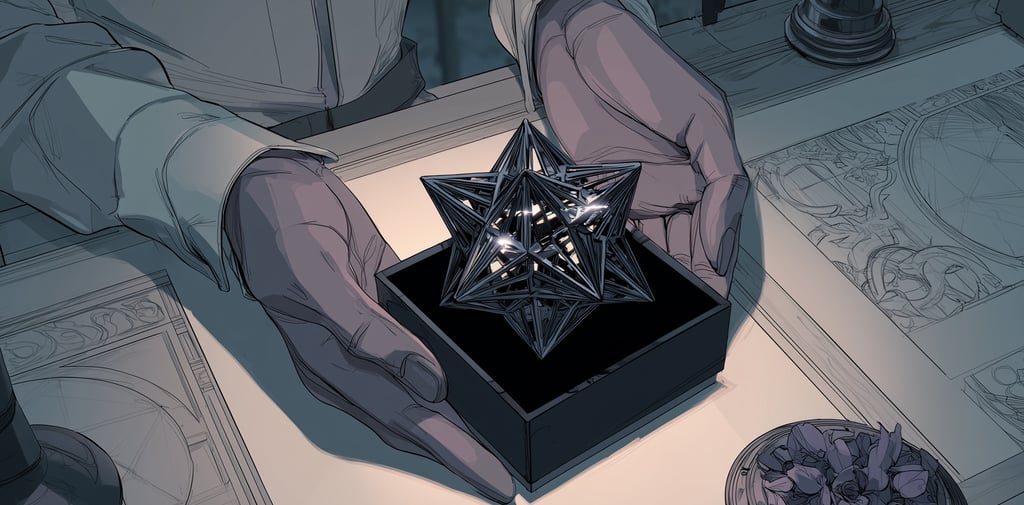
In the study their gaze found the puzzle box on its low stand. Obsidian and star-metal, interlocking, famously unsolvable for all but the most patient and logical minds. They picked it up. Its weight was cool and solid.
They sat. Their fingers began to work.
Click. A gear shifted. Whirr. A panel gave way, revealing a new and more complex layer beneath. This Sayo understood. This had rules. This had a solution.
Their hands moved without conscious direction. Their mind was still in a museum. Still in an alcove with too-clinical light and displays of cast-off flesh. Still replaying a voice that had arrived without weapon or demand and asked a single careful question.
Does it ever feel like a lie?
Click.
The final mechanism released. The box sighed softly—a hiss of released pressure—and opened, showing the small velvet-lined cavity inside. Empty. Solved. Meaningless.
Sayo looked into the dark interior. Their hands were still.
All the philosophy dissolved. The precision of the deflection. The airtight defense. In the silence of the apartment, in the held breath of the solved and empty box, there was only the question and its answer, and the answer had only ever been one thing.
Yes.
Not a whisper. Something tectonic—a shift felt in the body before the mind caught it, a tremor that ran the full length of everything they'd built.
All the time.
Updates
Follow for the latest on my stories.
Fiction
contact@msrayed.com
© 2025. All rights reserved.
My Substack: https://msrayed.substack.com
My Patreon: https://www.patreon.com/cw/MSRayed